Bronze Drums and Tigers
"The tiger killed him over there".
We were on the slopes above Jidao Shang, a pretty Miao minority village of wooden houses and cobbled lanes at the bottom of a deep river valley in southeastern Guizhou. Ninety-year-old Uncle Jiu, sporting a thin grey beard and oversized fur cap, pointed with his stick into the undergrowth while he told us the story.
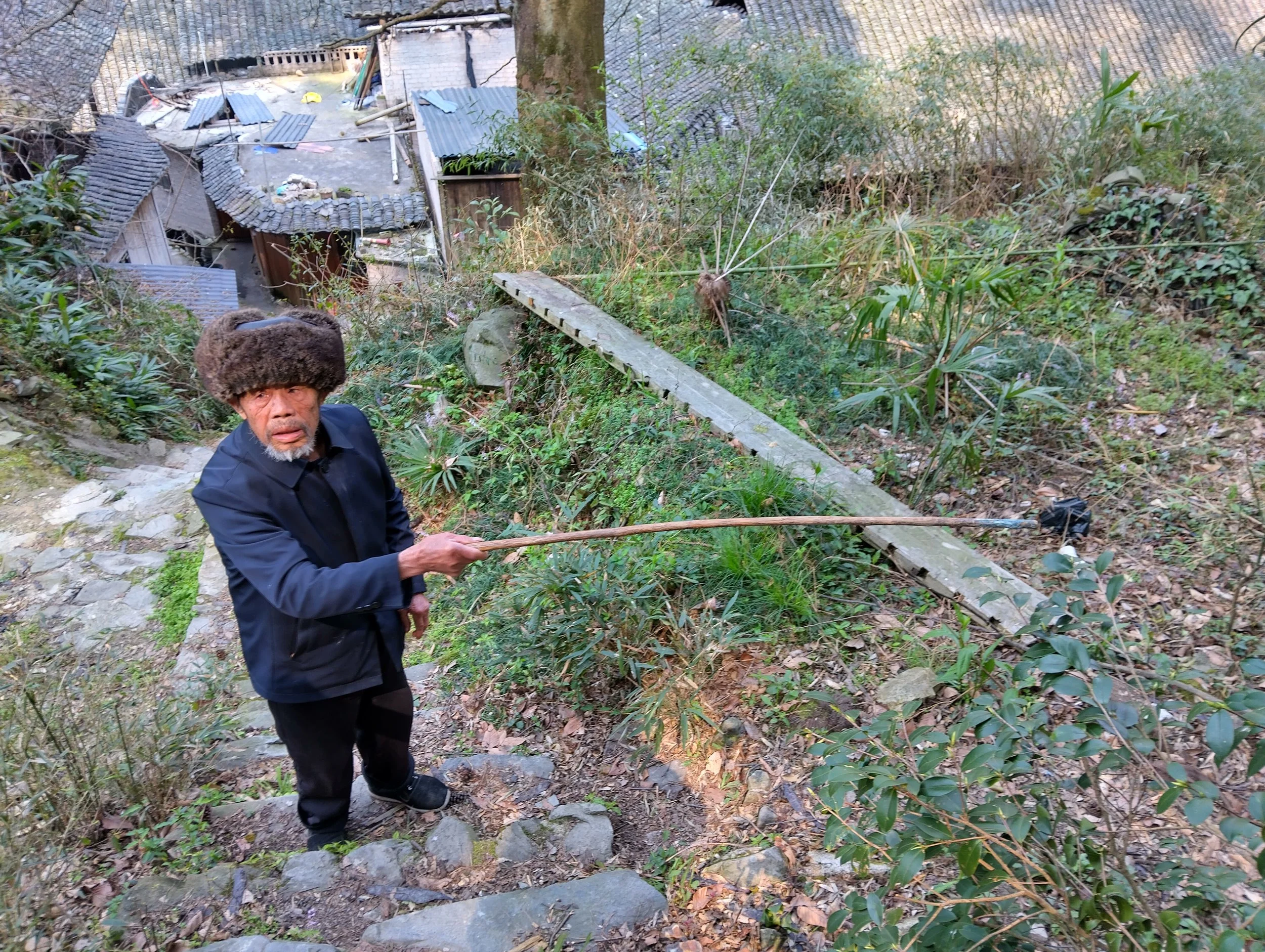
Uncle Jiu pointing out where the terrace used to be, Jidao Shang
The village, he said, once hosted bronze drum festivals, which were held on a terrace on the slope above. When not in use the drum was hung from a ceremonial maple tree specially transplanted to the centre of the terrace.
One day a tiger killed a man below the hanging drum; the villagers buried the drum as cursed and never celebrated another drum festival. Since then a landslide has nearly obliterated the terrace. According to Mrs Chen Qin, Jidao’s representative for the Provincial People’s Congress, all this happened "a very very long time ago". Her grandfather once searched for the drum but couldn’t find it.
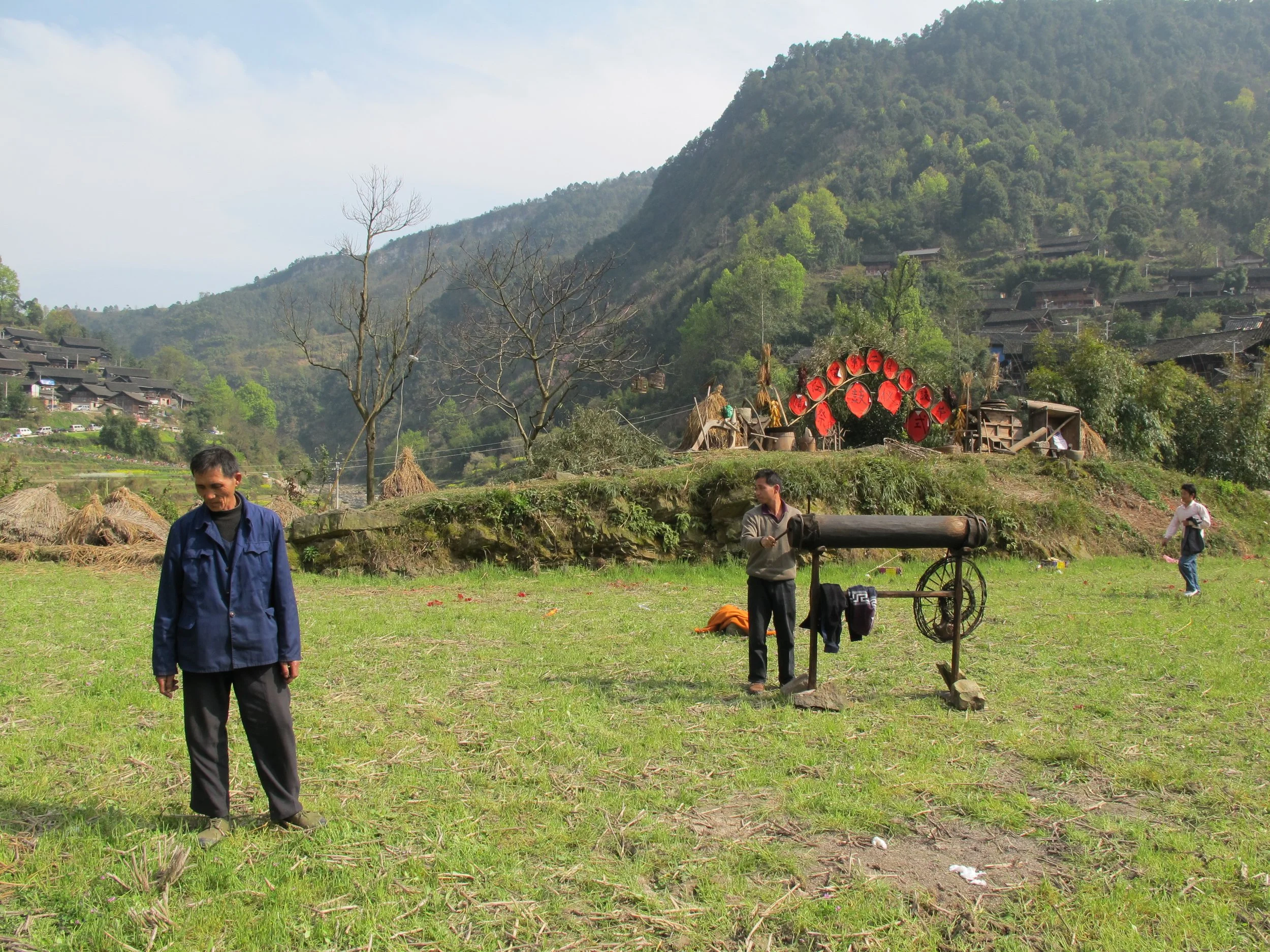
Drum master and his son (on drum), Qingjiang village, Guizhou
Drums play a big role in Miao culture. The Miao creation story, Song of Butterfly Mother, tells how the first human, Jang Vang, searched for a wooden drum to offer sacrifices to the ancestors; they are still used for this in the Miao’s Guzang festival, held every twelve or thirteen years – indeed, ancestral spirits are believed to inhabit the drum itself. Many villages also hold a wooden drum festival in spring and autumn to mark the agricultural cycle.
But the Miao also use bronze drums, instruments adopted – according to folklore – from neighbouring tribes back in antiquity. Bulbous and narrow-waisted, standing up to 80cm high and sometimes over a metre across, these are impressive things, their surfaces either plain or decorated with geometrical patterns, designs of fish, birds and animals, and longboats with rowers wearing feathered head-dresses. The tympanum often features a central star or sun with raised rays, sometimes with little frog or toad figurines set around the rim.
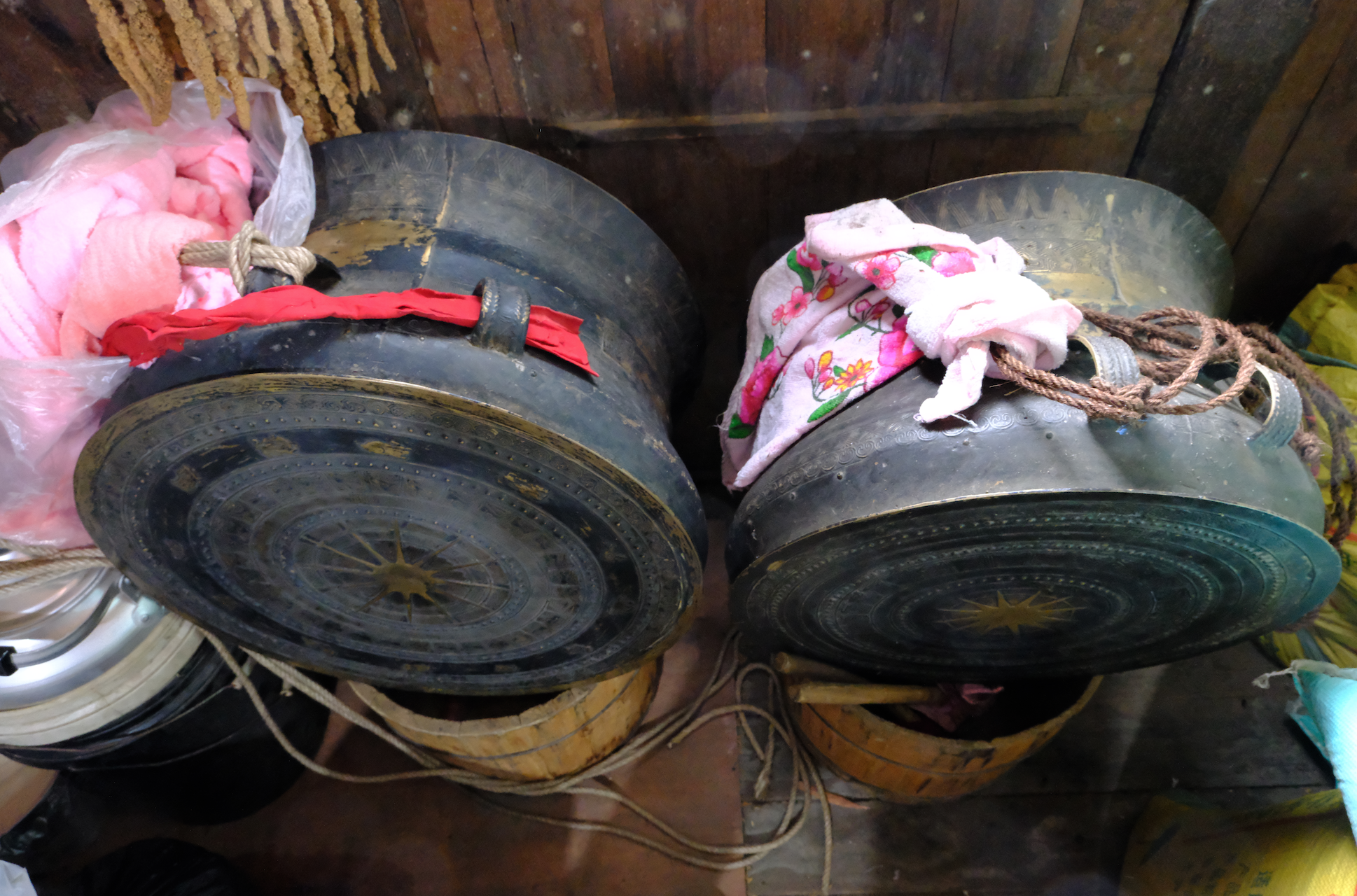
Bronze drums
The exact origins of these bronze drums are clouded by nationalistic arguments over which country has the oldest examples, and the fact that many excavated drums were – like Jidao Shang’s – buried in isolation, with no associated datable material. What is certain is that their use goes back thousands of years, and that the culture that originally produced them – sometimes known as the Dong Son – flourished on the Vietnam-China borderlands from about 700BC until the second century AD.
These drums appear early on in Chinese records. According to the Annals of the Later Han, in 43AD the imperial court sent general Ma Yuan to what is now northern Vietnam to suppress an uprising by the two Trung sisters. He later celebrated his victory over them by melting down a tribal bronze drum, recasting it in the shape of a horse (his surname, Ma, means “Horse”) and presenting it to the emperor.
Around this time a cultural exodus – perhaps because of the Chinese invasion – spread the drums right across southeast Asia: antique examples have been excavated in Myanmar, Cambodia, Thailand, Malaysia and eastwards through the Indonesian archipelago as far as New Guinea. Today their use survives piecemeal across the region, including amongst Guizhou’s Miao.
In ancient times creating a drum – some weigh over a hundred kilograms – was both technically demanding and expensive. First enough copper, tin and lead had to be mined or bought to make the required amount of bronze. Then the drum itself was cast in pieces using the lost wax process. Each section was carved full-sized in wax, which was then covered in soft clay. This clay block was fired, the wax vaporising through carefully-placed holes to leave a mould. Molten bronze could then be poured in through the holes to make a cast of the section. When cool the clay block was smashed and the bronze section removed and welded to the other pieces to make the complete drum.
Given the necessary cost and organisation in casting a drum they would never have been everyday items, but only commissioned by the wealthy and powerful. A contemporary bronze storage jar from Yunnan seems to bear this out: a diorama on the lid shows a festival with crowds milling, tame leopards being led about and naked captives tied to sacrificial posts, all overlooked by a woman seated on a platform surrounded by sixteen bronze drums – clearly a sign of high status.
They remained so throughout history. Seven hundred years later, the Book of Sui described how when a new drum was cast, aristocrats wanting to claim some of the kudos sent their children to leave gold or silver hairpins with the owners. In 1739 the official History of the Ming Dynasty suggested the wealth and power that drum ownership bestowed: "The drum with the loudest sound is the best, and can be exchanged for a thousand buffalo; the next best is worth seven or eight hundred. Those who have two or three drums can claim to be a king”.
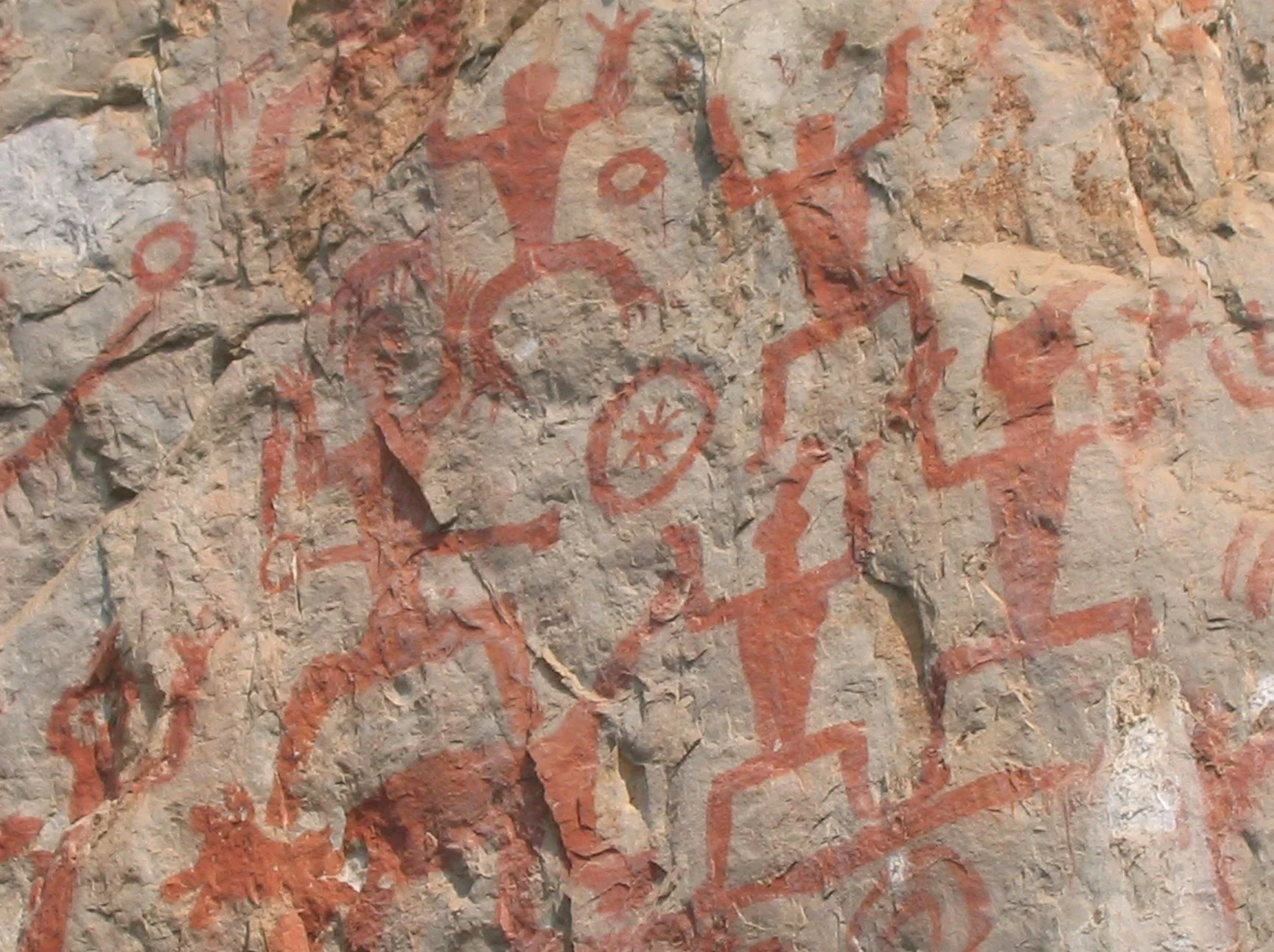
Rock art showing figures dancing around a drum, Zuo river, Guangxi – barely 100km from the Vietnam border
But beyond a symbolic function, what was their practical use? Most obviously as musical instruments: scenes at a first-century rock art site along Guangxi province’s Zuo river show warriors dancing around a drum, depicted as a star inside a circle. But they had other uses too, which perhaps changed over time.
From the seventh century onwards Chinese records are awash with mentions of southwestern minorities unearthing ancient drums buried in their fields and using them to pay tax, or presenting them in tribute along with musk and tiger skins. A widespread myth evolved that these had been planted by the third century strategist Zhuge Liang during his pacification of China’s southwest; people called them “Zhuge drums” and today there’s even one hanging up at his ancestral temple in Sichuan’s capital, Chengdu.
Later commentaries begin specifically to mention the Miao. In 1558 the Yanjiao Chronicles claimed that “At certain times of the year, [the Miao people] summon relatives to beat bronze drums and enjoy bullfighting” (bullfights remain a major component of Miao festivals). Three hundred years later, the Guizhou General Records confirmed that the Miao slaughtered buffalo and played bronze drums at funerals, and that drums were also used to attract healing deities. More recently, Chinese archaeologist Zheng Shixu observed in 1936 that "Bronze drums are the treasures of Miao chiefs, and the big and heavy ones are the most valuable ... Drums are used as a musical instrument in daily life and as a gathering signal when there is something wrong.”
Jidao Xia – “Lower Jidao” to counter the “Upper Jidao” of Jidao Shang – is a modern version of its sister village downstream; the houses are mostly concrete and there’s a formal festival ground out front above the river, with flagstones laid in concentric circles. Here I meet with shaman Mr Sheng Vang Ti, who had kindly delayed a healing ceremony for a few minutes to show me the village’s two bronze drums. Inside his house, a wall shrine is decorated with sheep jawbones, remains of animals given to him in gratitude for curing sick children, rescuing their souls from disease.
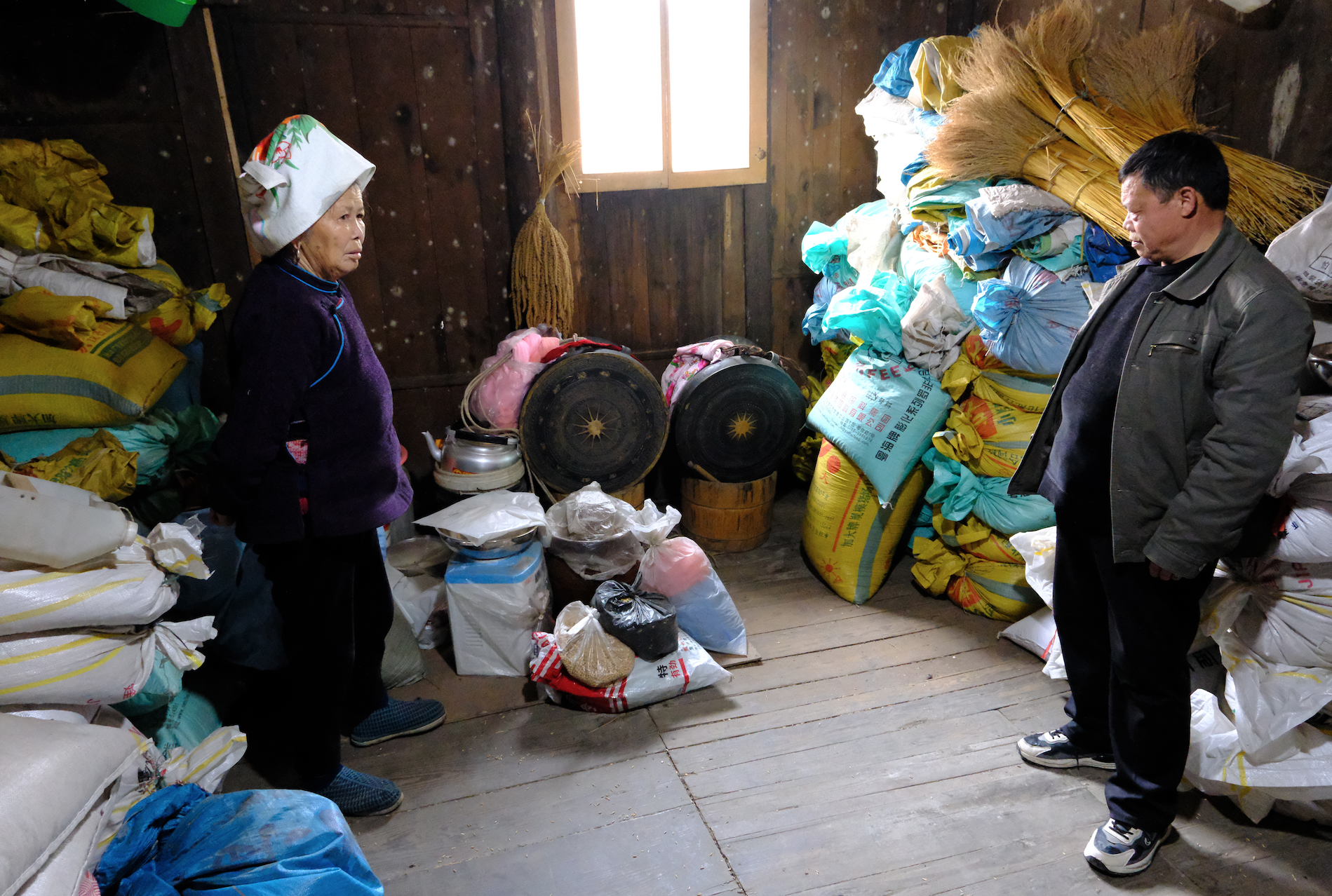
Shaman Sheng Vang Ti (right) with village drums, Jidao Xia
We walk through to a storeroom where the drums are unearthed from between sacks bulging with last year’s rice harvest. Mr Sheng explains: “The rice keeps them dry, stops them from corroding. In other villages they fill them with rice before burying them for safekeeping under the drum master’s home”. Back when wooden villages were prone to fire and warfare, drums were hidden in mountain caves known as “drum treasuries”. He waves us over for a closer look, but keeps a respectful distance himself.
Both drums are supported off the floor on wooden buckets, and are relatively small – maybe half a metre wide. They are also fairly new. Today most ancient drums are on display in museums, not hidden away in villages; they’ve been prized by collectors since at least the nineteenth century. In 1874 William Mesny, a British arms instructor hired by the Chinese government to fight an uprising by the Miao, wrote to a friend:
“I now send you a Brass Drum, such as the Miaou-tze use at their feasts. When I first came here (1868) they were plentiful, nearly every town we took had one or two, but for the last 2 years they have been very scarce, having all been bought up by Antiquarians of Sz-chuen and Hu-nan, who prize them highly.
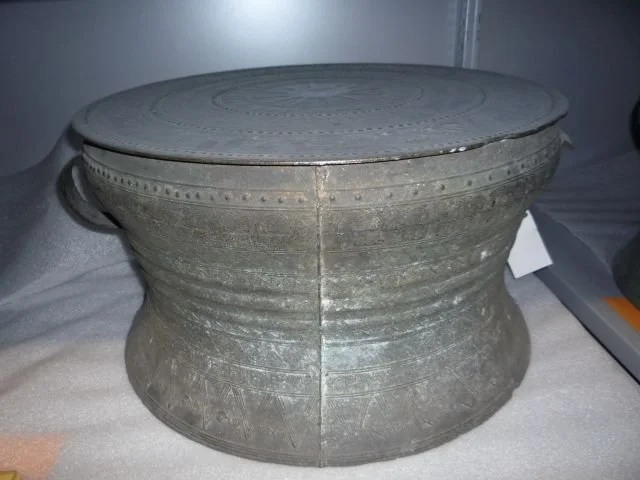
Mesny’s drum in the Weltmuseum, Vienna, Austria
Then during the early years of communist rule (1950–1976) drums were confiscated as signs of China’s feudal past. When Jidao’s villagers asked for theirs back in the 1980s they were told that the drums had been too badly damaged, and received compensation to have new ones made. One replacement was bought at Guiyang, the provincial capital; the other came from neighbouring Guangxi province, where demand is so great that there are several bronze drum factories making them commercially. Both have a similar weight, but Mr Sheng felt the one from Guangxi sounded better.
The top of the drums are decorated in concentric rings, the spaces between filled by clouds, zodiac animals, what might be a stylised character for “rain” and seemingly abstract patterns. Suggesting meanings for bronze drum decorations has kept archaeologists arguing for over a century, so I ask Mr Sheng for the local interpretations. The star in the middle of the tympanum? “It’s the sun, of course”. How about the geometric symbols? “They’re special drum designs”. Either any deeper meanings, if there ever were any, have been forgotten, or Mr Sheng doesn’t want to share them with me.
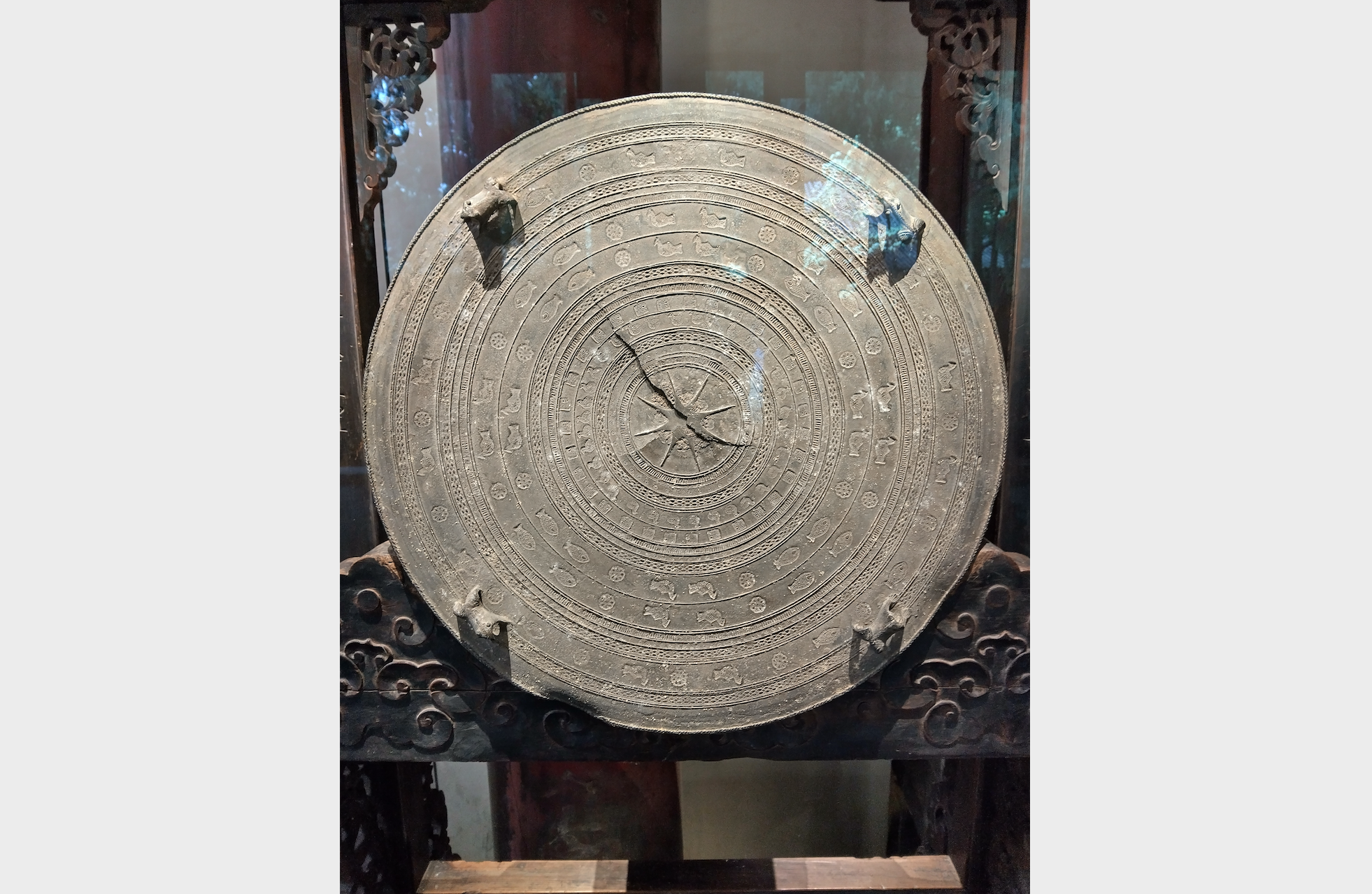
Bronze drum tympanum showing central sun, concentric ring patterns and frog figurines, Wuhou Ci (Zhuge Liang’s Temple), Chengdu
At Jidao Xia they use bronze drums to celebrate the Miao New Year, starting on the fifth day of the festival and beating them for nine days afterwards. But Mr Sheng emphasised that they were just musical instruments for entertainment only, with no religious purpose at all. So did they still use them at funerals, like people did in the old days? No, in Jidao Xia they play lusheng reed pipes instead.
This view of bronze drums as purely secular instruments is not universal. In many Miao communities – including nearby Langde – bronze drums play an important role in the Guzang festival and similar Summoning the Dragon festival, which are both held to wake the ancestors and local earth spirits, welcome them to village celebrations, and ask them to send to send plentiful quantities of children, crops and buffalo.
According to local researcher Li Maoqing, who is himself Miao, during the Guzang festival “two assistants carry the bronze drum up into the mountains and back to the village, accompanied by a shaman and twelve young men carrying offerings such as pig, rice wine, sticky rice, eggs, fish, a live duck, and people-like papercuts.” When the group arrive at the mountain behind the village, the shaman pounds the ground with a wooden mallet and orders his followers to beat the drum, saying:
Oh, ground deities!
Wake up on this auspicious day.
Wake up and come with us to the village for a wonderful festival!
Wake up and bring with you nine thousand green rice seedlings,
Ninety thousand rice fields,
Bring us nine boys and seven girls for each family.
In Mr Li’s view, bronze drums are not a sanctuary for the deities themselves, but rather a holy instrument used to summon them. These beings sleep deeply in the mountains, so the drum must be big and noisy enough to wake them up.
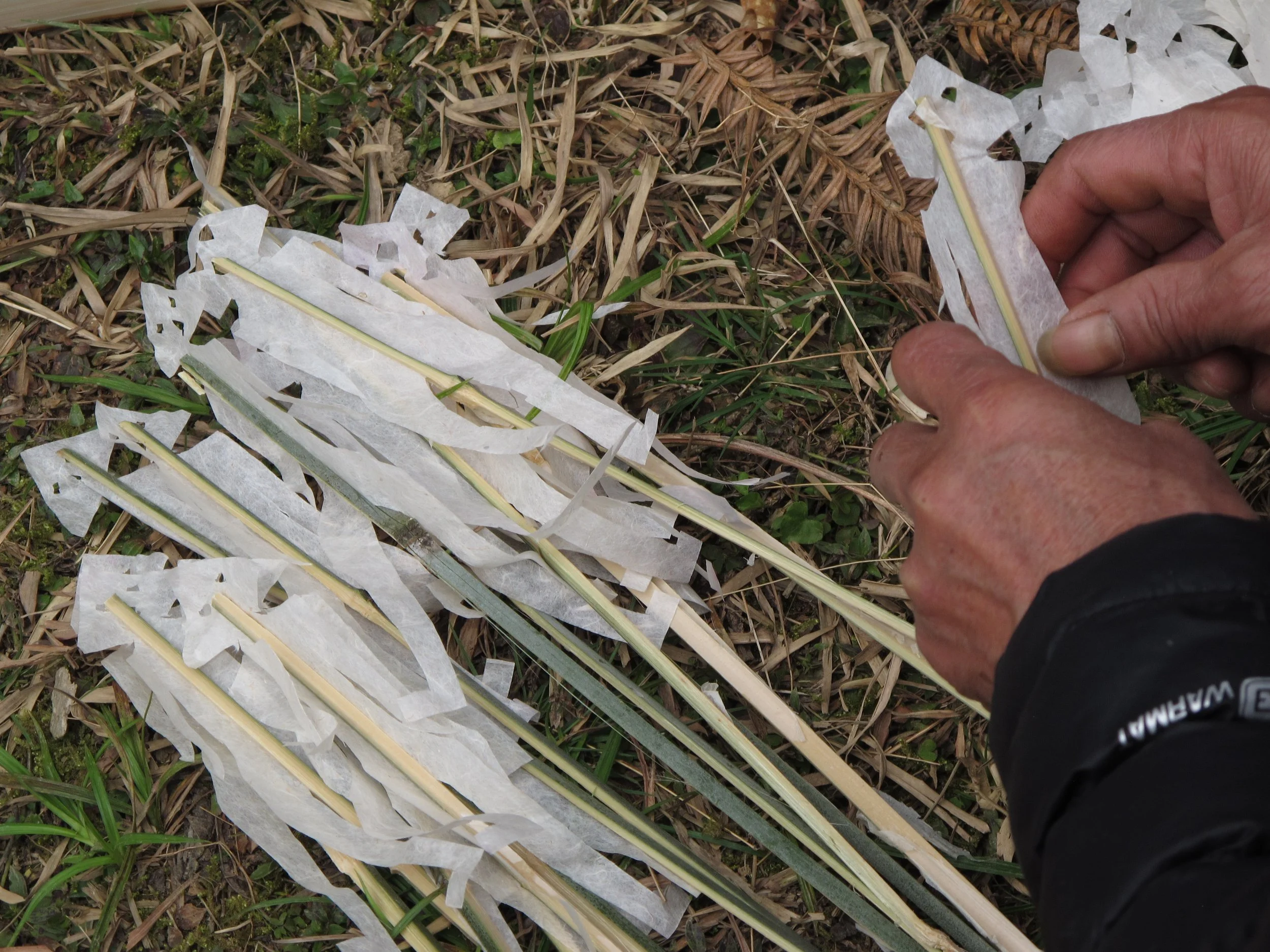
Papercuts of children, Welcoming the Dragon festival, Xiao Kaitun village, Guizhou
At Xijiang, the largest Miao village in all Guizhou, hereditary drum master Mr Tang Shoucheng offers another perspective: “In the past, wooden drums were used for sacrifices, but later bronze drums were used instead because bronze drums are rot-proof and fire-proof. The Miao people believe that all the ancestors of the clan live in bronze drums”. During the Guzang festival, “the souls of clan members who died since the last drum festival are invited to enter the bronze drum and live with the other ancestors”, then the drum master knocks on the drum to wake the resident spirits before toasting them with rice wine and food. In the old days people sacrificed water buffalo, but nowadays it’s usual to substitute pigs.
Back at Jidao Xia, I ask if Mr Sheng know anything about the tiger incident. “Yes, it all happened ten years before the Miao Uprising, in about 1845. The man was killed by the tiger because during the drum festival you can’t say things like “give me the knife” or “kill the pig”, you have to say “give me the grass”, “worship the official” and so on. By forgetting to use these code words he offended the ancestors”. The landslide that buried the festival terrace soon afterwards also cut off the road connecting upper and lower Jidao; this was held to be proof of the ancestors’ continuing anger, so the settlements have remained separate ever since.
Mr Sheng checks his phone; he has been generous with his time and needs to return to the healing ceremony. “OK, is that all? I have to go.” But first he wraps up each drum in their cotton blankets – “just like a baby”, he explains – before hiding them away again between the rice sacks.
Many thanks to Chen Qin, Li Maoqing, Sheng Vang Ti, Tang Shoucheng, Mathew Spriggs and Peter Veth. Also to Natascha Strassl and Bettina Zorn of the Weltsmuseum, Vienna, for photos of Mesny’s drum.
Sources
Ancient Chinese Bronze Drums (中国古代銅鼓; Chinese Association for the Study of Ancient Bronze Drums; Cultural Relics Publishing House 1988)
Annals of the Later Han (後漢書; https://ctext.org/hou-han-shu/zh)
Bender, Mark Butterfly Mother: Miao (Hmong) Creation Myths from Guizhou, China (Hackett 2006)
Book of Sui (隋书 地理志; https://ctext.org/wiki.pl?if=gb&res=88210&remap=gb)
Brow and Brow Bronzes of the Dong Son Culture of Vietnam (Arts of Asia Vol.37, no.3; 2007)
Calo, Ambra Transitions of a Feathered World: Distribution of Bronze Drums in Early Southeast Asia (PhD thesis, SOAS, University of London 2005)
Deal and Hostetler The Art of Ethnography: A Chinese “Miao Album” (University of Washington Press 2006)
De Jong and van Dijk Forgotten Islands of Indonesia (Periplus 1995)
Epic in the Bronzes: Dian Kingdom in History (滇国寻踪:青铜铸成的史诗; Yunnan Peoples’ Publishing House 2008)
Guizhou General Records (貴州通志; https://ctext.org/wiki.pl?if=gb&res=198625)
Han Xiaorong Who Invented the Bronze Drum? (Asian Perspectives Vol 43, No 1; University of Hawai’i 2004)
History of the Ming Dynasty, volume 212 (downloaded from https://zh.wikisource.org/zh-hans/明史/卷212)
Jao Tsung-i Further Discussion of Bronze Drums 銅鼓餘論 (Harmoniousness: Essays in Chinese Musicology; Brill 2022)
Li Yuwen Leishan Miao Guzang Festival (李玉文: 雷山苗族鼓藏节; China Culture Publishing House 2010)
Lingbiao Luyi (嶺表錄異; https://ctext.org/wiki.pl?if=gb&res=215926)
Lu Qiuyuan et al Provenance study on ‘Big bronze drums’ (Journal of Cultural Heritage vol 44; Elsevier Masson 2020)
Loofs-Wissowa, Helmut Dongson Drums: Instruments of Shamanism or Regalia? (Arts asiatiques vol 46; 1991)
Mesny, William
– Mesny’s Chinese Miscellany (vol II; Shanghai 1896)
– Shanghai Evening Courier (21 May 1874)
Meyer and Foy Bronzepauken aus Südost-Asien (Dresden 1897)
Nitzky, William Moving the Living and the Dead: The Power of Bronze Drums in Contemporary Ethnic China (Asian Ethnology vol 81; Nanzan University 2022)
Official Book of the Jin Dynasty (晉書; https://ctext.org/wiki.pl?if=gb&res=788577)
Spriggs and Miller A Previously Unreported Kettledrum from the Kai Islands (Bulletin of the Indo-Pacific Prehistory Association 1988)
Thorne and Raymond Man on the Rim: The Peopling of the Pacific (Angus & Robertson 1989)
Yanjiao Chronicles (炎徼纪闻; https://ctext.org/wiki.pl?if=gb&res=232911&remap=gb)
Zhang Xin’ge Research on the Decorative Patterns of the Bronze Drums (DPBD) in China (Malaysian Journal of Social Sciences and Humanities 2022)
Zheng Shixu A Brief Study of Bronze Drums (鄭師许: 銅鼓考略; Shanghai 1936)