Chinese Domino Cards
Here’s a deck of Chinese playing cards, probably dating to the nineteenth century. Each card measures 2.3cm x 8.2cm and is printed on thin, flexible cardboard. Black outlines and main colours are woodblock printed, the black and red pips are overpainted or stencilled on, and the character 總 (meaning unclear) is stamped separately on just one card.
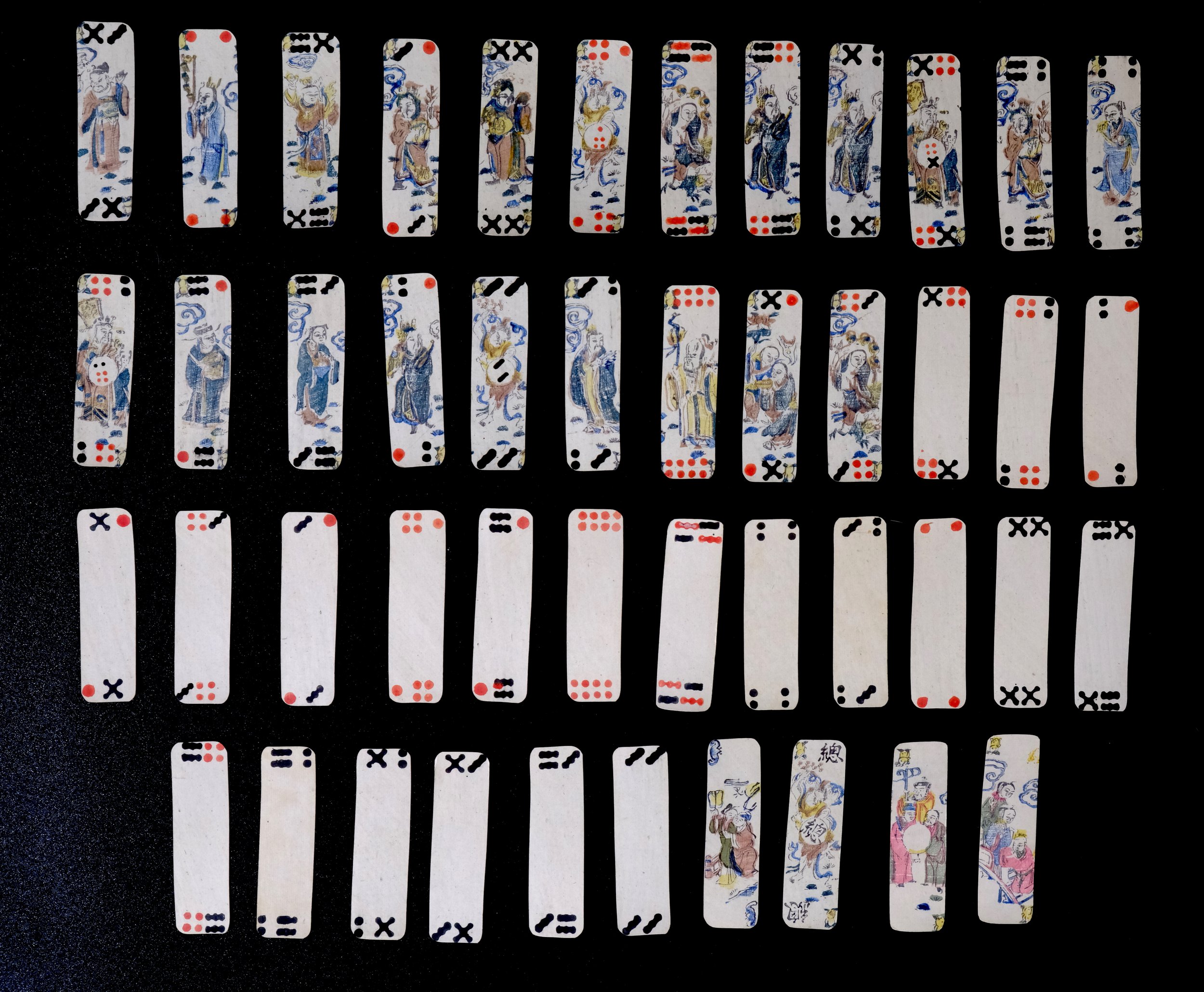
Deck of 46 cards – 25 illustrated (including four wild cards), 21 plain
A Chinese “game of leaves” (葉子格戲) – possibly playing cards – was mentioned by the ninth-century scholar Su E (苏鹗: 杜阳杂编), though the earliest undisputed record of a card game dates to 17 July 1294, when a certain Yan Sengzhu and Zheng Zhugou were prosecuted for gambling. The cards and the woodblocks for printing them were confiscated and everyone involved was punished.
By the fifteenth century cards were widespread; the scholar Lu Rong (陆容) bemoaned his lack of skill and gave an early account of a madiao deck (馬吊, literally “hanged horse”), where 38 cards were ranked according to their notional value in strings of cash – hence the term “money deck” in English. Card values were also named after the 108 bandit heroes from the popular novel The Water Margin.
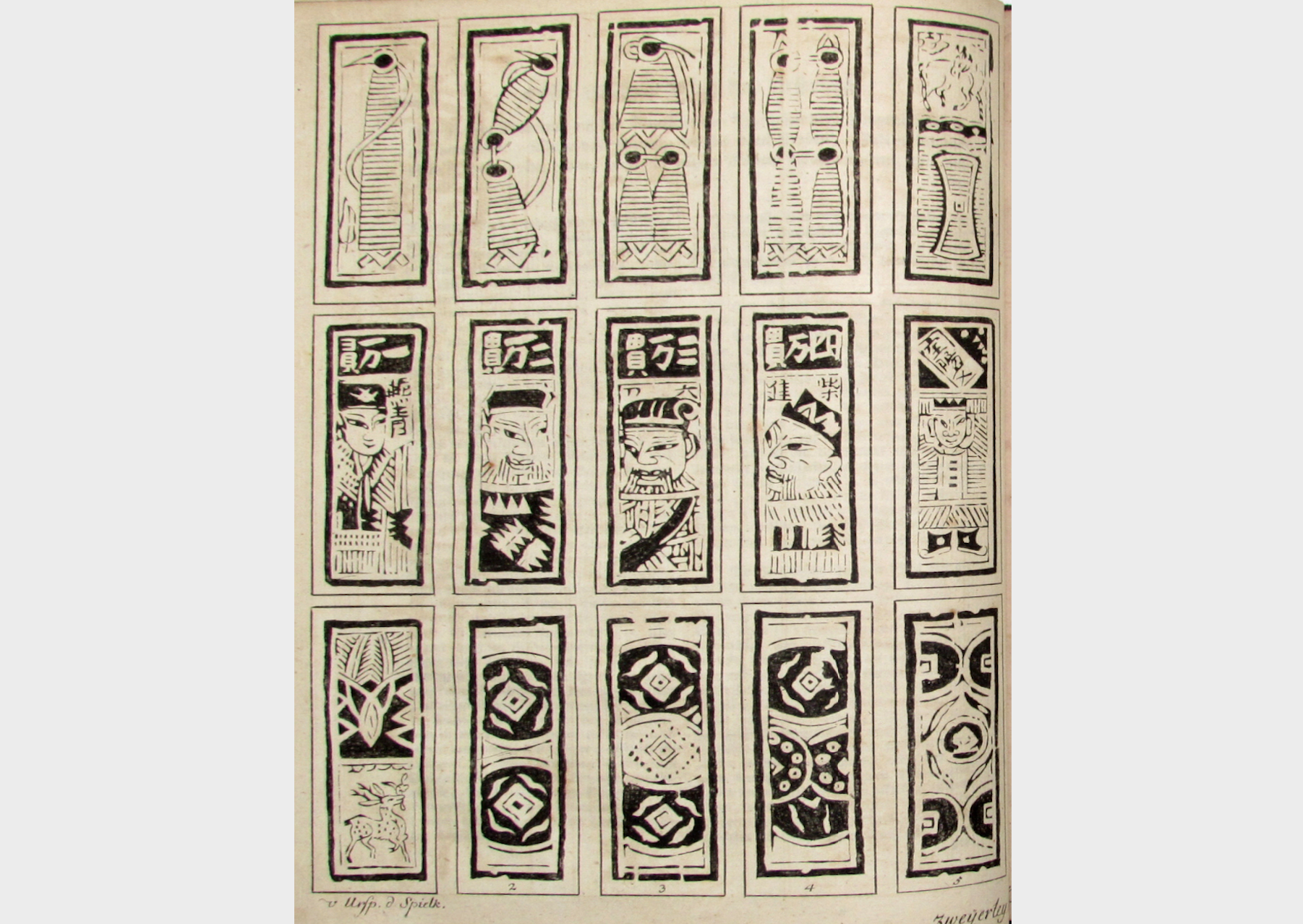
Madiao or money deck from a German book on the origins of playing cards, 1794. Cards in the upper row show strings of cash coins and a silver ingot; the illustrated middle row cards are valued in tens of thousands of cash; with low-value unstrung coins on the bottom row
Other types of decks developed too. Ones like mine with red and black pips (點紙牌 , “dotted cards”) are known in English as domino cards, based – like dominoes – on the 21 possible combinations of throwing a pair of dice. Instead of Water Margin heroes, this deck is illustrated with Chinese folk gods. The corners of most of the cards also have a yellow pair of peaches, representing longevity – just one has bats instead (good fortune).
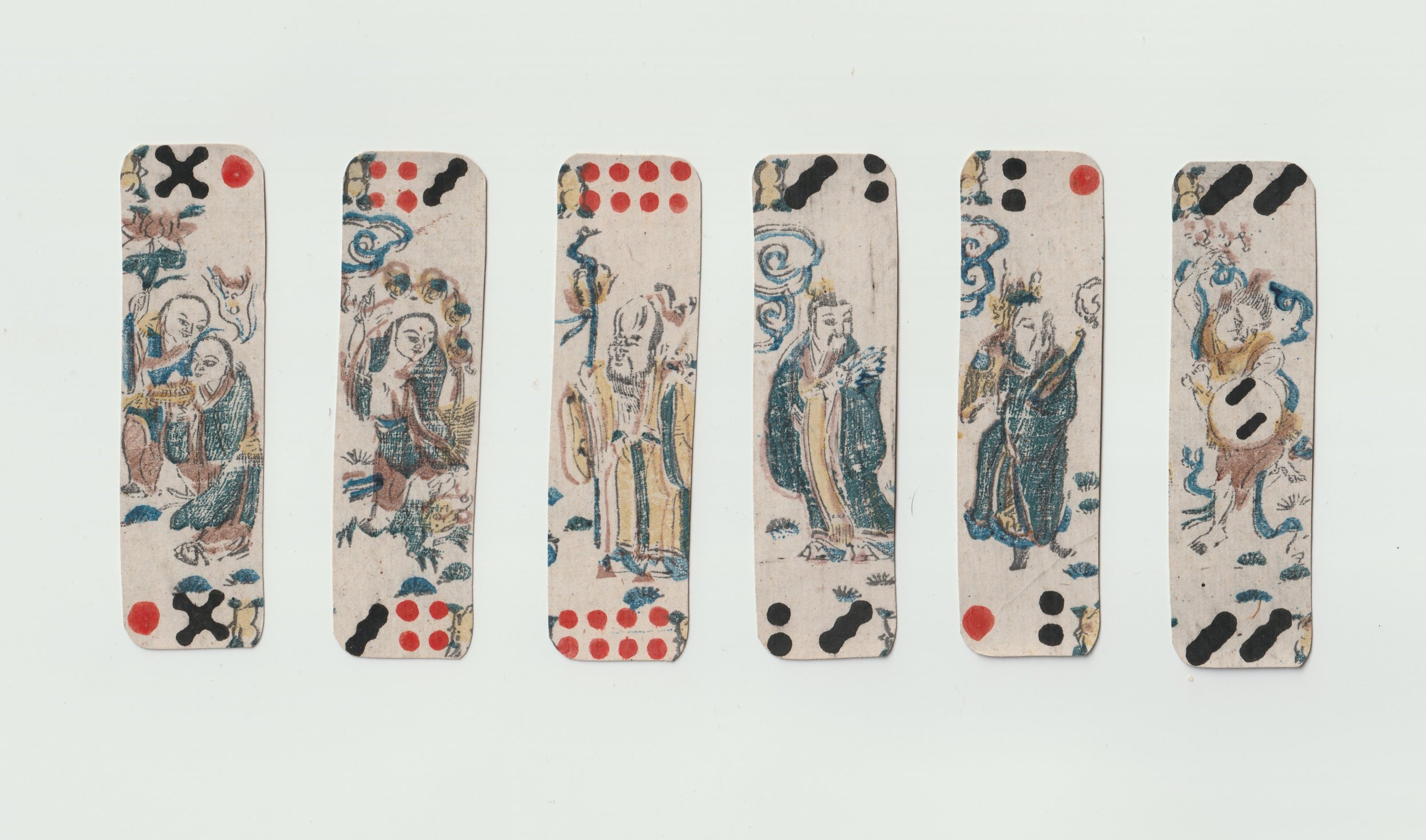
From left: Twin Deities of Harmony, Liu Hai and toad, Shou Lao, possibly Kongming (with fan), Archer Zhang and Kui Xing
While some domino sets contain 84, 105, 126 or even more cards, it’s still possible that this set of 46 is complete: the 21 plain cards with pips match the 21 with both pips and gods, and presumably the game involves collecting or discarding pairs. The four cards with gods alone are some kind of wild cards or jokers.
There’s a similar set of illustrated cards in the American Museum of Natural History collected by George B. Glover (1827–1885), a US official who served at Fuzhou and Shanghai. Given that the printing of their cards is crisp whereas mine are clearly made from worn woodblocks, I’d guess that my set was probably printed towards the end of the nineteenth century.
Many thanks to Katherine Skaggs at the American Museum of Natural History, Division of Anthropology.
References
American Museum of Natural History: www.amnh.org (Asian Ethnographic Collection, Catalogue number 1/2368)
Asia Society: https://sites.asiasociety.org/arts/asiangames/match01.html
Breitkopf, Johann: Versuch den Ursprung der Spielkarten, die Einfuhrung des Leinenpapieres und den Anfang der Holzschneidekunst in Europa zu erforschen (Leipzig 1794)
Lo, Andrew: The game of leaves: an inquiry into the origin of Chinese playing cards (Bulletin of the School of Oriental and African Studies, vol 63, no 3; 2000)
Su E: 杜阳杂编 (https://ctext.org/wiki.pl?if=gb&res=562619&remap=gb)
Wilkinson, WH: Chinese Origin of Playing Cards (American Anthropological Association; Jan 1895)
World of Playing Cards: https://www.wopc.co.uk/china