Grand Military Exercises in Hejian Prefecture 河間府演大操
Here’s a woodblock print documenting the birth of China’s modern military. It shows the recently-formed Beiyang Army parading in front of their commanding officer, Yuan Shikai, during exercises in October 1905 at Hejian (河間), an administrative centre 150km south of Beijing. Officially involving 45,000 men, the exercises lasted six days and cost one million ounces of silver.
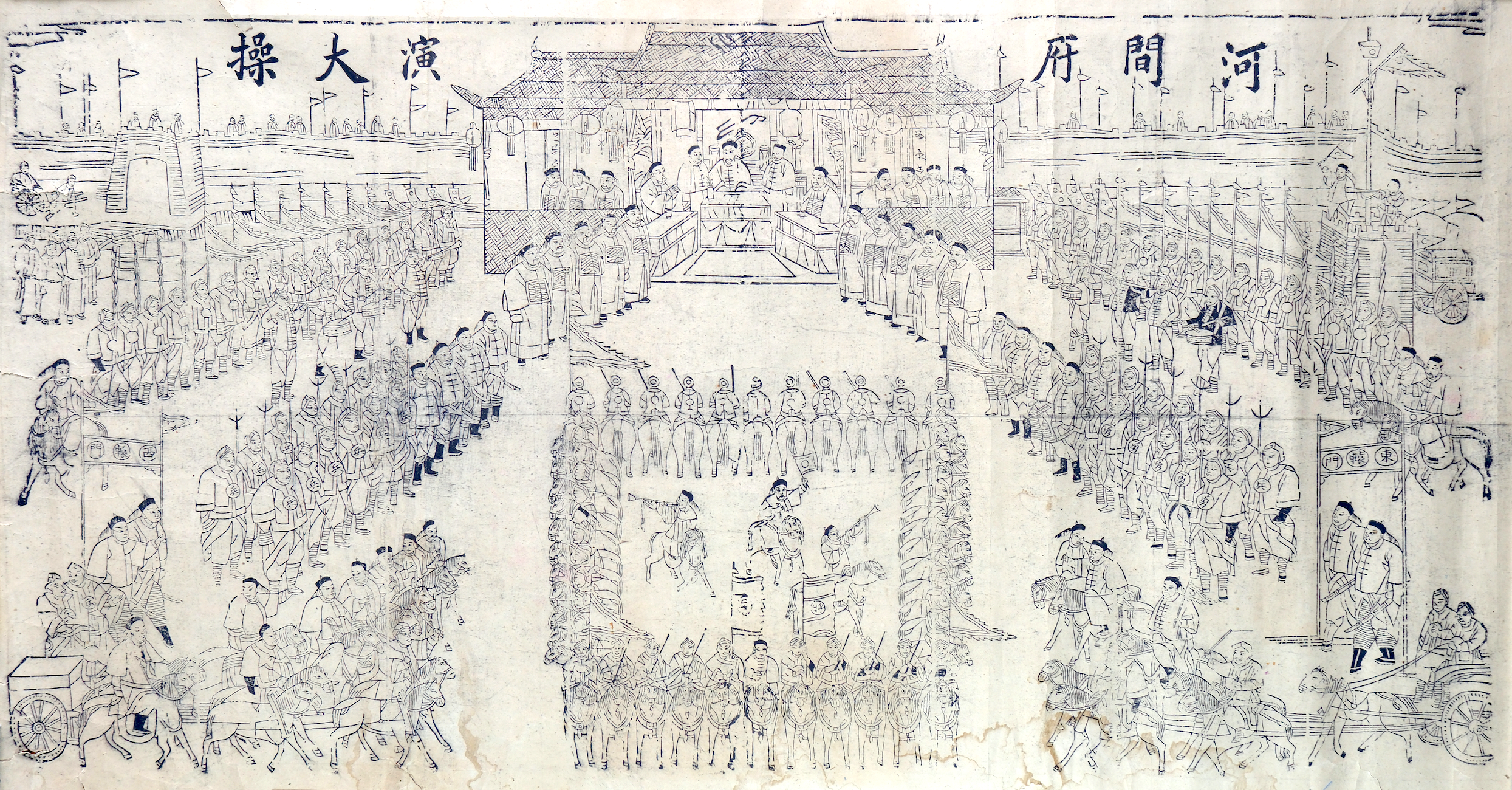
“Grand Military Exercises in Hejian Prefecture”, a monochrome woodblock print from Wuqiang in Hebei province. Printed on thick bamboo-fibre paper, it’s a large souvenir at 53cm x 110cm
According to a brief mention in the Complete Chronicle of Qing History, written a decade later, “The results were remarkable, and Western visitors marveled at the speed of its achievement.” But why were these exercises held at all, and what about them so impressed European observers?
By the late nineteenth century China’s military were a mess. Emphasising parade-ground archery skills and armed with a medieval array of pole weapons and swords, they had been unable to prevent efficient Western armies, with their modern cannon and firearms, from barging into China during the Opium Wars (1839–1860). Defeat saw the country forcibly opened up to unwanted foreign trade, settlement and internal meddling.
Not surprisingly Europeans held the Chinese military in contempt, sarcastically labelling them as “braves”. But so did many Chinese – and not just because of their failure to defend the empire. Educated classes despised the profession as uncultured and brutish, while the wider population saw soldiers as a menace, so badly paid and fed that they often turned bandit and raided villages for food and valuables.
Being beaten by foreigners polarised Chinese politics. Conservatives, centred around the Imperial court, resisted change and hoped the invaders would simply go away. Reformers, often veteran officers who had faced Western firepower, pragmatically reasoned that China needed to modernise its forces in order to bring foreigners to the negotiating table as equals.

Imported modern machinery at the Nanjing Armoury, c1872. Photo by John Thomson
Some attempts were made to upgrade China’s martial capabilities: foreign advisers were hired, modern firearms imported, mechanised armouries established and even the latest battleships commissioned from European shipyards. But efforts were local and slapdash, the funding for projects often compromised by widespread corruption and conservative scheming.
Then came the Sino-Japanese war of 1894–1895. Like China, Japan had been unwillingly cracked open by foreign aggression during the nineteenth century, but had learned a lesson: if Europeans could use modern armies to build empires, maybe they could too. Reorganising their military along Western lines they looked at Korea, where factions were in revolt against the throne. When China – who considered Korea a client state – sent military aid to help suppress the uprising, Japan decided to support the rebels. Within just a few weeks they demolished China’s combined land and naval forces and launched an invasion of Manchuria. China sued for peace, ceding not only Korea but also handing the island of Taiwan to Japan.
For the Chinese, loss of territory was an enormous humiliation. Ensuing calls for real change included the creation of a New Army (新建陸軍) drilled in Western methods, and in 1898 a broad package known as the “Hundred Days Reform” even found support with the emperor. But when news leaked out of plans for a constitutional monarchy the powerful empress dowager Cixi launched a coup, taking control of the throne and executing prominent reformists.
It was in this repressive atmosphere that the Boxer Uprising (義和團運動) erupted out of an impoverished countryside in 1900. Demanding the destruction of foreigners, their peasant army marched on Beijing, killed two diplomats and besieged the international legation compound. Cixi rallied to the Boxer cause and called out Imperial troops to support them. But Western forces regrouped, defeated the Boxers, looted the capital and drove the court into exile. Conservative power was finally broken and, returning to Beijing two years later, a humbled Cixi commanded military statesman Yuan Shikai (袁世凱) to systematically modernise the army.
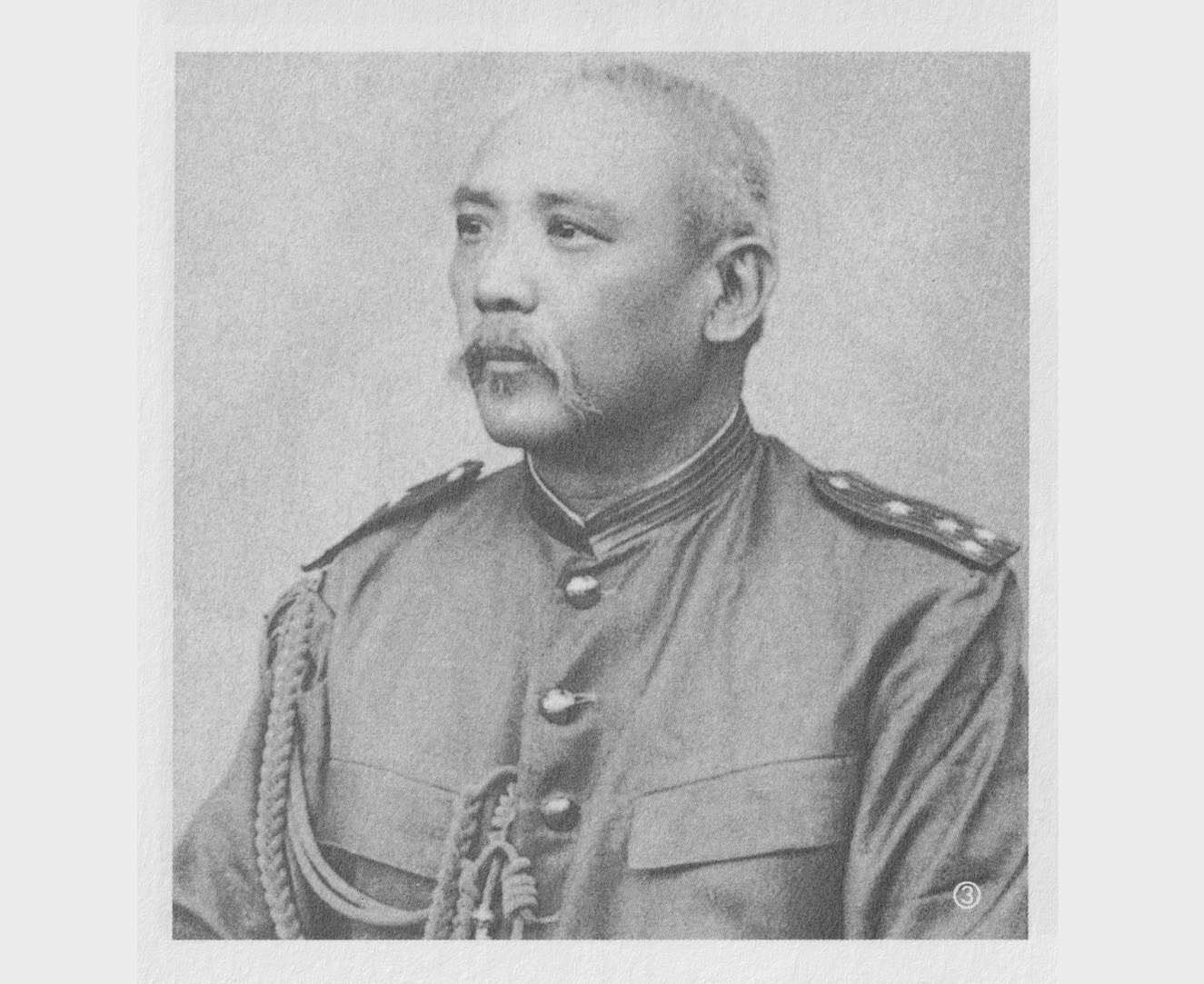
Yuan Shikai around 1910, wearing a Western-style uniform
Born in 1859, Yuan grew up at fortified Yuanzhai village in Henan province (项城袁寨村), receiving an education in both martial arts and the Chinese classics. Twice failing scholarly exams, he bought himself a military commission and served fourteen years in Korea, rising to become China’s Imperial Resident. Fleeing the disastrous Sino-Japanese war, he proposed reforming the military along German lines and in 1895 was appointed commander of the New Army.
Though courted by reformers Yuan possibly betrayed their plans to Cixi during the Hundred Days Reform, and so survived the subsequent purges. He had just taken up governorship of Shandong when the Boxer Uprising broke out in 1900, but ignored Cixi’s call to support the rebels. In the aftermath the court tried to appease foreign wrath by appointing a strong spokesman for change and Yuan was promoted to governor of Zhili, the defensive province surrounding Beijing. The North China Herald commented:
“Viceroy Yuan Shih-k'ai is fast ascending to the top, for his Excellency’s influence over the Empress Dowager is such that ... rarely a day passes in which there are not at least half a dozen secret code telegrams from the Empress Dowager to the Viceroy asking for his advice. Viceroy Yuan Shih-kai can easily be styled to-day the most powerful subject of the Throne.”
In October 1902 Yuan founded the entirely modern Beiyang Army (北洋軍), and within three years its six divisions numbered 75,000 men. British journalist Putnam Weale reported that Beiyang’s instructors were educated in Germany and Japan and that changes to its training methods were fundamental:
Everywhere I found clean rifles and proper ammunition, suitable uniforms and splendid-looking men housed in good, modern barracks ... the immense gulf separating them from the former effete creatures who, miserably paid and entirely underfed, masqueraded as serious soldiery, is clearly apparent ... it requires but good leaders and a careful selection from the great masses of men available to evolve regiments, divisions, and army corps which, conscious of their strength, will defy the best troops of Europe.
In August 1905 Yuan Shikai announced that the Beiyang Army would showcase its abilities in a grand military exercise at Hejian, the first of its kind ever held in China. Overseen by Yuan and Tieliang (鐵良), the Minister for War, manoeuvres would last October 21–25 followed by a review, with an audience to include provincial governors and foreign spectators. According to the short-lived China News (中华报), there would even be a film made of the event for the benefit of Cixi and the Imperial court. The China Times paraphrased Yuan’s pep talk to his troops:
“You, my soldiers, are about to take part in the most important military evolutions near Ho Chien Fu. ... Your skill and strategy or incompetence and weakness will be manifested not only to your Sovereign and the Imperial Court. There will also be great numbers of military attachés and diplomatic officials from various countries, and great numbers of spectators. ... I therefore call upon you, my soldiers, to look well to your conduct, your arms, your clothing and your equipment. Take every caution to drill with the utmost precision.”
Thirty foreign observers (the British party included Commander Hamilton Bower, who wrote an official report) left Tianjin by boat on October 19, arriving at Hejian three days later. They found the city surrounded by open flat countryside patterned by neatly-furrowed fields, scattered orchards and mud-brick villages which offered very little cover. Despite the novelty of the manoeuvres nobody was expecting to be impressed, The Times correspondent laughing that “Foreigners went to Ho-chien-fu to a picnic, and, incidentally, to witness a military parade, half-comic, half-pathetic.”
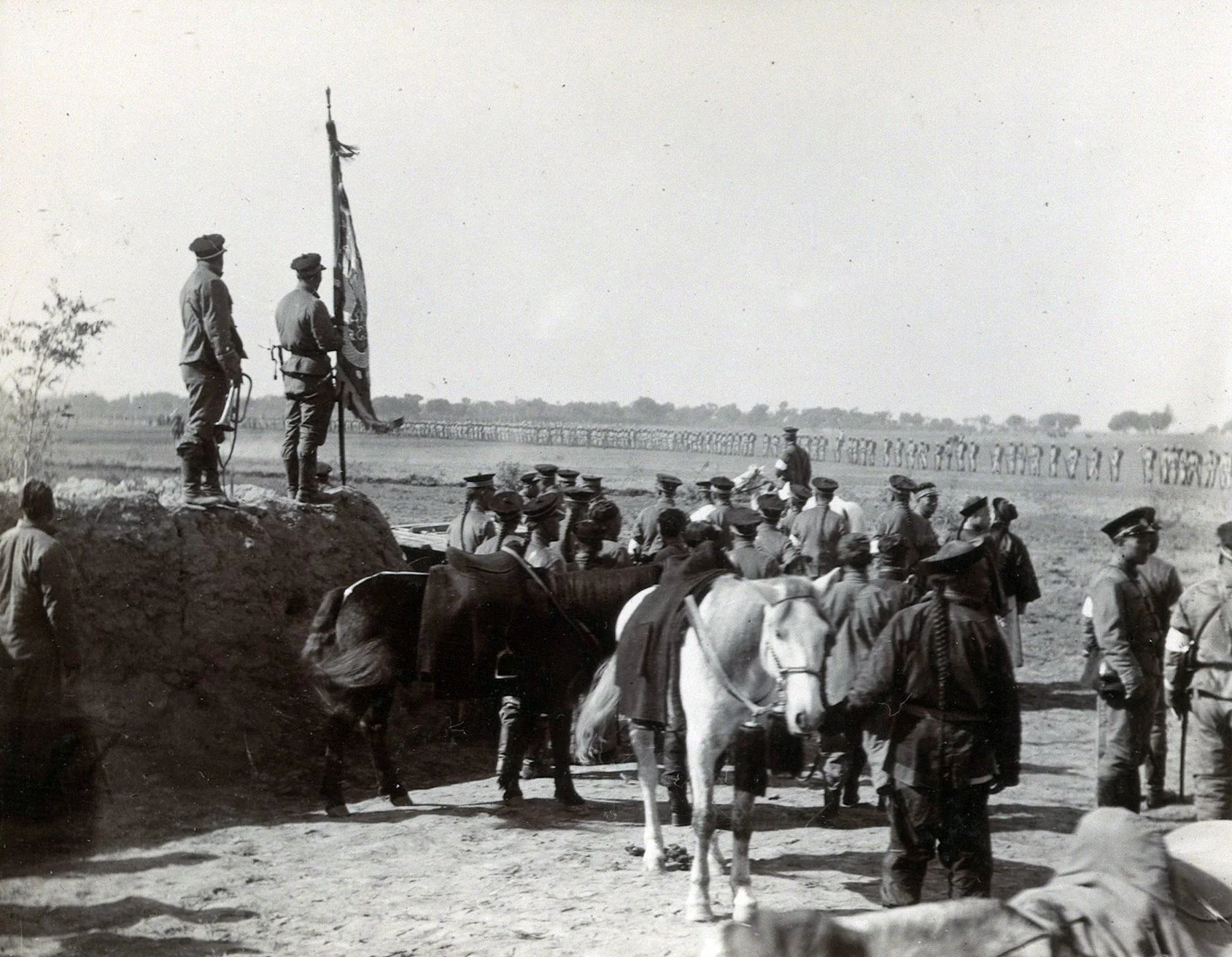
Yuan Shikai’s staff overlooking the exercises, infantry ranks in the middle distance. Note the modern uniforms, and – aside from the man holding the white pony’s head – the soldiers’ lack of braided “pigtail” queues, usually a mandatory sign of subjugation to the Manchu Qing administration. Beiyang troops had a special dispensation allowing short hair, though some coiled queues under their caps.
The plan was simple: the Southern Army in blue would advance north from their headquarters at Jinan in Shandong province, while the Northern Army in red (khaki) were moving south from Beijing to defend Zhili. Southern forces consisted of 24 battalions of infantry, 72 guns in 12 batteries of artillery, three brigades of cavalry and two regiments of engineers; the Northerners had 18 battalions of infantry, 15 batteries of artillery (90 guns), a brigade and a half of cavalry and two regiments of engineers. Chinese estimates had 45,000 men taking part; foreigners believed the total was closer to 30,000.
Having spent the first few days on distant campaigns with spectators kept informed of the action by telegraph, opposing cavalries clashed southeast of Hejian on October 23. According to Hamilton Bower, “The whole thing was evidently arranged for spectacular effect... the riding was good, no men came off, the drill was very smart and quick, line was well kept, but the Southern (BLUE) squadrons began the charge a little too soon and their horses were somewhat blown before getting close to the enemy. On the halt being sounded, both sides pulled up very smartly.”
The following day both armies came into sight. The Northern artillery opened fire as their infantry advanced either side of the guns, flushing a Southern brigade; a gap appeared in the Northern defences which was swiftly filled by reserves, the manoeuvre “carried out very smartly and without the slightest confusion”. But the Northerners missed the opportunity of occupying Guojialou village (郭家楼村) southwest of Hejian; this would have divided enemy forces and provided cover for the Northern artillery, which was badly exposed.
Meanwhile Southern forces concealed artillery while their infantry made “a decided attack on the Northern left flank”, though the overcrowded line prevented some of the men from using their arms effectively. Massed artillery was a feature of the day, with the Southerners outperforming the enemy in both firepower and tactics.
Then on October 25 observers were treated to a set-piece battle which kicked off at 9.32am and lasted until 11.12am. Forces were concentrated 9km northwest of Hejian; the Northern Army defensive line ran through what is now Baiyangxin Zhuang village (白洋辛庄村), the enemy advancing north towards them across country whose lack of cover would have proved “quite impracticable” in real war.
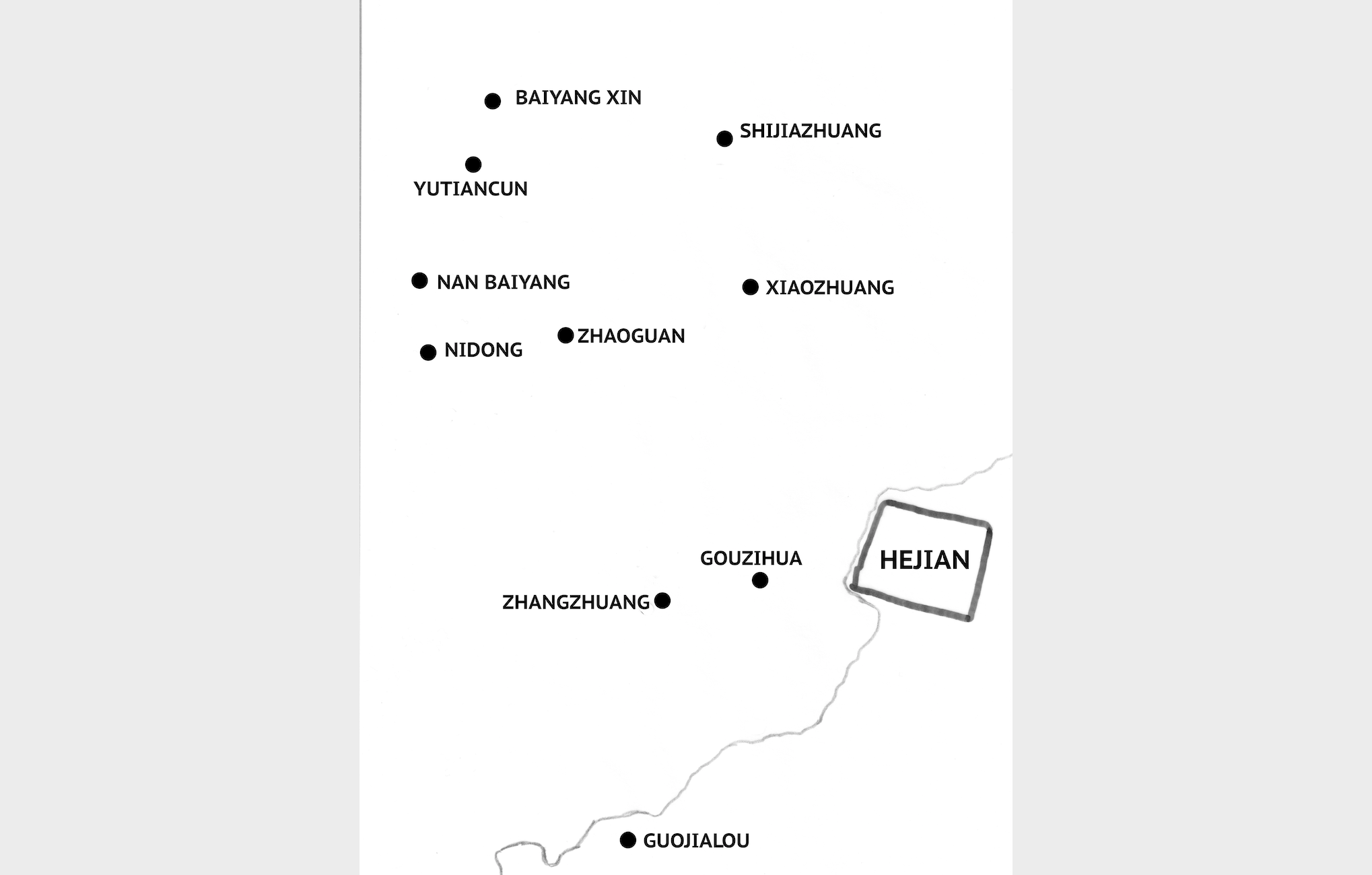
Hejian area, showing some of the villages involved in the October 25 “set-piece” battle
This time the Southerners opened hostilities with artillery, the guns concealed by a small isolated plantation – a bad choice because it was so obvious in the otherwise barren plain. As their infantry captured the hamlet of Nidong (泥洞村), west of Baiyangxin (at approximately Nanbaiyang, 南白洋村) the Northern guns supported their infantry in a failed attempt to outflank the Southern forces. The culminating manœuvre was the advance, after reinforcement, of the [Northern] army hitherto on the defensive, and a fierce encounter in the open between the two armies, with the usual foolish, but attractive, waste of powder.
The manoeuvres were finished and foreign observers, expecting to have spent the week laughing at a confused rout, were utterly astounded by the Beiyang Army’s unwavering professionalism. As The Times gushed:
The Chinese infantry stand like heroes, rigid and impassive, yet in attitudes instinctive with life, the expression on their faces firm, often suggestive of strong character. Skirmishing is conducted in orthodox fashion, the men showing great attention to the work in hand, carefully following every order with regard to sighting rifles, &c. They avail themselves of every scrap of cover when advancing, whilst the control of each subaltern over his section of the line and of the company commanders seems absolute. ... it was unanimously agreed that a very high state of discipline existed, that the men showed intelligent appreciation of the task to be performed, and that the officers were extremely keen and had their men perfectly in hand.
Forgiving the staged nature of the final day, The Times concluded:
A more imposing effect could scarcely be conceived than the meeting of two armies, the roar of 20,000 rifles, and the booming of a hundred cannon. Indeed, there was no more significant feature of the manœuvres than the fact that 30,000 men, after four days marching and countermarching, were manœuvred into two straight lines each three miles long, in the exact positions arranged beforehand, and at the precise moment planned. That alone requires a degree of organization and a capacity to handle troops which hitherto the world has been very far from associating with the Chinese.
There were also measured criticisms. Firearms were too varied, meaning that ammunition couldn’t be exchanged between different units, a serious shortcoming if supply lines failed. The mountain guns were dated and unsuited to the flat terrain, but at least were used intelligently, officers checking ranging and sighting and the men doing their best to find cover. The cavalry’s main problem was that their Mongolian ponies were simply too lightweight at just thirteen hands high, and could never have stood against a charge by more massive Western horses.
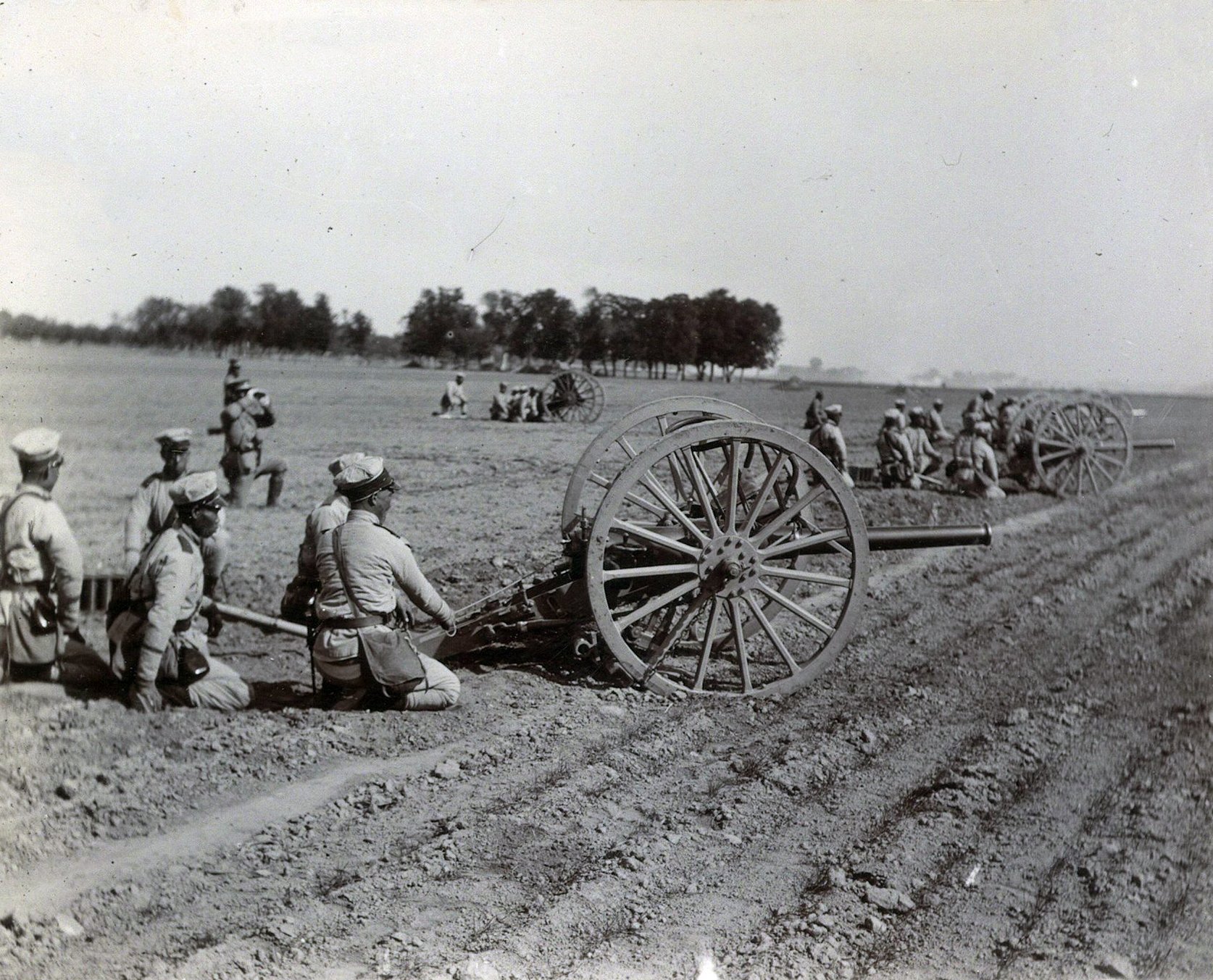
Guns, furrows and scattered groves of trees
Otherwise all observers agreed that they had witnessed a startling advance in China’s military capabilities – especially considering that the Beiyang Army was just three years old. If Yuan could so quickly train 30,000 men to this standard, what would China’s fighting skills be like given more time, and if other provincial armies followed suit? It seemed that foreign nations, so used to bullying China, would have to consider their future relationship.
There were also changes in the way this modern force saw itself, and the impression they made on ordinary Chinese. Yuan Shikai wore the same European-style uniform as his troops, rode about on horseback and dined with his officers, an egalitarian approach which old-fashioned officials would have found impossibly demeaning. His officers were well-educated, the soldiers “strong and healthy looking” – implying a good diet – and as for their treatment of locals, Hamilton Bower was astonished:
“A few years ago, had 30,000 Chinese troops visited any part of the Empire, they would have had either to starve or live on plunder... [Yet at Hejian] No case of complaint against the troops was heard of; on the contrary, the people said that they paid for everything and by selling fruit, etc, they were actually making money out of the soldiers. This is a sort of social revolution...”
And so finally back to the print, a souvenir of the parade on October 26. With Hejian’s city walls framing the background, Yuan Shikai and fellow officials sit under a pavilion, inspecting the formations drawn up outside. Officials are drawn larger than anyone else (perhaps because they were more important), and the cavalry square has been miniaturised to fit it in. Bands play European-style trumpets and drums and supply carts and wagons move in under gateways labelled “East Camp” and “West Camp” (東轅門, 西轅門). A small group of Chinese spectators watch from the upper left edge. The print also features Western-style linear perspective, with all lines more or less converging on Yuan Shikai at upper centre.
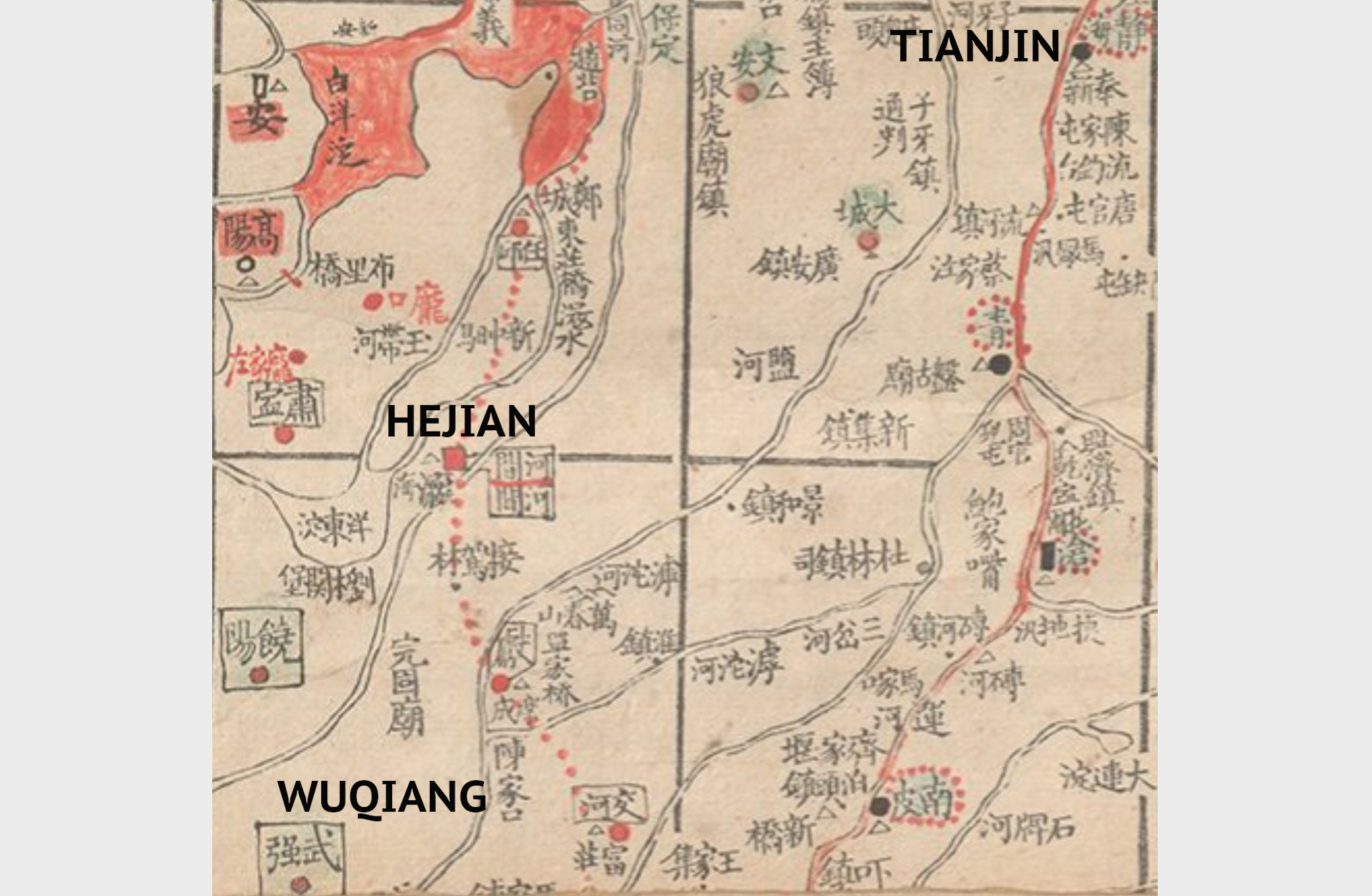
Local map showing Hejian, Wuqiang – where the print was made – and Tianjin. Beijing is way off to the northwest
The print was made just 50km from Hejian at Wuqiang (武强), and it’s tempting to imagine that the artist drew the scene from life. But it’s missing everything the exercises intended to show off: there are no modern uniforms (even the officials are wearing traditional court robes), arms are mostly limited to swords and tiger forks, and the heavy guns are absent. In fact the most contemporary feature is the rickshaw top left – a form of transport introduced from Japan in the 1870s.
As period prints from Wuqiang often featured innovations – cars, aeroplanes, trams, traffic lights, telegraph lines, bicycles, European clothing and even women militias drilling with rifles – it’s surprising that this one missed such an opportunity. A likely reason is that the printing block was originally cut for an earlier event and was later reused, with a title added, to portray the Hejian parade. A block this large (53cm x 110cm) would have been expensive and time-consuming to cut; in these cases it was common practice to make the scene as generic as possible so that with little effort the block could illustrate multiple similar events.
Indeed, one of the few other copies I can find of this print has no title at all, and a comparison shows that in my version the flags at the top right side have been cut down from the original to fit the Chinese characters in.
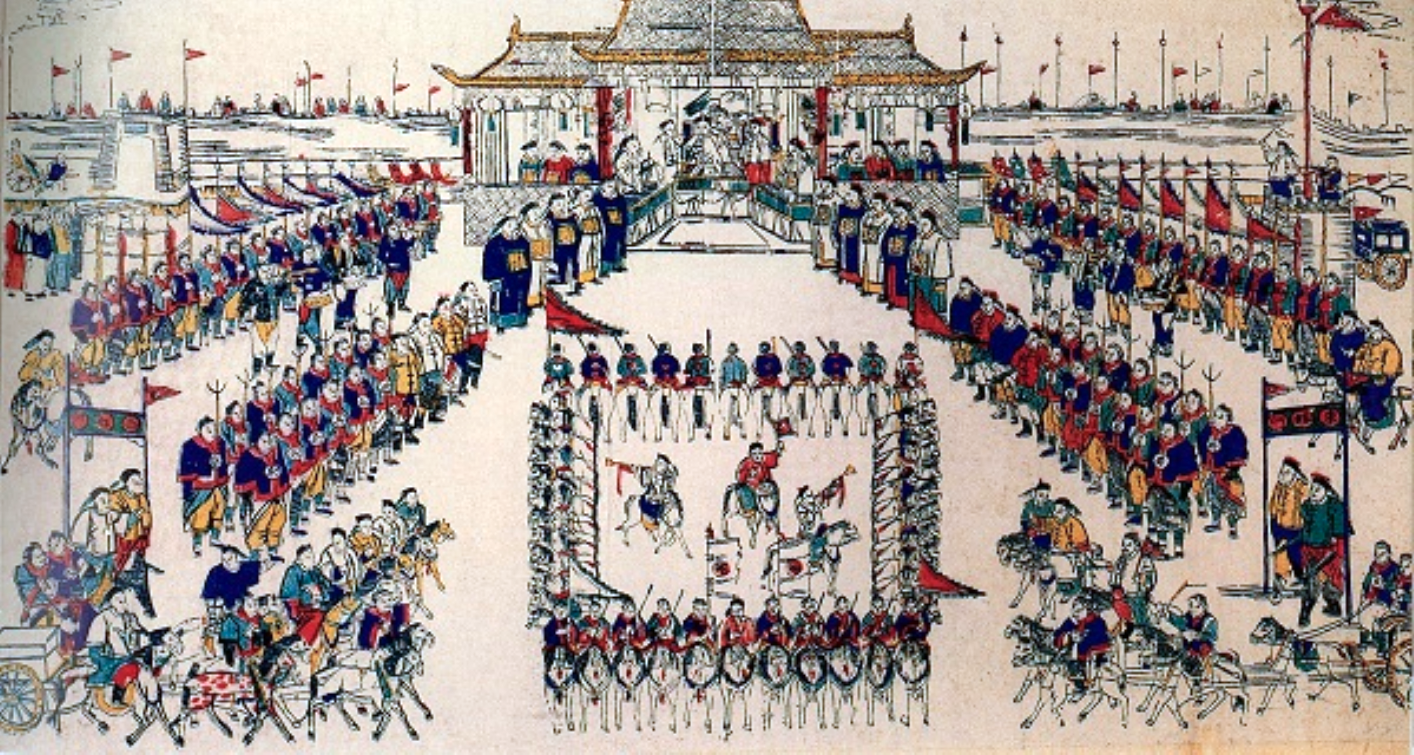
An earlier version of the print, using the same outline block but with added colour and no title. In my copy the row of flagpoles upper right have been shortened to accommodate the Chinese characters; the left side had more room and hardly needed changing. It’s possible that this design was originally cut to illustrate the efforts of Zhang Zhidong, another progressive military official in charge of the Huguang region, who employed foreign staff to drill his troops through the 1890s but had not gone as far as updating their uniforms.
Foreigners were not the only people impressed by the exercises. An Imperial decree on November 1 declared:
Their Majesties are greatly pleased at the conduct of the officers and troops concerned... Viceroys and Governors of provinces are further enjoined ... to do all they can to imitate and emulate the splendid results arrived at, and clearly demonstrated by the troops of the Beiyang Administration in the recent manoeuvres. In this manner alone can the high provincial authorities help their Imperial Majesties in their earnest desire to possess a well-disciplined and well-organised army which shall stand as a strong wall of defence against the enemies of the Empire.
Yuan Shikai was rewarded with a princely sable robe, an extraordinary honour, but was forced into retirement after his patron Cixi died in 1908. Recalled in 1911 as revolution tipped China towards civil war, Yuan engineered the abdication of the last emperor. Declaring himself monarch four years later, he was abandoned by his own generals and died in June 1916 aged just 56. The new military training, instead of being used to create a strong national defence force, was adopted by rival warlords for their private armies, whose infighting – and the Japanese invasion of 1937 – plunged China into chaos for the next thirty-five years.
Today the Beiyang Army’s landmark exercises at Hejian have been largely forgotten, and this print, despite its shortcomings, is virtually their only memorial.
Many thanks to Keith Robinson and his knowledge of Western musical instruments used in China, for suggesting the possible connection of this print with Zhang Zhidong.
Sources
Photos of the Hejian exercises from https://www.bilibili.com/opus/941612227547365397
Bower, Hamilton Report on Manoeuvres of Chinese Troops Near Ho-Chien-Fu (National Archives FO371/26/34; Folios 266-313, China Code 10, File 3005, Paper 3005)
British Newspaper Archive (www.britishnewspaperarchive.co.uk)
Chen Yong A Glimpse of Old China 1868–1945 (旧中国掠影; China Pictorial Publishing House 2006)
China Mail for 1905 (https://sls.hkpl.gov.hk/digital-collection/en/collection_old-hk-newspapers.html)
Feng Jicai Chinese New Year Woodblock Prints Collection: Wuqiang Volume (中国木版年画集成: 武强卷; 2009)
Foster, John Present Conditions in China (National Geographic Magazine Vol XVII, No. 12; Dec 1906)
Hong Kong Telegraph for 1905 (https://sls.hkpl.gov.hk/digital-collection/en/collection_old-hk-newspapers.html)
Huang Hongshou Complete Chronicle of Qing History volume 62 (黃鴻壽: 清史紀事本末; 1915; https://ctext.org/wiki.pl?if=gb&chapter=329655)
Hummel, Arthur Eminent Chinese of the Ch’ing Period (US Government Printing Office 1944)
Li Lin The 1905 Qing Government Film “Autumn Manoeuvres” (栗琳: 一九〇五年清政府拍摄电影《秋操》; 当代电影 2025; https://www.sohu.com/a/846393003_121124735)
Mesny, William Mesny’s Chinese Miscellany (volume IV p.361; Shanghai 1905)
North China Herald for 1905 (https://archive.org/search?query=creator%3A%22north-china+herald%22)
Weale, Putnam The Re-Shaping of the Far East (two volumes; Macmillan 1905)