New Prints From Old
Recently I wrote about a large woodblock print, Grand Military Exercises in Hejian (河間府演大操; which you can read all about here). Though the title dates it to 1905, the lack of modern military features suggested the woodblock had been cut for an earlier event, and then reused to commemorate the parade at Hejian. A coloured version of the same print lacks any title at all, and comparisons show that my 1905 copy had been altered so that characters could be fitted in.
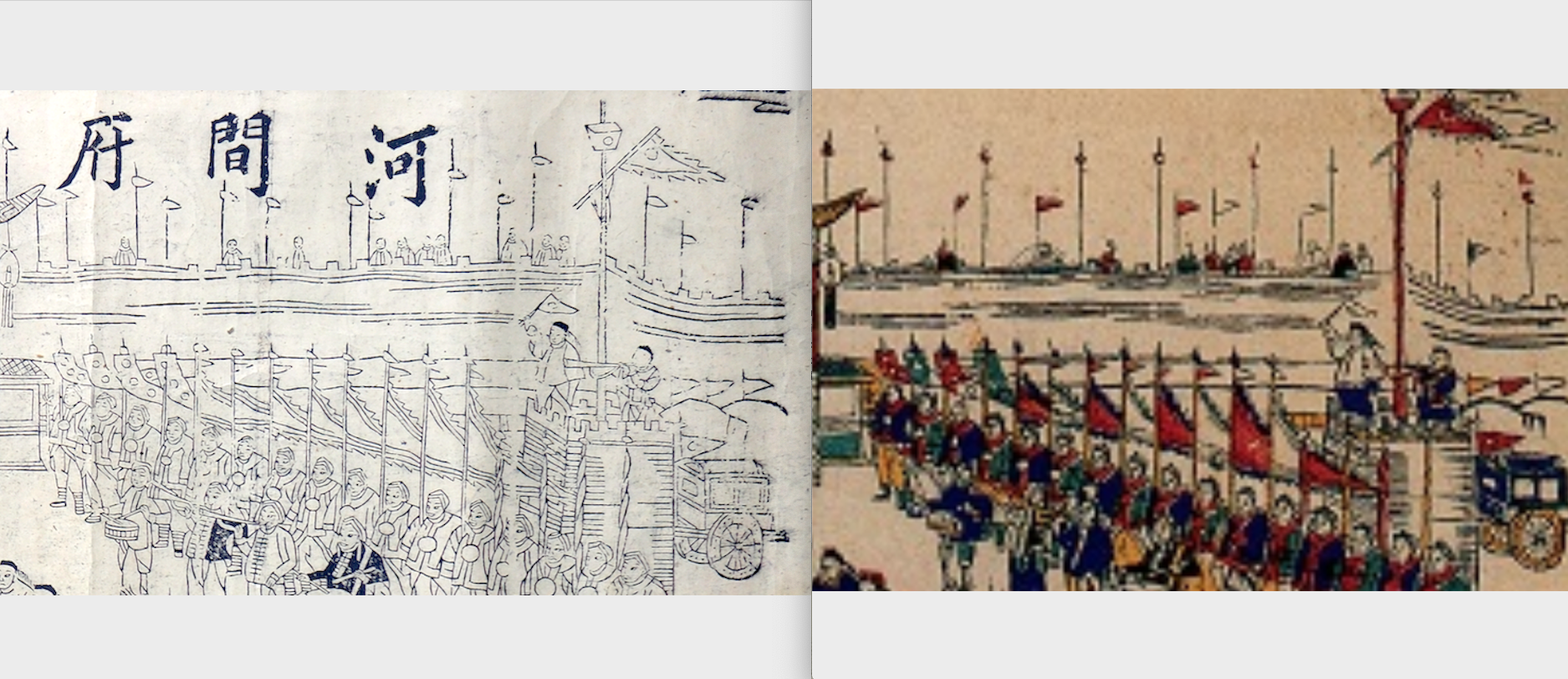
Original coloured version on the right, with long flagpoles and no title. 1905 version on the left, with flagpoles shortened to fit in characters
By the late nineteenth century, military prints like this served as news-sheets, usually showing China’s many enemies being thrashed in battle – in fact they came to be known as “Victory Prints”. To keep up with current events they had to be produced quickly, but cutting a block this large was time-consuming (Grand Military Exercises measures a metre across, though most Victory Prints were closer to 60cm). An easy shortcut was simply to retitle an existing block – after all, one battle looks much the same as another.
So with that in mind, here’s a print in the British Museum titled Victory at Asan: The Japanese Occupy the Korean Capital (牙山大㨗圖倭奴佔踞韓京圖), which dates from the First Sino-Japanese War of 1894. In it Japanese soldiers – wearing Western-style military outfits (caps, trousers, jackets) and armed with modern rifle and cannon – storm the gates at Asan, putting herds of Korean officials to flight.

Victory at Asan: The Japanese Occupy the Korean Capital (牙山大㨗圖倭奴佔踞韓京圖). Keep an eye on those “top hats” lower left
And then here’s another from my collection, set a year later in 1895. By now China had been beaten in Korea and as part of the settlement had to hand Taiwan over to Japan. The original print has been retitled Liu Yongfu’s Black Flag Army in Taiwan: Victory on Land and Water (劉永福鎮守䑓灣黑旗兵水陸得勝圖) and shows resistance to the Japanese occupation mounted by the guerilla leader Liu Yongfu, who fought for the Chinese cause.
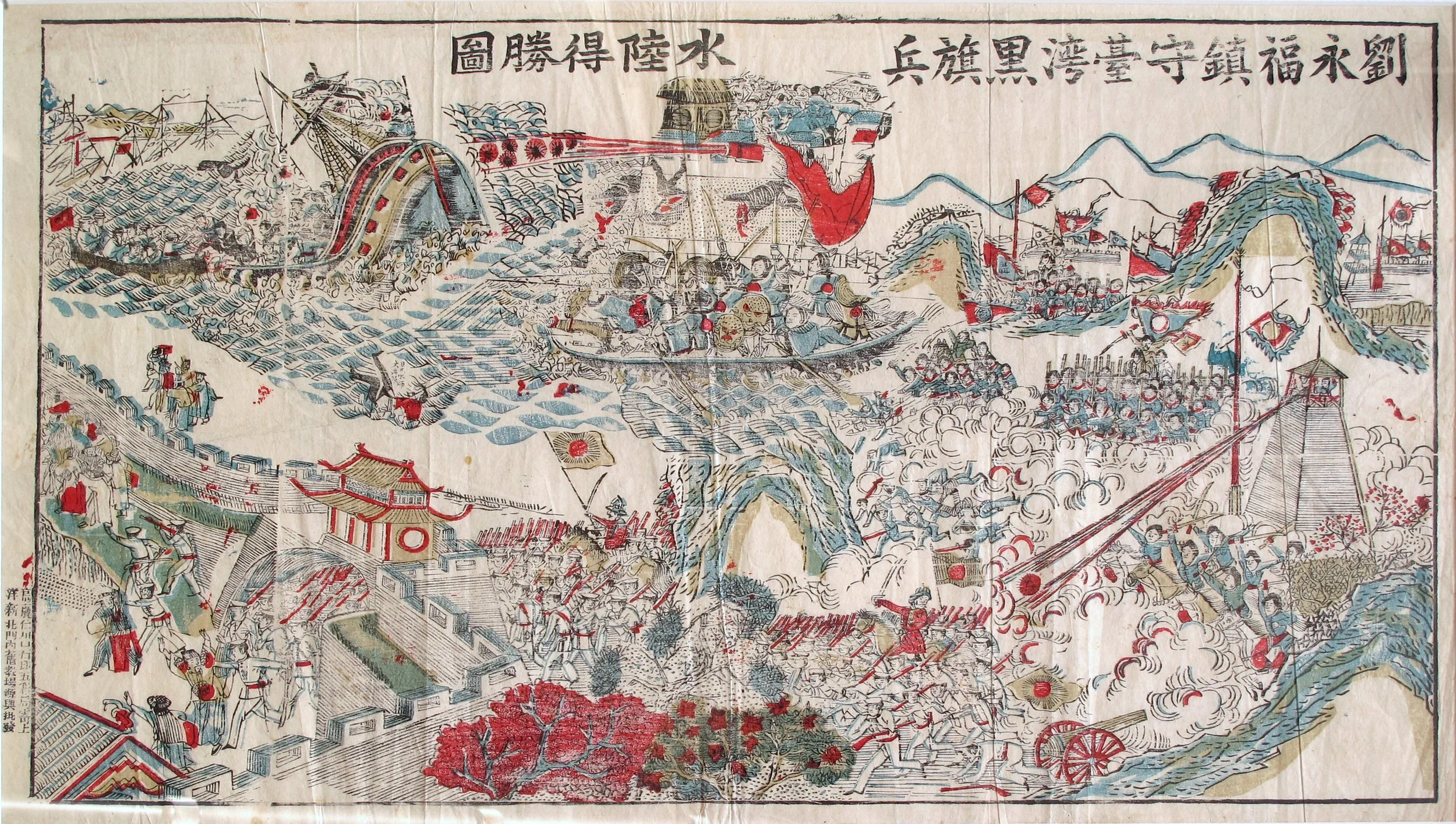
Liu Yongfu’s Black Flag Army in Taiwan: Victory on Land and Water (劉永福鎮守䑓灣黑旗兵水陸得勝圖). Upper left side of the print greatly altered
Beyond the new title, there have been other changes to the print. In the lower left corner of the original, Korean officials wear distinctive gat headware, looking like miniature top hats. But in my version – where the action has been relocated to Taiwan – the most obvious hats have been crudely cut out.
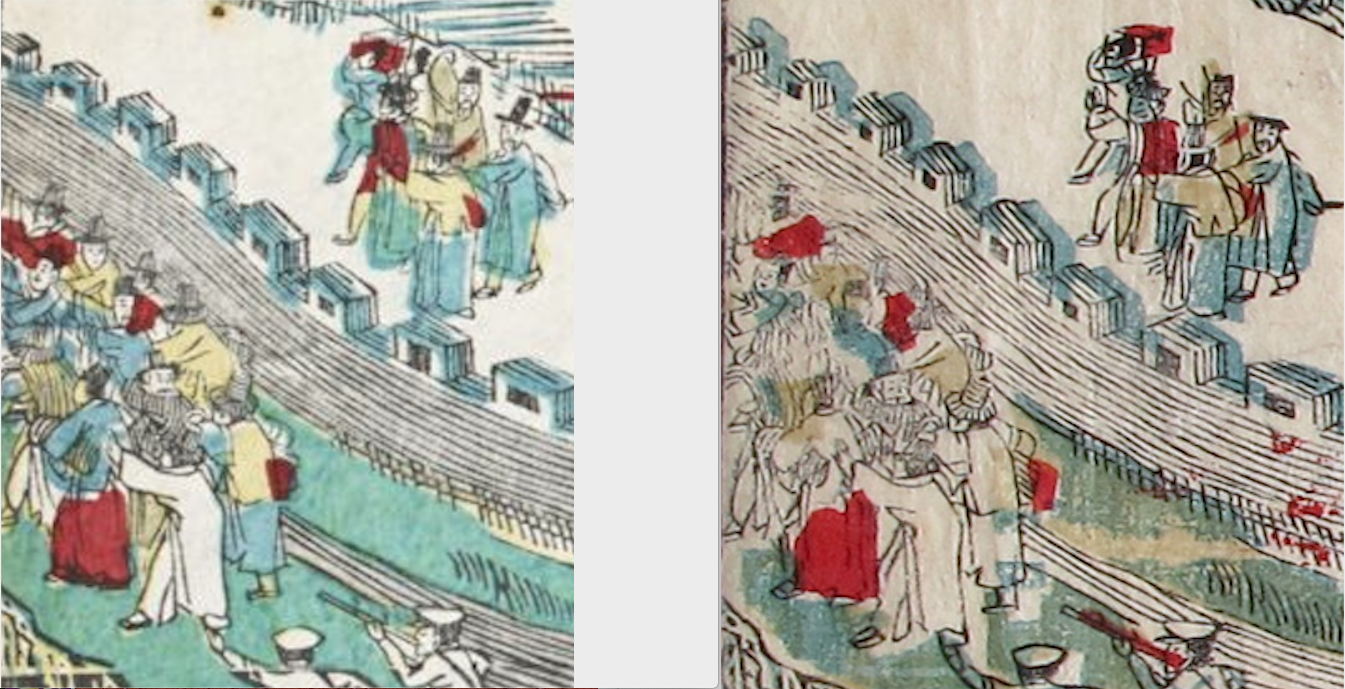
Korean scene on the left, Taiwan scene on the right. Note the gentleman on far right with top hat hacked off. In fact many of the figures in the main huddle retain their hats in both versions
And then the whole top-left side of the 1895 print has been changed from the original, which simply shows a fleet of battleships cruising calmly off the coast. My version is crammed with action – ships are sinking, war boats packed with heavily-armed soldiers are heading out to spear enemy survivors, a hilltop fort spews cannon-fire.
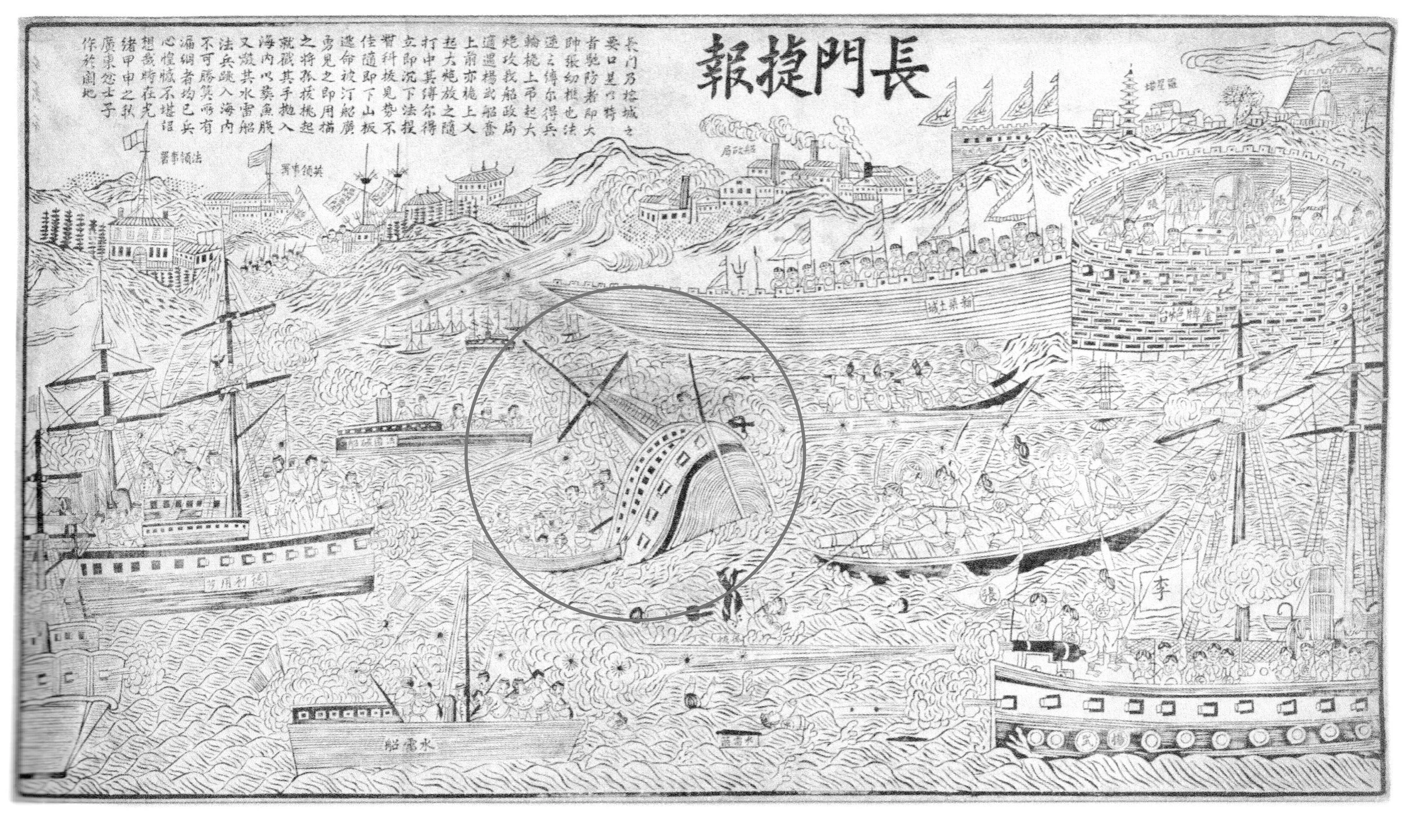
Great Victory at Changmen from 1884, with sinking ship at centre reused eleven years later in the Liu Yongfu print. In fact at one point this entire design was also retitled “Ding Junmen’s Naval Forces Retaking Korea” (丁軍門水師恢復朝鮮圖) and used to depict fighting in Korea in 1894. From “Hot Off the Press: Impressions of Modernity in 1920s China” (MARKK 2025)
This corner of the block seems to be assembled from many different pieces. For example, the distinctive stern of a sinking ship can be traced back to a woodblock cut ten years earlier during fighting between France and China over control of Vietnam. This block, Reporting a Great Victory at Changmen (長門㨗報), shows the Chinese and French fleets clashing off the Fujian coast in 1884; the central sinking ship is identical to the one in my print and presumably has been cut out and reused. Other components – the war boats, soldiers, hill fort and even the drowning foreigner – can probably be traced to old blocks too.
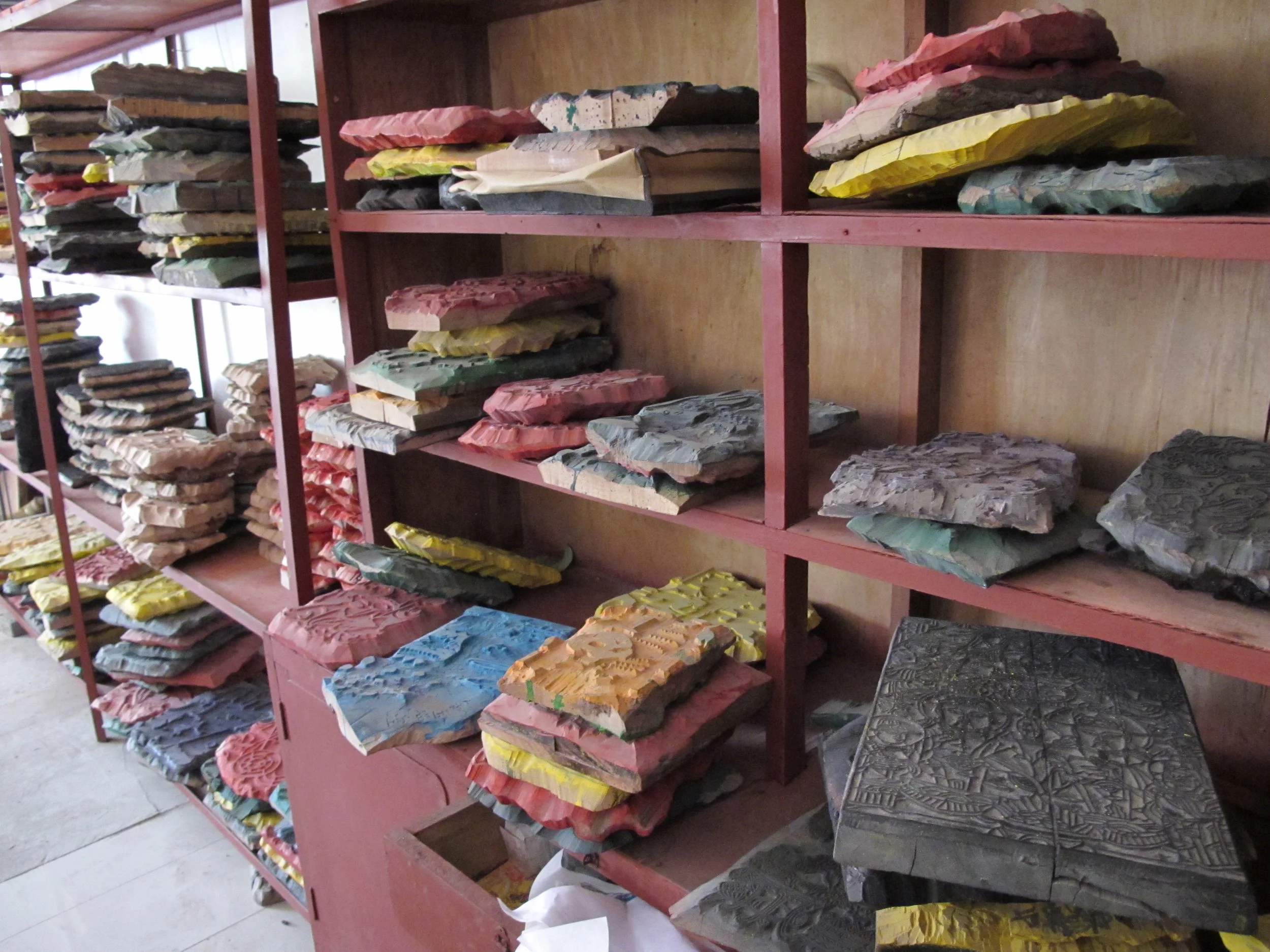
Woodblock store at a studio in Zhuxian Zhen, 2019. Multicoloured prints need up to six blocks per design
Aside from quickly creating a new design or covering a recent event, there were many reasons to repurpose old blocks. A block this size (even one made from several smaller planks) would have been expensive; most likely some had the old designs planed off and were recut with entirely new scenes. But more troublesome is the question of storage – studios I have visited are overflowing with blocks, piled up on shelves and crammed into cupboards.
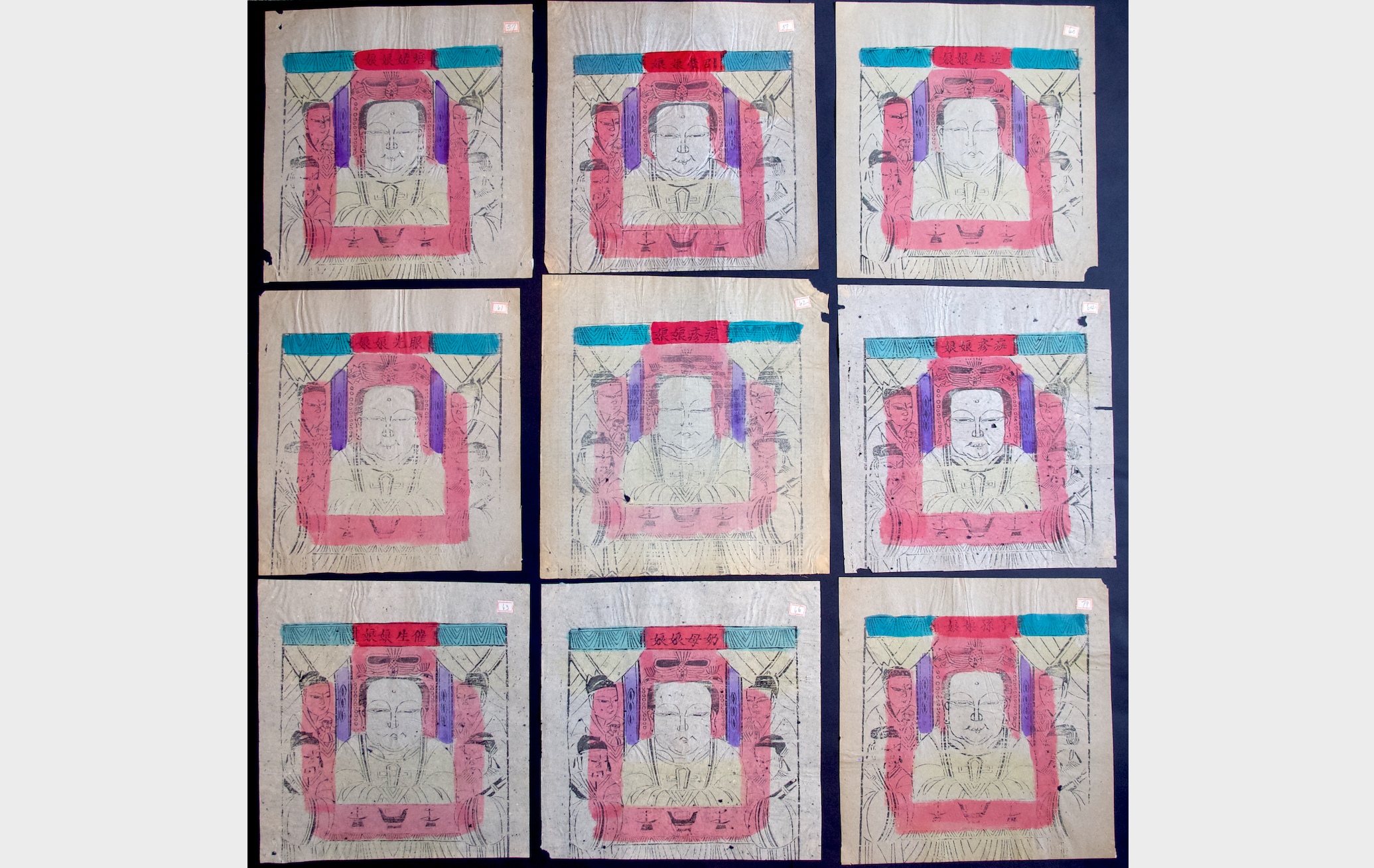
Nine different deities of childhood illnesses, printed from just two blocks with the names added in afterwards
These battle prints were not the only ones to serve multiple purposes. China has thousands of folk deities, often worshipped through woodblock-printed images. But no studio had the space to physically store purpose-cut woodblocks for each and every god. The solution was to cut blocks for generic military and civil deities, and use them to print any number of different gods, filling in the blank nameplates as required. This would have saved a lot of workshop space.