Madame Zhao: Unparalleled Ingenuity 巧妙無雙
The Chinese deity of needlework is usually Zhinü, from the tale of the Cowherd and Weaver Girl. But here the title 巧妙無雙, “Unparalleled Ingenuity”, links this print to the obscure Madame Zhao, who lived during the Three Kingdoms era (184–280 AD).
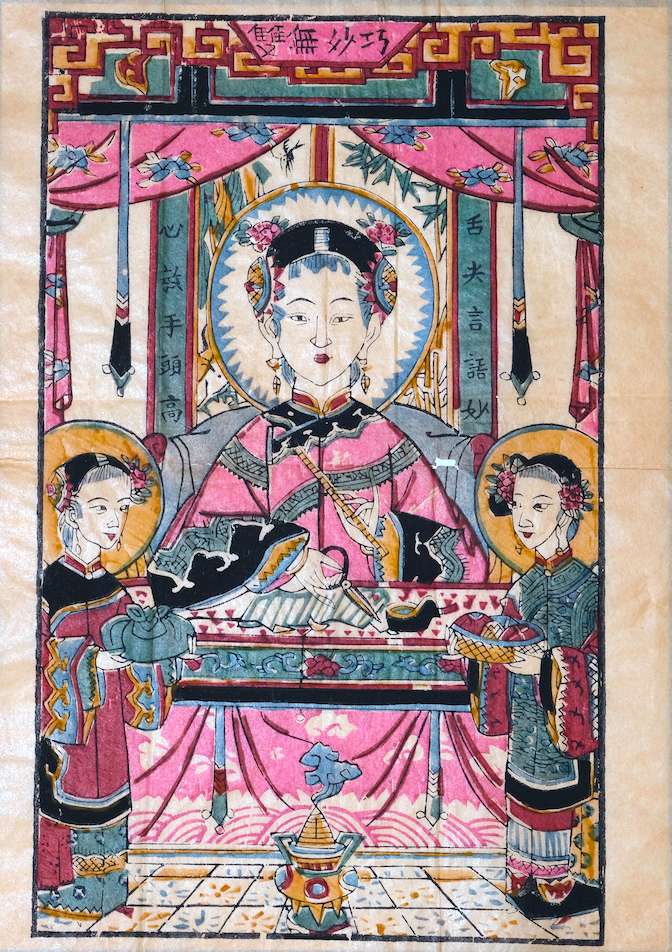
Unparalleled Ingenuity. I like the scissors and ruler
Her story isn’t in the well-known fourteenth-century historical novel Romance of the Three Kingdoms, but appears in Wang Jia’s Lost Historical Fragments (王嘉; 拾遗记), written three hundred years earlier. Madame Zhao (越夫人) was the sister of Zhao Da, politician and astrologer to the state of Wu. She was famous for her outstanding skill with a needle: so nimble were her fingers – “as slender and tender as onion roots” – that she could embroider or weave incredible detail onto the smallest piece of fabric.
Sun Quan, king of Wu, was looking for an artist to paint a detailed military map of the rival states of Shu and Wei, and Zhao Da recommended his sister. But instead of using brush and ink Madame Zhao embroidered the map on silk, being more durable than paper and less likely to get torn or damaged when taken to war. Her creation became the wonder of the court.
During one sweltering summer, Madame Zhao also invented the world’s first mosquito net, woven from hair and “light as smoke”, so that Sun Quan could sleep comfortably in the outdoors breeze. “When spread out it was ten foot wide; when rolled up it could fit inside a pillow”. Sun always carried it when off campaigning.
Eventually Madame Zhao fell victim to jealous court intrigues and was banished from the palace. It is not known what happened to her after the State of Wu fell in 280 AD.
The Chinese couplets “舌尖言語妙,心敬手頭高“ mean something like "At the tip of her tongue, beautiful words; With her respectful heart, excellent dexterity". A note written in English at the top reads: “The Chinese women put this up in their houses. This goddess favours them in their sewing.” An accompanying Kitchen God print dates this to 1911; the style suggests a workshop at Wuqiang in Hebei or Shandong's Yangjiabu.