Six Copies of the Peking Gazette 京報
Here are six woodblock-printed copies of the Peking Gazette (京報, literally “Capital News”) which arrived among a stash of papers relating to the British missionary Ernest Box. As Box lived in eastern China 1890–1930 and these copies predate his arrival, he must have collected them a souvenirs; he’s pencilled on one cover a widely-held belief that the Gazette was “Probably the oldest newspaper in the world”.
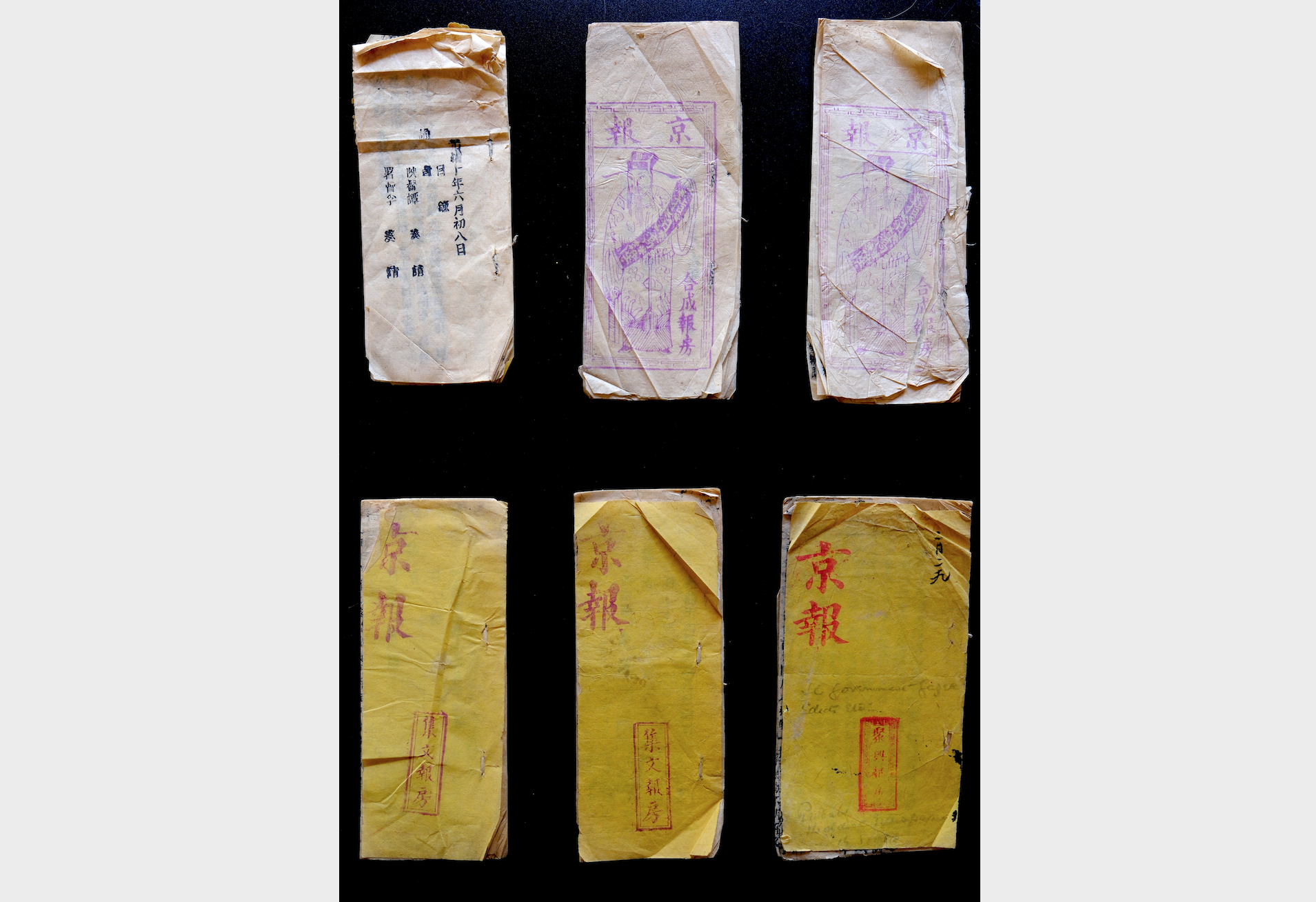
Six copies of the Peking Gazette, published between 1876 and 1889 in Beijing. Top left without a cover, showing date of 光緒十年六月初八日, Guangxu tenth year, sixth month, eighth day (29 July 1884). The two copies with illustrated lilac covers were printed by 合成報房, the “Hecheng Newsroom”, the lower right stamped in red 聚興報房, “Juxing Newsroom”, the other two stamped 集文報房, “Jiwen Newsroom”
But although it remained in print from the late Ming until the fall of the Qing (c1600–1912), the Peking Gazette wasn’t a newspaper in the sense of providing critical reportage of current events. Instead it was the mouthpiece of China’s Imperial court, its proclamations informing the public of government promotions and demotions, new laws and regulations, the official take on current wars and diplomacy, and verdicts on scandals and complex criminal cases which needed Imperial judgement.
Originally distributed by the court, by the late nineteenth century the Gazette was published by a whole raft of private printers in Beijing and provincial capitals, who brought out their own versions more or less daily. The little pamphlets measured around 9cm x 23cm, with ten or more pages depending on the quantity of news. Belted out quickly in huge numbers to sell for just a few coppers, production values were necessarily cheap – rough, tissue-thin paper, atrocious printing using wooden moveable type, and just two stitches binding everything together (the thread sometimes made from tightly rolled “paper nails”).
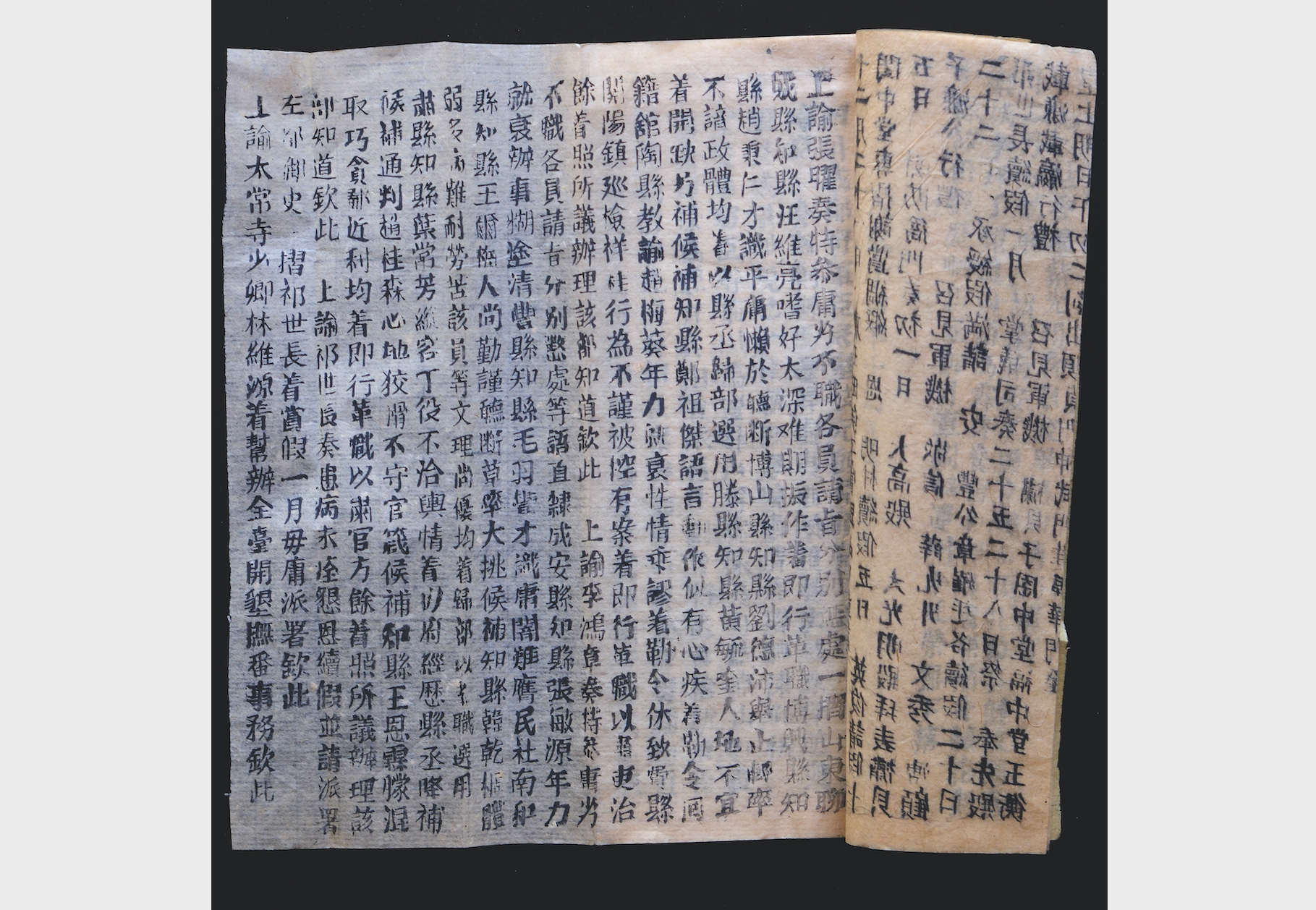
A relatively well-printed, legible page. Most editions comprise concertinaed pages of about 7x24 characters each; others, like this one from January 1889, have fold-out leaves with 18x24 characters. Individual proclamations begin 上諭, “An Imperial edict...”, the main ones here naming and demanding the impeachment of incompetent, lazy, corrupt and mediocre officials. The left-most column appoints minister Lin Weiyuan (林維源) to assist in the reclamation and pacification of aboriginal lands in Taiwan
Despite their rushed, insubstantial nature, copies of the Gazette were eagerly read by not just the public but also Chinese and foreign officials. English translations of a selection of articles appeared in the North China Herald, China’s most reputable foreign-language newspaper, later gathered together and published annually in book form.
I’ve used these Gazette translations extensively over the years – they’re a fascinating look at the workings of the Chinese court across a huge range of topics. A good number are available free online (see below).
References
Mokros, Emily
– Communication, Empire and Authority in the Qing Gazette (John Hopkins University doctoral dissertation 2016)
– The Global Peking Gazette (https://storymaps.arcgis.com/stories/9427ce0196ce4c758d85304d1c0f0006)
Translations of the Gazette 1873–1899 available free online: https://archive.org/search?tab=all&query=%22peking+Gazette%22