May You Soon Bear Noble Sons 早生貴子
Here’s a beautiful pair of prints which according to the seller was collected by “a British missionary resident in Wuhan 1865-1885”.
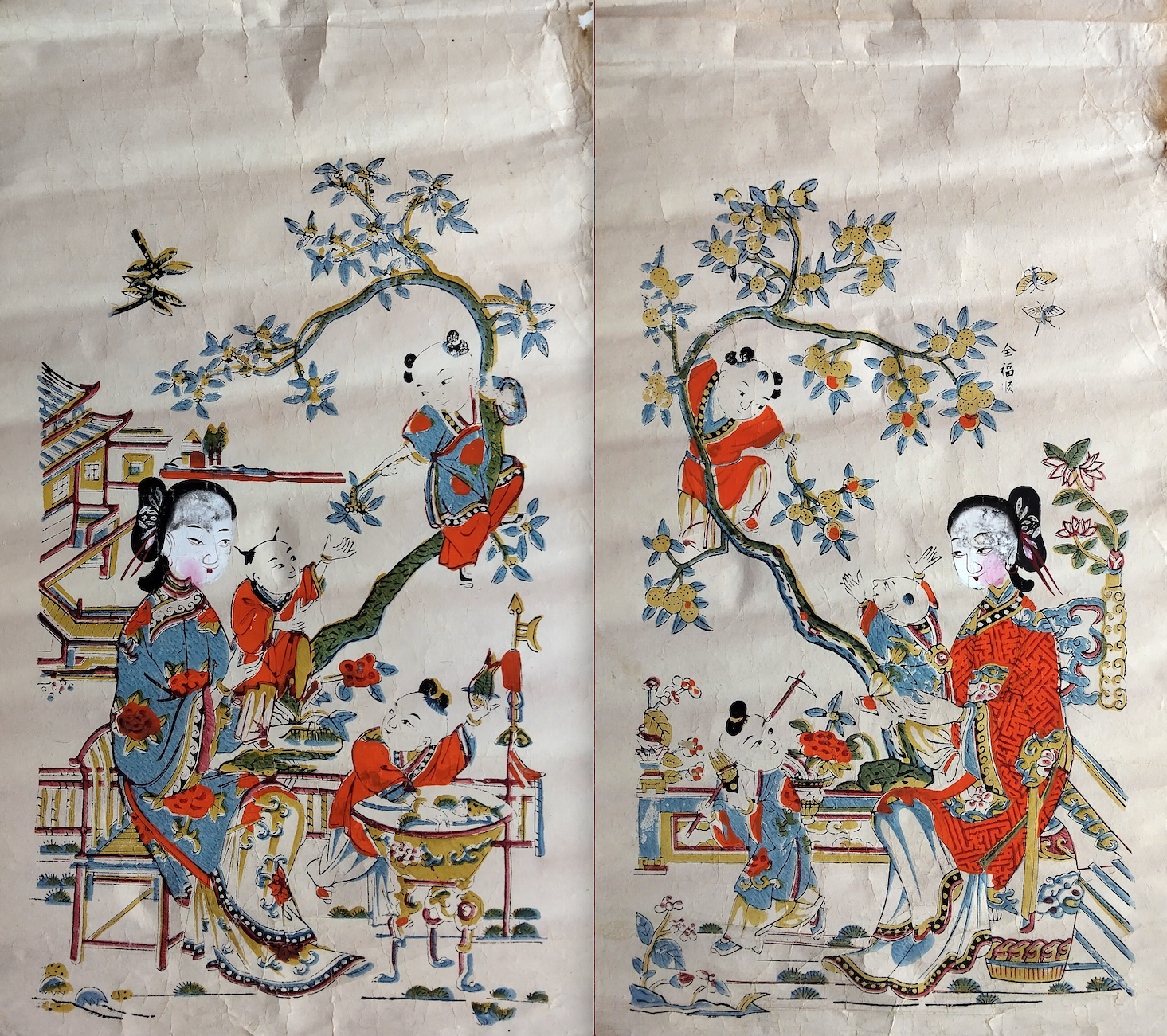
Two elegant ladies with stylish hair and robes sit under fruiting trees. Each holds a infant boy on her lap; an older boy in a tree hands down a branch of fruit while a third holds various auspicious objects. There are many nice details: the vermilion robe patterned in swastikas, dragonflies and butterflies fluttering above, a fine wooden chair and porcelain drum stool, balustraded walkways with views of a distant mansion. Aside from oxidised white paint on the women’s faces all the colours remain very bright – the prints must have been hidden away since purchase.
As is common in folk prints, the scenes are packed with auspicious rebuses. The tree on the right with red fruit is a Chinese date, zao zi (棗子) – pronounced the same as 早子, literally “early sons” but implying the phrase zao sheng gui zi 早生貴子, “May You Soon Bear Noble Sons”. Similarly the lychee tree on the left, 荔枝, sounds like 俐子, “clever sons”.
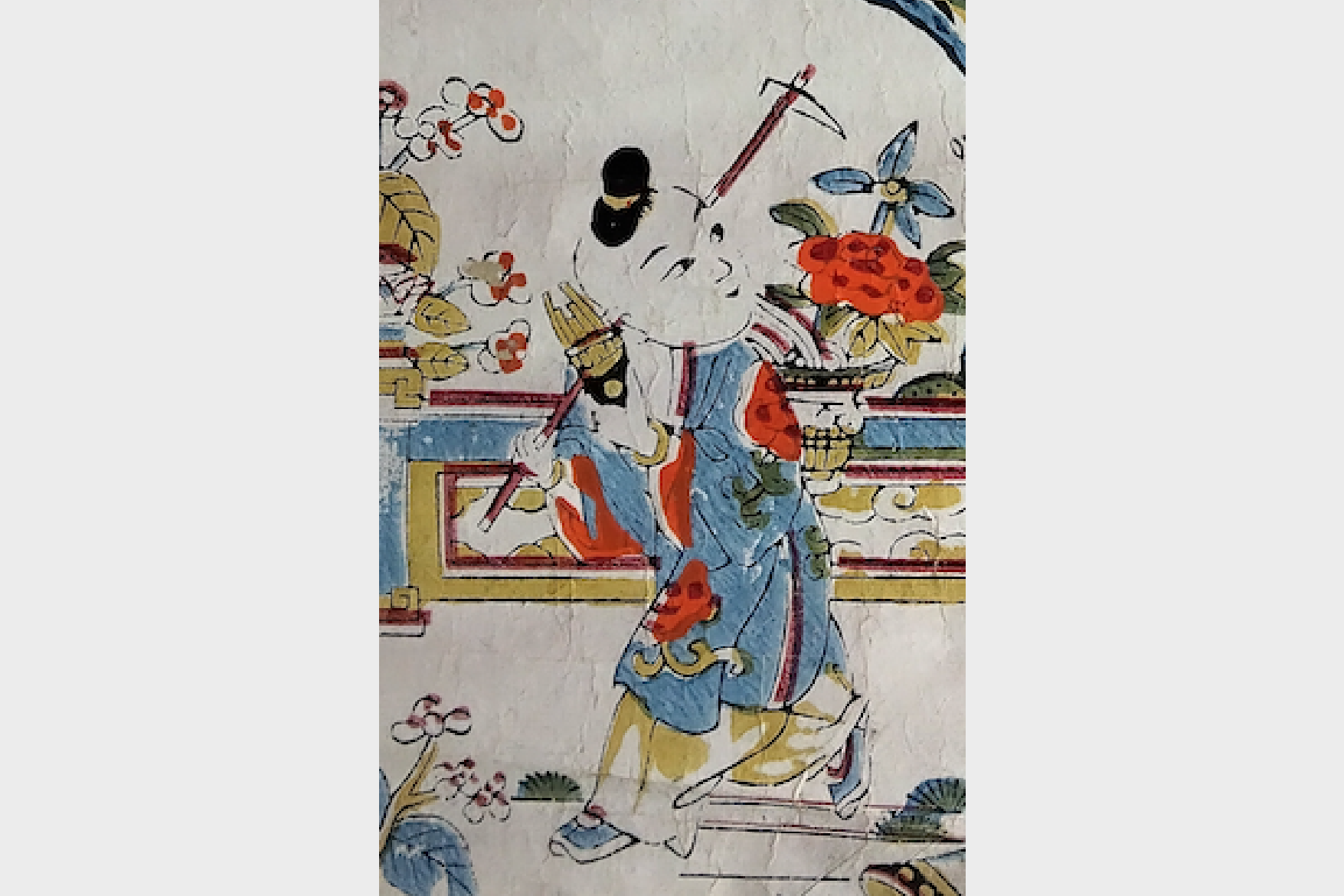
Boy with reed pipes (sheng 笙) and gardening pick (jue 镢) - close to sheng jie 圣杰, “eminent talent”
On the left, a halberd (戟, ji) hung with a triangular stone chime (磬, qing) stands beside a child holding a fish (有魚, you yu) – evoking ji qing you yu, 吉慶有餘, “An Abundance of Auspicious Celebrations”. The lotus in a vase (瓶荷, heping) on the far right echoes the heping (和平) meaning “peace”; while peonies (in a pot on the right, and on the left-hand lady’s robe) represent good fortune and nobility.
Paired butterflies and dragonflies stand for romantic affection, but also for spring and summer respectively – suggesting that there were two similar designs for autumn and winter.

19C Tantou door god print from same source on left; modern Tantou print on right; sizing paper at Tantou with white slurry before printing in centre
The prints were made at Tantou in Hunan (湖南隆回灘頭真), 500km southwest of Wuhan: others from the same seller were all well-known Tantou designs, and the grey bamboo-fibre paper has been primed on one side with a white chalky wash, a distinctive feature of Tantou studios. I haven’t been able to identify the maker’s mark 全福順 on the right-hand print, but nineteenth-century Tantou had around one hundred workshops (today there are just two) and only a few are known by name.
The Noble Sons design can be traced back to eighteenth century “Gusu prints” from Suzhou in eastern China. Gusu prints were strongly influenced by European copperplate engravings, and characteristically sport such un-Chinese artistic techniques as perspective, intensive shading and cross-hatching to lend modelling and bulk to objects.
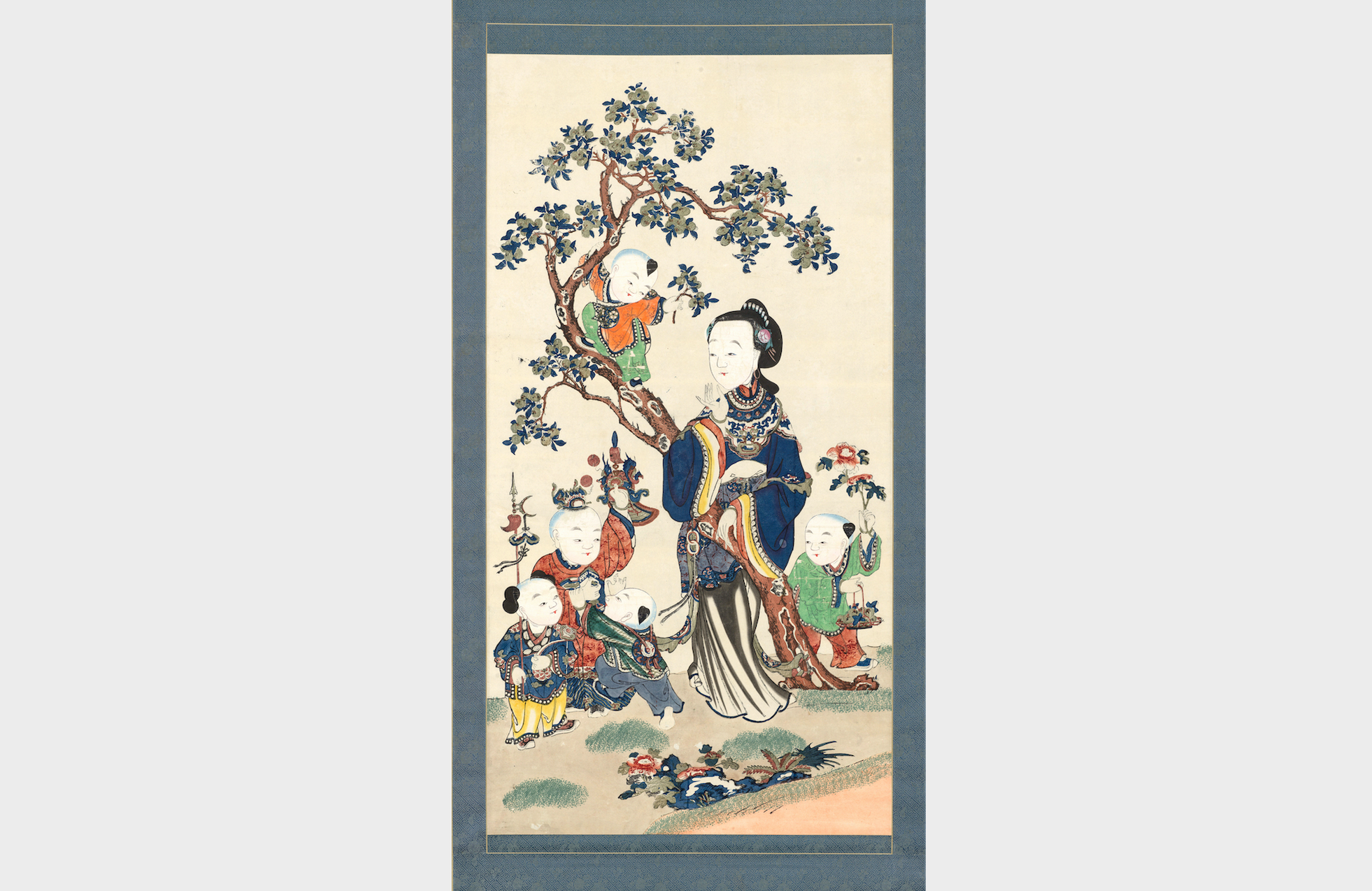
Eighteenth-century Noble Sons print from Suzhou in the Metropolitan Museum of Art, New York. It’s probably from late in the Gusu period as the European aspects are minimal, with only limited modelling on the skirt pleats and tree trunk
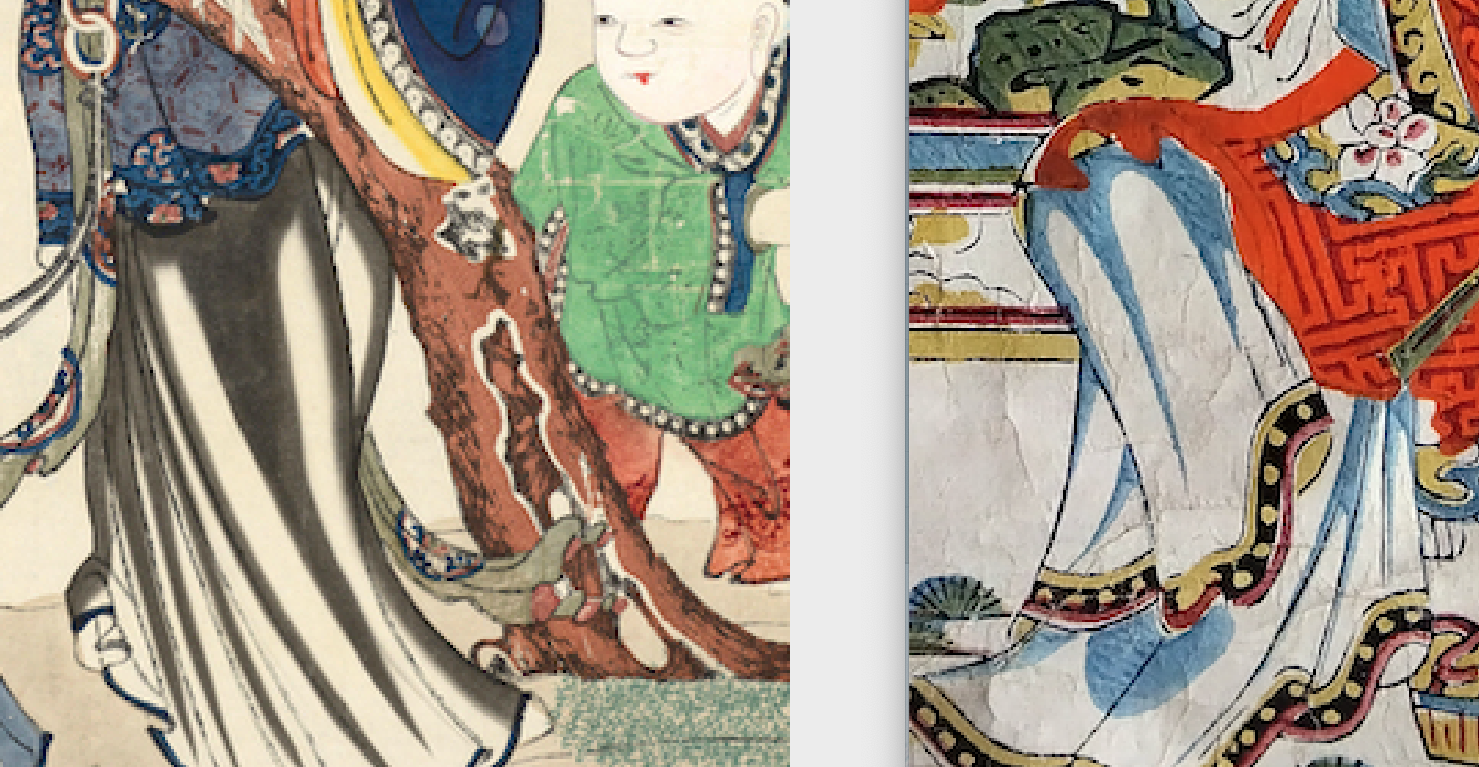
While Tantou is 1000km southwest of Suzhou the Tantou print is clearly based on the older Gusu version, right down to the shape of the trees. These similarities could imply there was a standard, widely-used format for this design, but the shading on the right-hand tree and the women’s skirts closely echo the Gusu print, and it’s tempting to wonder if Tantou artists actually copied it directly.
And finally to provenance. 1865 is a relatively early date to find a British missionary at Wuhan: the north-bank district of Hankou only opened to foreign occupation in 1860 and by 1865 there were just three establishments with a handful of missionaries between them. The most likely candidate is William Scarborough (1841–1894), whose dates in China fit exactly.
Born in Lincolnshire, Scarborough was in his mid-twenties when he arrived at Hankou to bolster the English Wesleyan Mission. He married Ann Shrewsbury at Shanghai in 1868, travelled as far afield as Chongqing and Fuzhou, and was perhaps the first European to visit the great Daoist mountain of Wudang Shan. Scarborough left China in May 1885 (a year or so after his wife died) and spent the rest of his life at Darlington, Northumberland.
Though staunchly Christian, Scarborough showed enough interest in traditional folk culture to publish an extensive collection of Chinese proverbs, and to write observant articles on popular religion for the Chinese Recorder. It wouldn’t have been out of character for him to have picked up these folk prints as curios.
Special thanks to Christer von de Burg
References
May You Soon Bear Noble Sons Gusu print at the Met, New York: https://www.metmuseum.org/art/collection/search/911824
Scarborough, William A Collection of Chinese Proverbs (American Presbyterian Mission Press, Shanghai 1875)
The Chinese Recorder and Missionary Journal (March–April 1874, July–Aug 1882, Sept–Oct 1882)
von der Burg, Christer Chinese Gusu Prints in the Christer von der Burg Collection (Cultural Relics Press 2026)