A Kitchen God Print for 1881
Here’s a Kitchen God print from 1881 which according to the seller came “from an estate of a family named French from New Haven, Connecticut.”
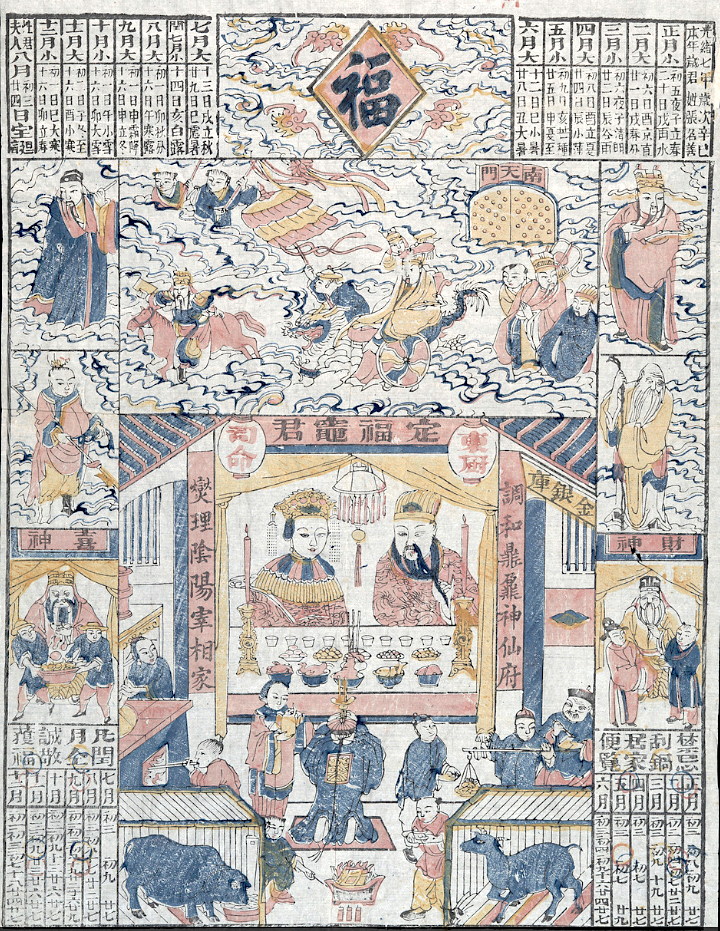
The Kitchen God – more accurately Zaojun (竈君), Lord of the Stove – in fact had little to do with the kitchen. He watched over the household, returning to heaven at New Year to report on whether the family has been naughty or nice. A week beforehand his print was taken down from its kitchen alcove and burned to send him on his way; it was usual to rub honey on his lips to “sweeten” his words (or to seal his mouth shut). A fresh print was installed on New Year’s eve. In some places Zaojun also served as patron deity to professional cooks – his one association with food.
As here, Kitchen God prints tend to follow a broad pattern: a calendar up top, a central panel showing Zaojun seated beside his wife, groupings of other deities, glimpses of domestic scenes and a treasure bowl in front glowing with ingots and gems.
But this print differs in details with those I’d seen before, some features suggesting a workshop in southern China. And when research began I couldn’t find a single example of another southern Kitchen God print, either online or in my own library. The majority come from Weifang in Shandong (濰坊), Henan’s Zhuxian Zhen (朱仙鎮) or Yangliuqing in Hebei (楊柳青).
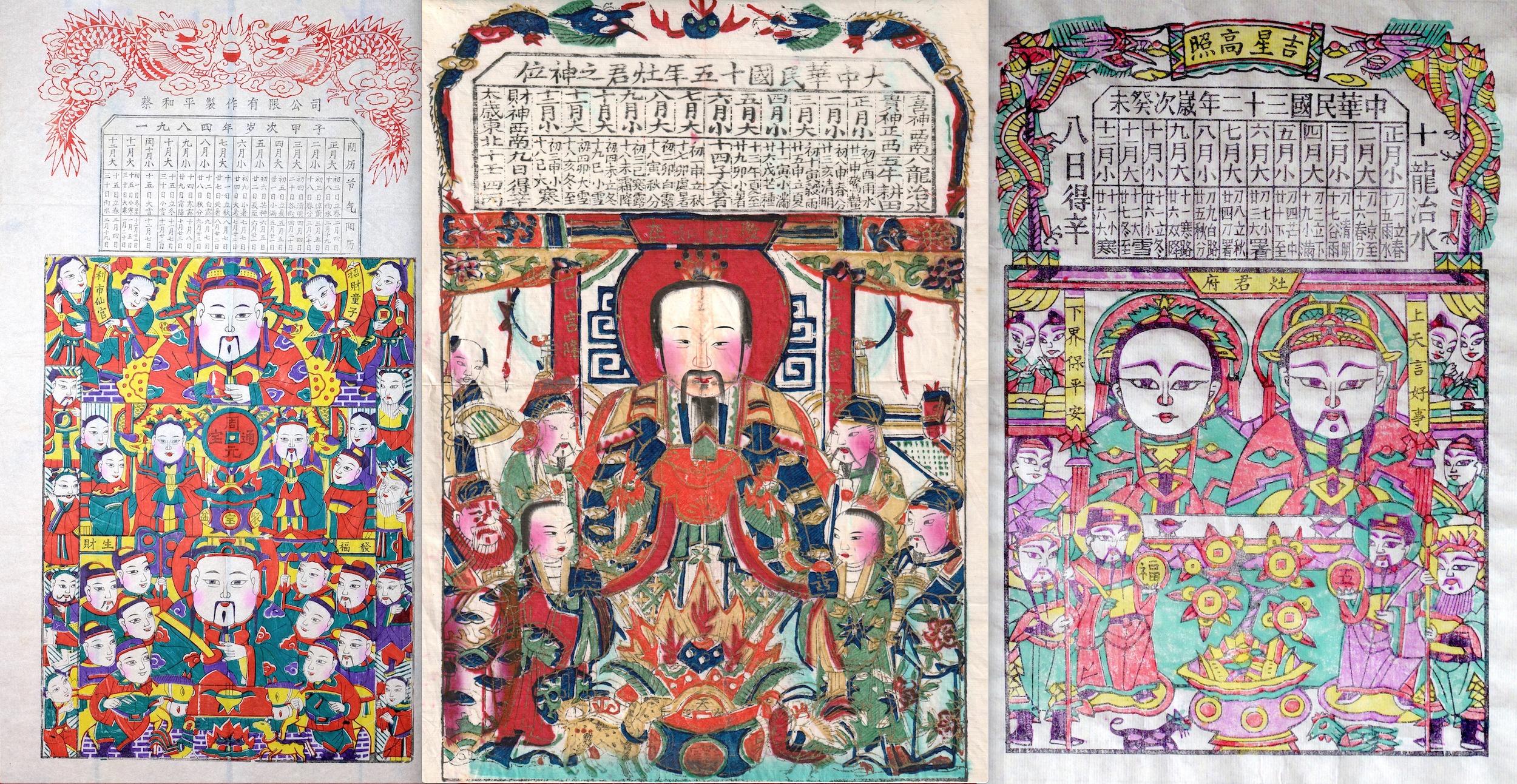
Three northern Kitchen God prints. Left to right: a large and complex version from Weifang, 1984, featuring Zaojun, his wife, wealth gods and the Eight Immortals; Yangliuqing 1926 without wife, but with Zaojun’s horse poking his head into the frame at right; and Zhuxian Zhen 1943 (modern reprint), kitchen maids preparing new year dumplings upper corners of the side panels. All three feature a calendar up top, and a flaming treasure bowl at the bottom flanked by a rooster and dog
Dating the print is straightforward. Text at top right reads 光緒七年, 歳次辛巳, “Seventh Year of the Guangxu emperor’s reign, xinsi year” (xinsi is the eighteenth year of the sixty-year Chinese calendrical cycle) – 1881.
The large upper panel shows the Jade Emperor riding his dragon chariot outside the southern gates of heaven (南天門). In front a heavenly messenger on a red horse carries an edict – perhaps representing Zaojun galloping heavenwards to deliver his report. Figures down the sides of the print include deities of longevity and wealth.
The main scene shows the head of the household with braided pigtail kneeling in homage to Zaojun and his wife, who sit behind an altar table loaded with offerings of food and drink. To the right of the altar, an official watches while gold is measured in a balance, under a banner reading “Gold and Silver Vault” (金銀庫) – most likely referring to the need to settle all debts (both earthly and spiritual) by the New Year. On the left, a woman cooks food in a wok while a servant gets the fire going underneath.
Meanwhile at the front children set off fire-crackers either side of a treasure basin to send Zaojun off in style, while a pig and goat watch from cages. Lower corner almanacs mark the months and days which are either taboo or auspicious.
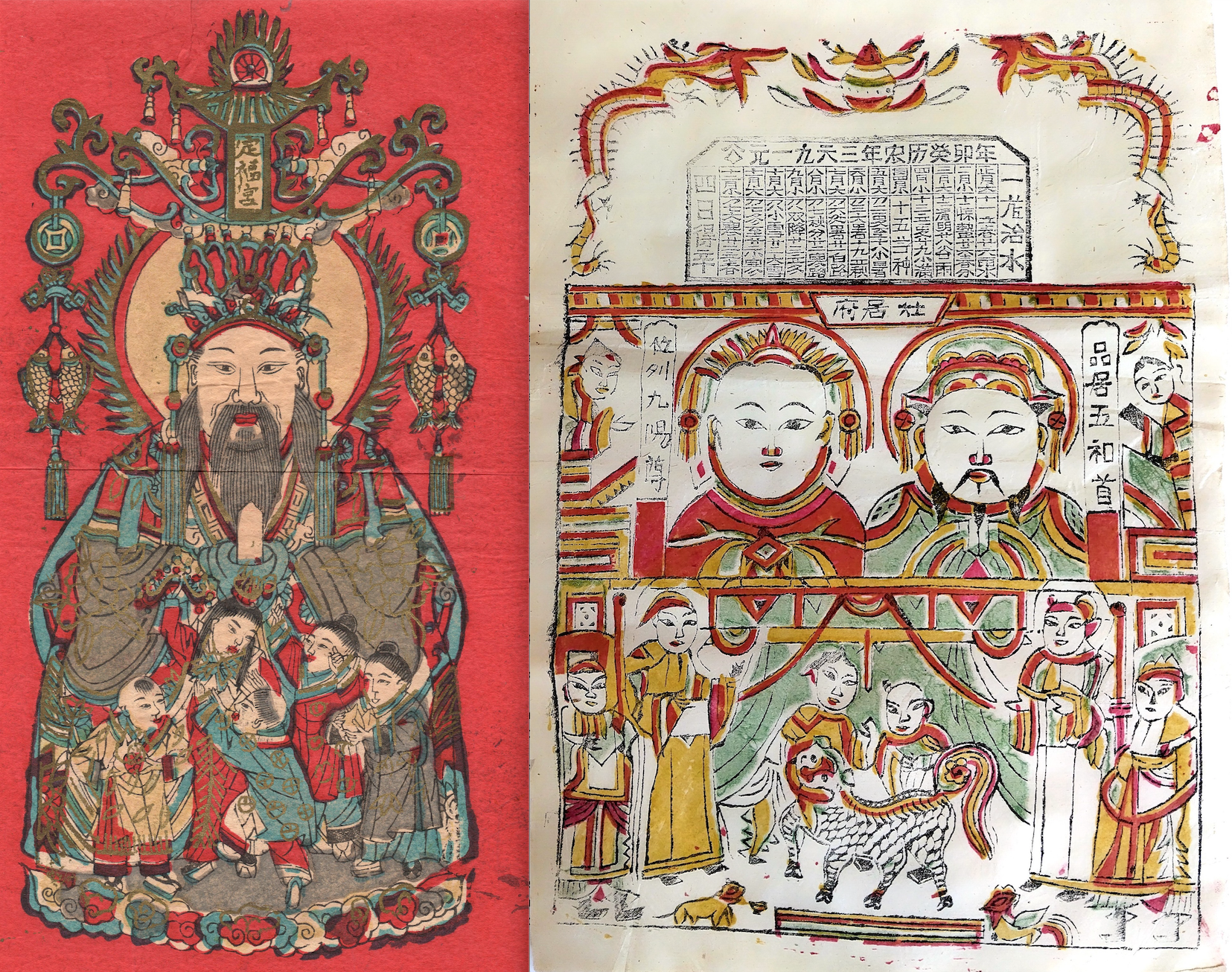
Two non-northern Kitchen God prints; note the lack of wealth basins. On the left from Shanghai c1930, missing a calendar and only identifiable as Zaojun by the vertical tablet reading 定福宮, Palace of Blessed Abundance, his residence. The right-hand print dated 1963 is a rough folk design from Sichuan, with mythical qilin (bringer of intelligent sons) plus the dog and rooster. The couplets 品居五祀首, 位列九陽尊 , “Ranked first amongst the five sacrifices, Honoured among the Nine Yangs” equates Zaojun with his ancient incarnation, Huode, the Fire Virtue deity
So why does this feel like a southern print? Firstly the free, sketchy lines reminded me of examples from Zhangzhou in Fujian. Then there’s the lack of a dog and rooster, household guardians always found on northern Kitchen God prints. Replacing them here are the pig and goat, two major sacrificial animals in China.
More specifically, the left-side panel of a warrior in pink robes with lowered halberd is the boy deity Nezha. While familiar across the country – he’s a major character in the sixteenth-century classic Investiture of the Gods (封神演義), not to mention the 2019 hit animation Ne Zha – Nezha is rarely worshipped outside southern Chinese communities. I have only ever seen him on woodblock prints from Guangdong and Fujian.
Language also possibly suggests a southern origin. The name tablet above Zaojun reads 定福竈君, something like “Zaojun of Blessed Abundance”. The couplets either side translate as “Harmonising ritual cauldrons in the immortals’ mansion, Regulating yin and yang in the Prime Minister’s residence” (調和鼎鼐神仙府, 爕理陰陽宰相家– a balancing of heavenly and earthly concerns which brings stability to the home). The phrasing of both tablet and couplets are most commonly found in Fujian and Taiwan.
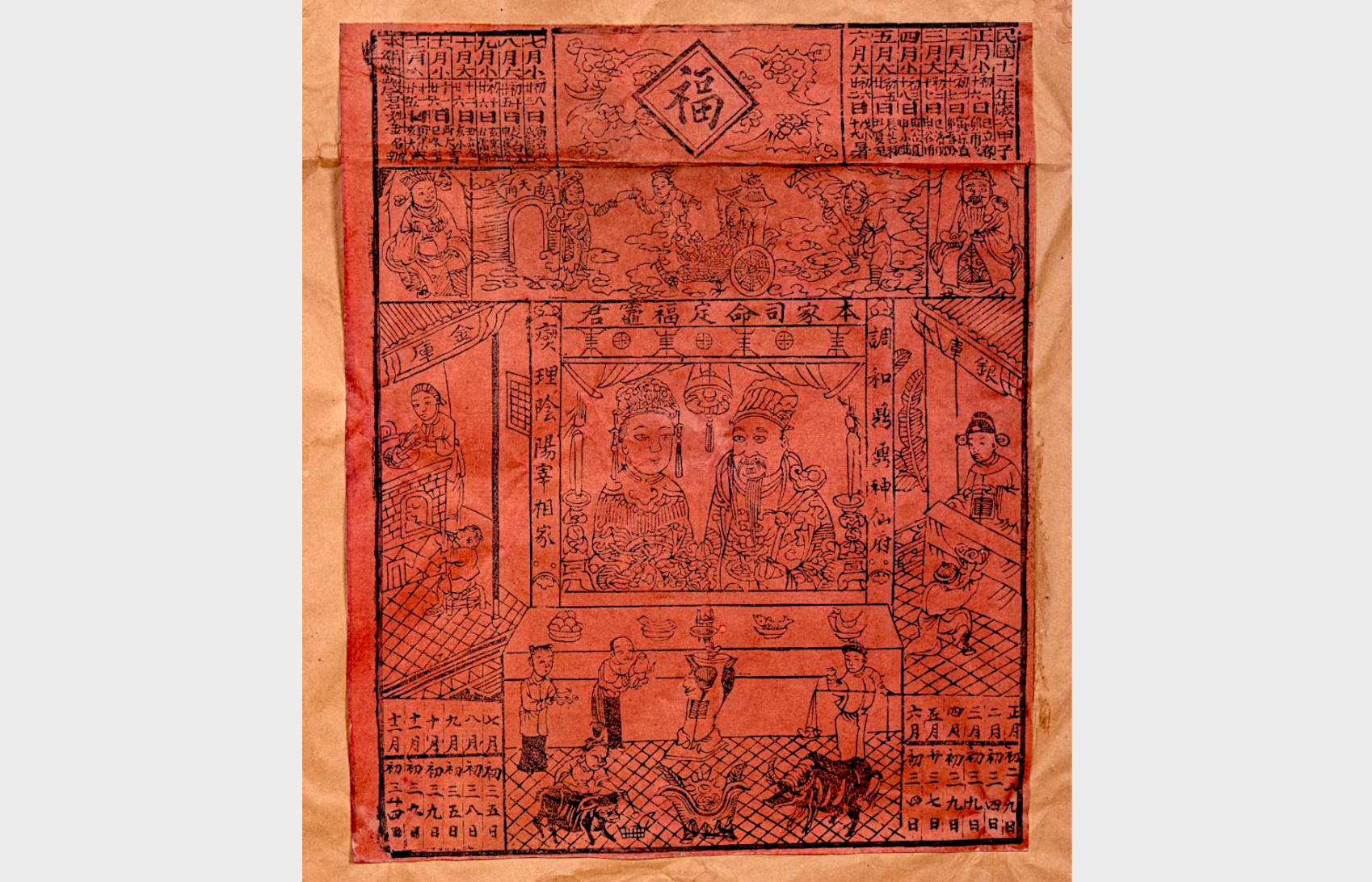
1924 version of the 1881 print – note red paper, banana leaves and water buffalo
I did eventually find a later incarnation of this print from 1924 (民國十三年). Along with banana leaves to the right of Zaojun’s shrine, the sacrificial goat lower right has been replaced by a water buffalo – both firmly locating the print in China’s tropical south. Using red paper for a monochrome print is again very common practice in the region.
So altogether I’m pretty certain that my 1881 Kitchen God is a southern Chinese design, most likely from Fujian.
On a completely different tack, the fact that this print came from the estate of a prominent Connecticut family might link it to the Chinese Educational Mission of 1872–1881. Set up by Yale graduate Yung Wing (容閎; 1828–1912), the Mission was an experiment to have 120 young Chinese receive modern schooling in the US. Students were farmed out “among some of the best families in New England”, including in New Haven.
According to the New Haven Evening Register for July 15, 1880 “The highest rank in the class graduating this year from Hopkins’ Grammar School was attained by a Chinaman, Yan Phou Lee”. (Lee later graduated from Yale and published a memoir, A Boy in China.)
Though the CEM programme was terminated abruptly in 1880 – after an undercover Chinese investigation found that participants had too thoroughly embraced foreign culture – some students kept in touch with their host families after returning to China. Perhaps one of them sent this print back as a gift the following year.
Thanks to Otoko Han, Ronni Pinsler and Angela Sim
Sources
Burkhardt, Valentine Chinese Creeds and Customs (three volumes in one; Chenming Press 1978)
Chen Chi-lu and Huang Tsai-lang Traditional Woodblock Prints of Taiwan (台灣傅統版畫源流特展; Taipei Fine Arts Museum 1985)
Cheng Wen-Chien and Jiang Yanwen Gods in My Home: Chinese Ancestor Portraits and Popular Prints (Royal Ontario Museum 2019)
Laing, Ellen Johnston Art & Aesthetics in Chinese Popular Prints: Selections from the Muban Foundation Collection (University of Michigan 2002)
Po Sung-Nien and Johnson, David Domesticated Deities and Auspicious Emblems (Chinese Popular Culture Project 2, 1992)
Shaffer, Barbara Celestial Vision: China’s Scholars in the Connecticut Valley (Redex Report, Volume 8, Issue 4, November 2013)
Pinsler, Ronni and Stevens, Keith bookofxianshen.com (Zao Jun; P8215)