Shen Shu and Yu Lei 神荼郁壘
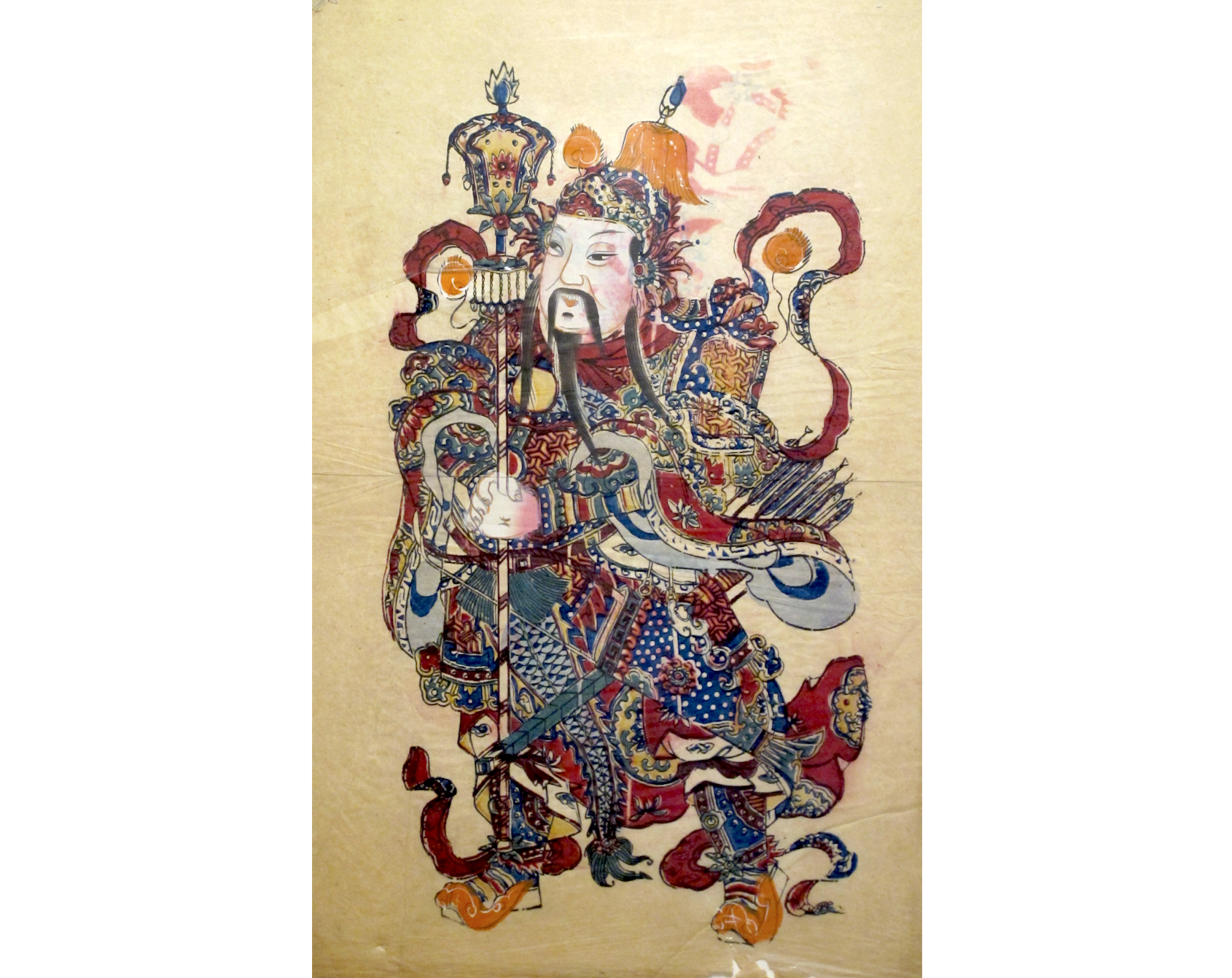
Shen Shu, not Qin Qiong – though both have calm, pale faces in contrast with their fierce, red-faced partner door gods
Here’s a door god from Yangliuqing, the prolific woodblock printing village west of Tianjin in Hebei province. It would originally have been one of a pair – the other being a warrior facing right, with bulging eyes and red face.
I’ve always assumed that this pair represented familiar China-wide gate guardians, the deified generals Qing Qiong and Yuchi Gong (秦瓊; 尉遲恭). The story goes that the seventh-century emperor Taizong posted these two outside his bedroom door to scare off evil spirits who were plaguing him with nightmares. This worked, but obviously the generals couldn’t stand there forever, so Taizong had their portraits hung on his doors instead – which proved just as effective.
But one of the problems with door god prints is that they all follow pretty much the same design right across China – so without insider knowledge it’s impossible to know whether you’re looking at Qing Qiong and Yuchi Gong or a local pair with their own back-stories. And in this case another Yangliuqing print has the same figure holding a mace with the name Shen Shu (神荼) written on it.
Shen Shu – and his companion Yu Lei (郁壘) – are very old deities indeed, dating back at least two thousand years to the Han dynasty. Contemporary texts describe them guarding the entrance to hell, defending humanity by catching emerging evil spirits and feeding them to tigers (also protective figures in Chinese mythology).
So it seems that the once widespread door gods Shen Shu and Yu Lei were supplanted in the popular mind by Qin Qiong and Yuchi Gong, except – for unknown reasons – around Tianjin and a few other places.
References
Laing, Ellen Johnston Divine Rule and Earthly Bliss: Popular Chinese Prints (Museum für Asiatische Kunst / nicolai 2010)