Fourteen Pandas
Early 2026 found me up in the mountains of western Sichuan watching a wild giant panda which had wandered into view.
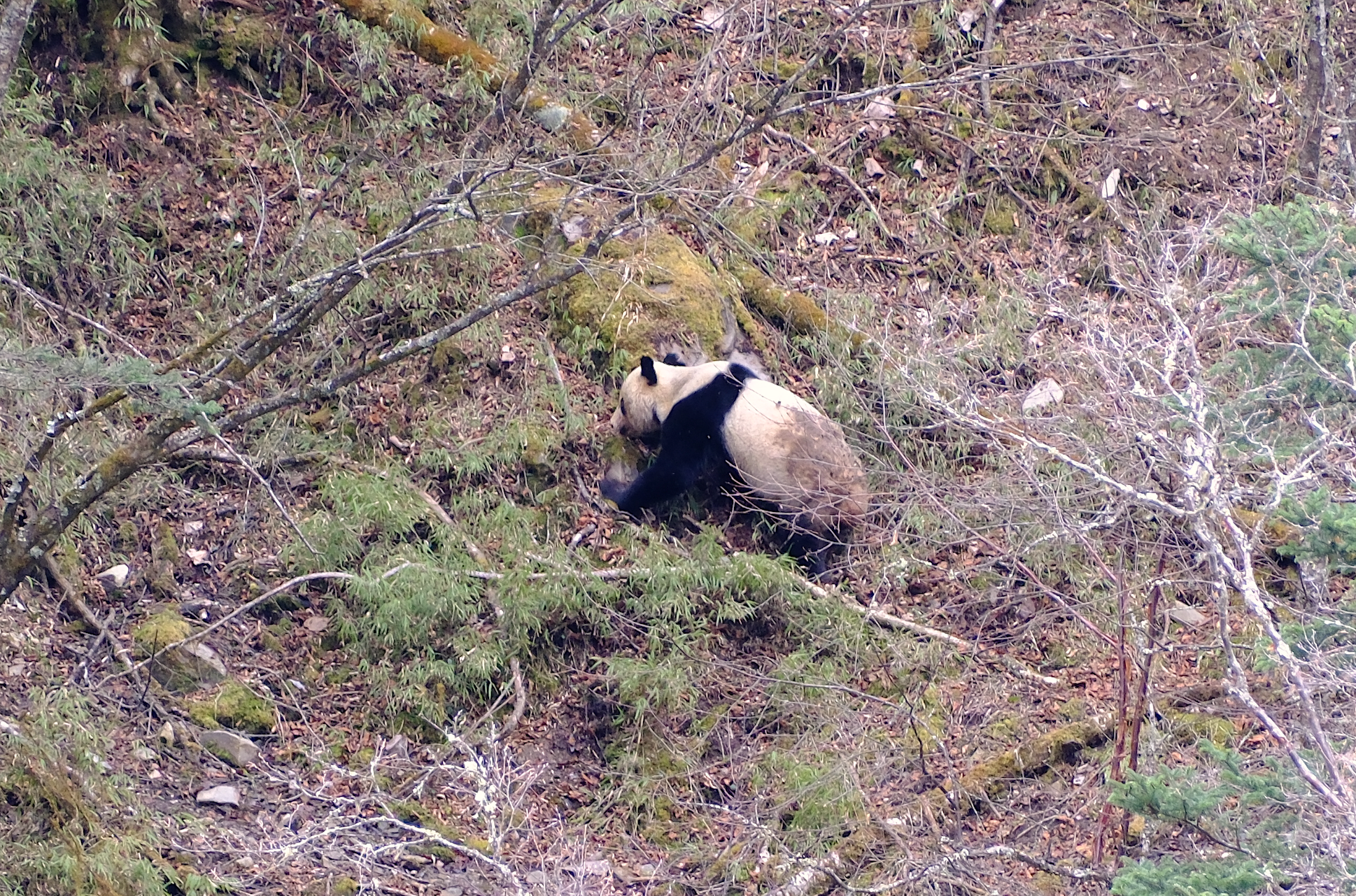
In two hours, this was virtually the only sighting I had of the panda moving. Most of the time it was half-hidden by bamboo and other vegetation. A young bear, about three years old and two-thirds grown
Giant pandas are endemic to China, where their ancestors roamed some 2.4 million years ago. Once fairly widespread across lowland regions, they are now restricted to the mountainous borderlands of Yunnan, Sichuan and Shaanxi provinces at altitudes of 1200m–4100m.
Pandas have a carnivore’s teeth and gut but live almost exclusively on bamboo; their modified wrist bone acts as a thumb for gripping bamboo stems. This diet provides very little nutrition and they have to spend most of their waking lives eating. The one I watched sat back and ate all the bamboo within reach before getting up and moving just a few metres to the next suitable clump, where it slumped and resumed its meal. And so on for two hours.
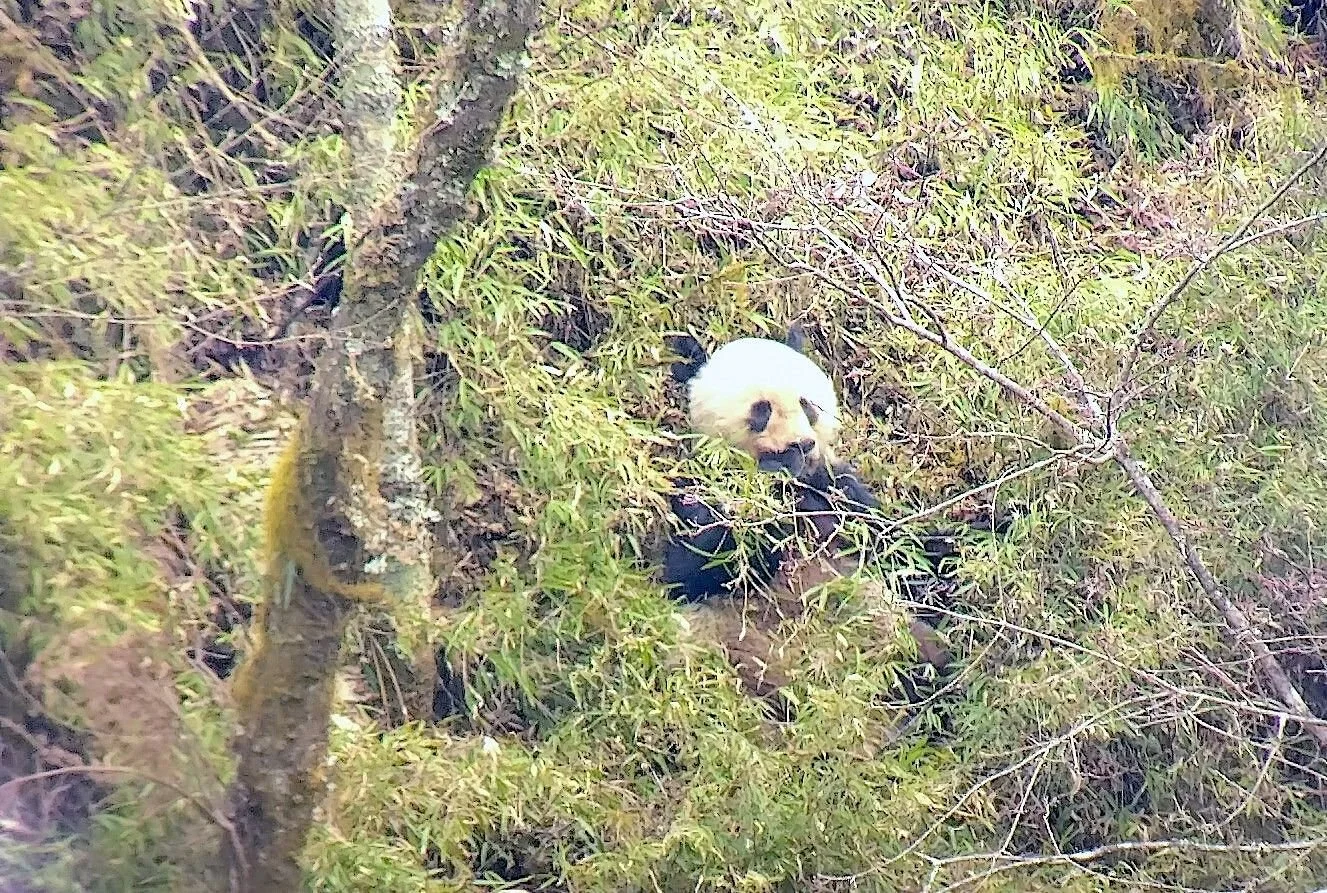
An idea of why it’s so hard to see pandas in the wild, as they sit buried in head-high undergrowth
Needing unfettered access to their food source each panda occupies a fair-sized territory and lives a solitary existence, only meeting up to mate. They don’t invest much effort in reproduction either, giving birth to an almost embryonic infant; if it dies the mother hasn’t wasted the energy needed to bring a more developed baby to term. If this makes them sound inefficient, panda habitat couldn’t support a dense population so their low birthrate makes evolutionary sense.
Despite its remote homeland such a distinctive animal must have been long familiar to locals, though references in Chinese historical literature are sketchy – the best candidate is the bicoloured, bamboo-eating mo (貘) from Sichuan described in Li Shizhen’s sixteenth-century Materia Medica (李時珍: 本草綱目). However, a panda skeleton found in 2021 buried with Emperor Wen of Han (漢文帝; 203BC–157BC) suggests that they were known over two thousand years ago at the Chinese capital, Chang’an (Xi’an) – only just beyond their present northernmost limit, Shaanxi’s Qinling mountains.
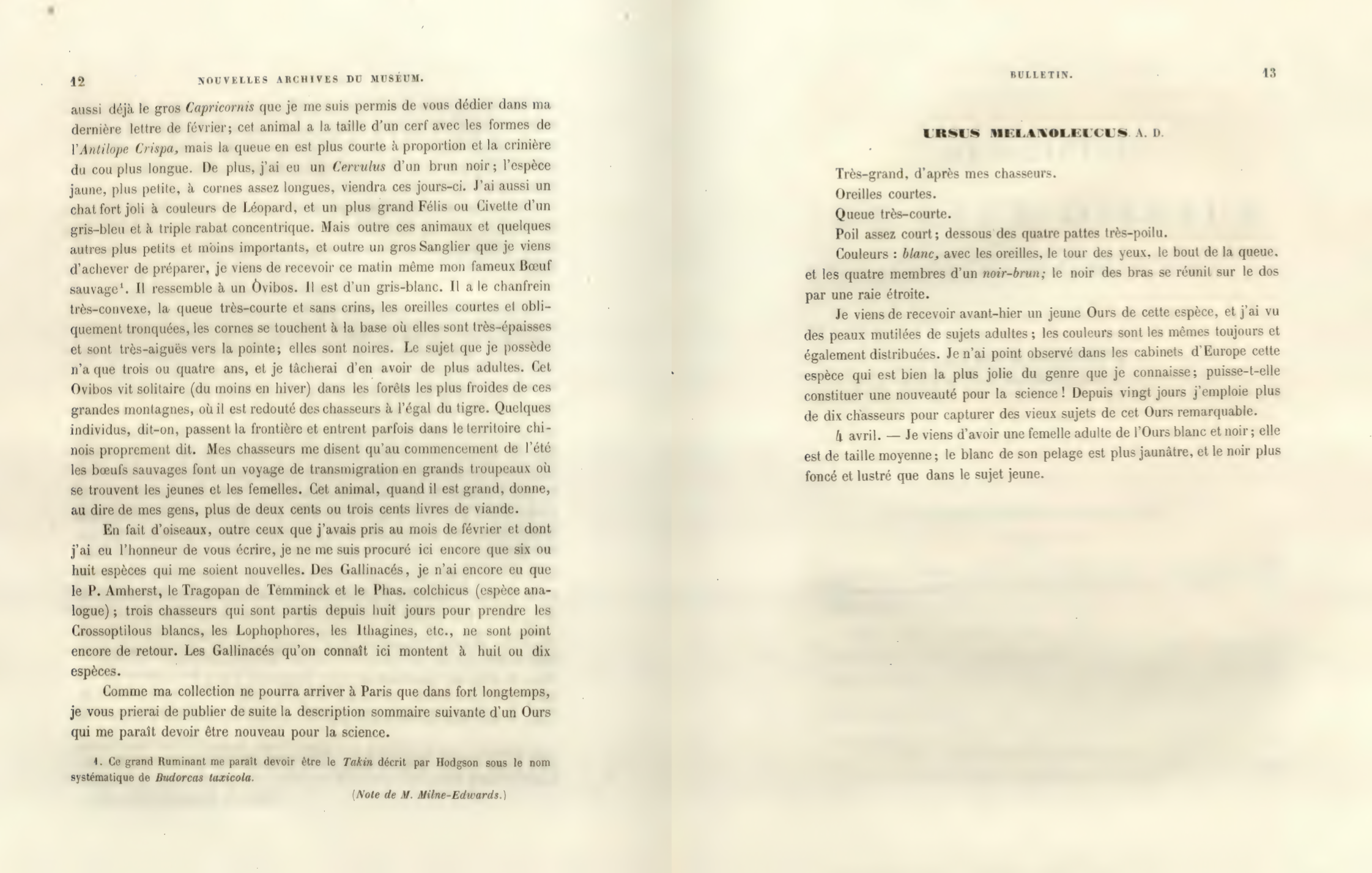
Armand David’s original description in his article Voyage en Chine, published in the Bulletin of the Nouvelles Archives du Museum d’Histoire Naturelle de Paris, 1869
News of the giant panda’s existence first reached Europe through the nineteenth-century French missionary and naturalist Père Armand David. On 21 March 1869 David was at Muping (穆坪镇) in western Sichuan:
The country where I find myself and where I intend to stay for nearly a year is a dreadful region of steep, sharp mountains piled one upon another... I have worked well in these first three weeks and have put a good number of hunters on the trail of the animals that inhabit these forests... [and] I would ask you to publish immediately the following brief description of a Bear that appears to me to be new to science:
URSUS MELANOLEUCUS: Very large, according to my hunters. Short ears. Very short tail. Fairly short fur; very hairy undersides of all four paws. Colours: white, with the ears, the area around the eyes, the tip of the tail, and the four limbs a dark brown; the black of the arms joins the back with a narrow stripe.
I just received a young bear of this species the day before yesterday, and I have seen mutilated pelts of adult specimens; the colours are always the same and evenly distributed. I have not observed this species in any European collection; it is by far the most beautiful of the kind I know.
The adult and cub collected by David are on display at the Muséum National d’Histoire Naturelle, Paris.
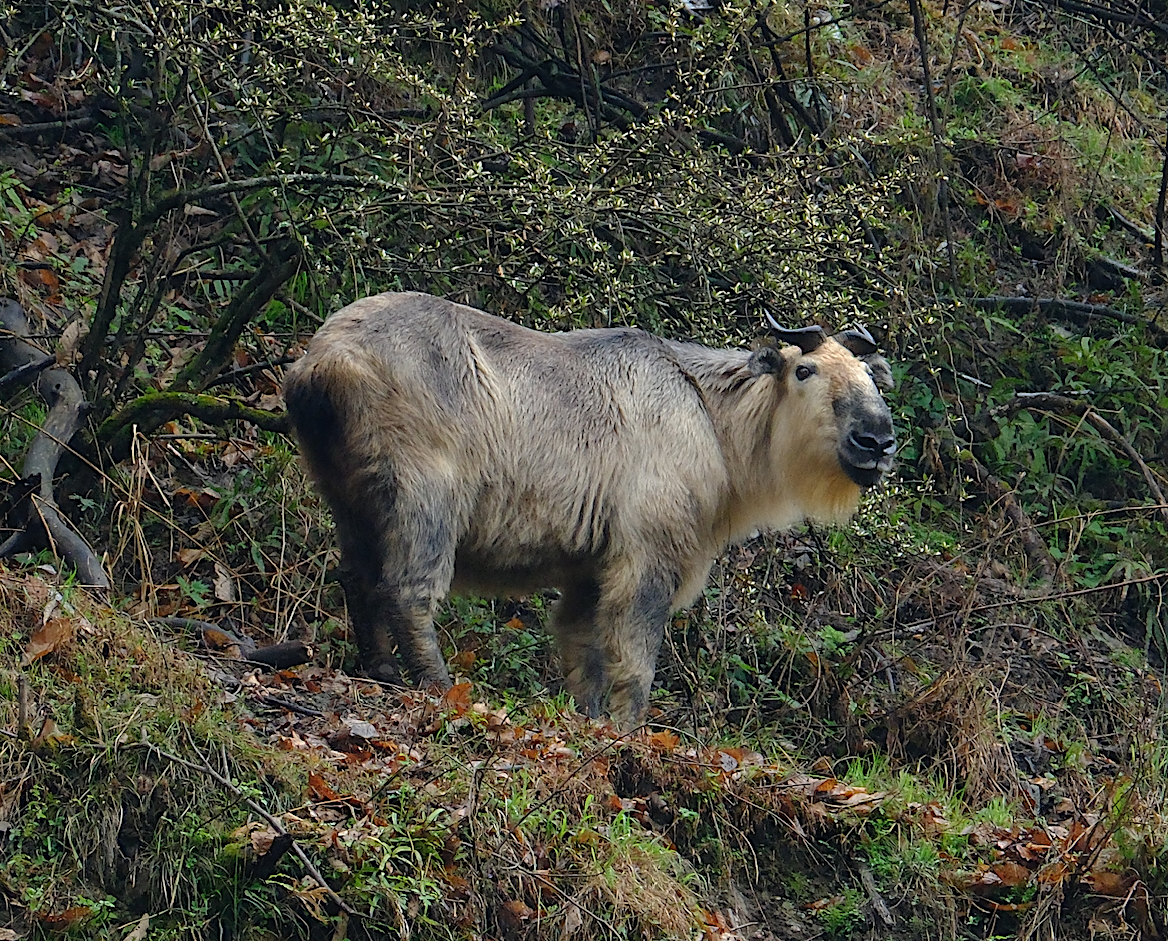
Takin, described by David as a fierce “wild ox” much feared by his hunters. Once considered as rare as the giant panda, but that’s another story…
The word “panda” is thought to derive from Nepalese, coined by the French zoologist Frédéric Cuvier in 1825 for the smaller, unrelated but structurally similar red panda. David’s Ursus melanoleucus means “black and white bear” but after debating whether pandas were in fact bears, the name was changed to Ailuropoda melanoleuca, “black and white cat-foot”. The modern Chinese “big bear-cat” (大熊猫), covers both contingencies. (In 1985 molecular biology proved that giant pandas are indeed true bears.)
It was over forty years before anyone added much to David’s information. In 1913 British botanist Ernest Wilson published notes on the giant panda compiled during plant-collecting trips through central and southwestern China 1899–1910. Wilson knew “no record of a foreigner having killed a specimen... no foreigner has so far seen a living example”. Although he had come across pelts used as floor rugs, these had all been caught accidentally in traps set for other animals; it seemed that pandas were never deliberately hunted as they were too scarce and their habitat extremely remote and rugged. Locals called them baixiong (白熊; “white bear”) and believed they ate nothing but bamboo – something Wilson doubted – and hibernated (they don’t).
Then at some point in April 1914, during a two-year zoological expedition to China, German ethnologist Walther Stötzner became the first Westerner to see a live bambusbär (“bamboo bear”), after a cub was brought to him by hunters:
A small human child could not be cared for more carefully than I cared for that adorable little bear, which looks like a ball of wool but is marked exactly like the adults. Clumsily, the little bundle of joy stumbled around on his short legs on his soft, warm cloth bed in the house. But to everyone's sorrow, he soon died. He refused the lukewarm milk, which I gave him diluted to protect his stomach, as well as a thin flour gruel. I tried desperately to find a human wet nurse for him, but ... before the wet nurse was found, the little creature was dead – an animal which, had it been brought alive to Europe, would have been one of the expedition's greatest triumphs.
In all, Stötzner obtained six giant panda skins. One is on display in the Naturhistorisches Museum, Basel, with another two (including the cub) in the Zoologischen Museum der Universität Zürich. The British Museum also has a single skin from this expedition.
Once pandas had been seen alive, it was only a matter of time before somebody wanted one dead. An early effort was made by George Pereira, a former British officer who had seen service in China and was known as “Hoppy” after a hunting accident left him lame. In 1921 Pereira spent five months living rough in the mountains west of Qionglai (邛崃) in Sichuan, hoping to shoot a “giant pandar”; the closest he came was finding panda droppings. Pereira finally shot a red panda before heavy winter snows ended his expedition.
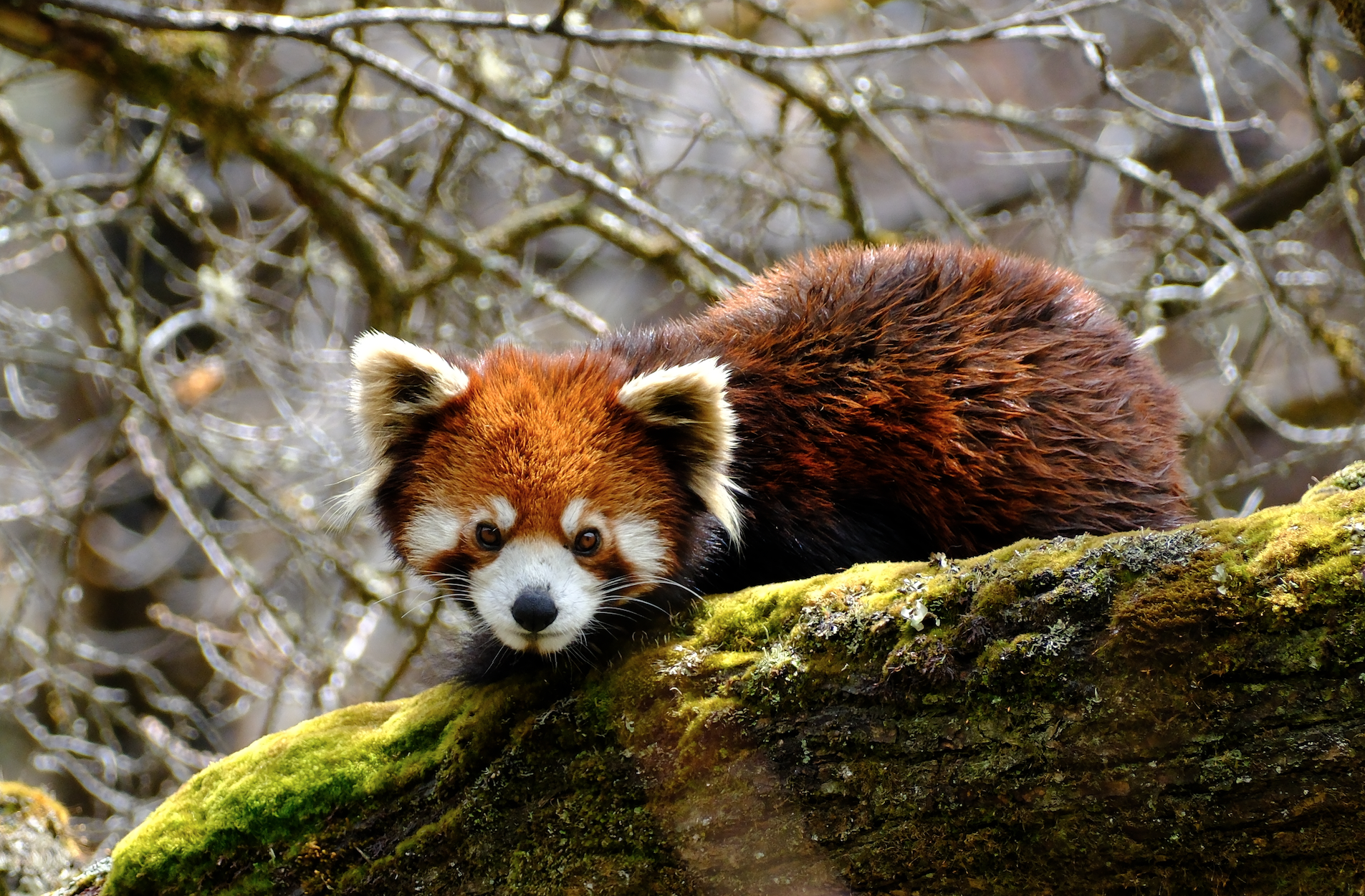
Red panda, about the size of a large domestic cat. Also eats bamboo but arboreal and otherwise unrelated to the giant panda
The first Westerners to actually bag a giant panda were the brothers Kermit and Theodore Roosevelt, sons of the former US president. Their hunting trip through southwestern Sichuan brought them down into Liangshan (凉山), the Cool Mountains, near the border with Yunnan. On Saturday 13 April 1929, the guide frantically waved Kermit over:
As I gained his side he pointed to a giant spruce thirty yards away. The bole was hollowed, and from it emerged the head and forequarters of a beishung. He looked sleepily from side to side as he sauntered forth. He seemed very large, and like the animal of a dream, for we had given up whatever small hopes we had ever had of seeing one. And now he appeared much larger than life with his white head with black spectacles, his black collar and white saddle. ... As soon as Ted came up we fired simultaneously at the outline of the disappearing panda. Both shots took effect. ... He was a splendid old male, the first that the [local Yi people] had any record of as being killed in this region.
The Roosevelts also obtained another complete skin, both now mounted and on display at the Field Museum’s Hall of Asian Mammals, Chicago.
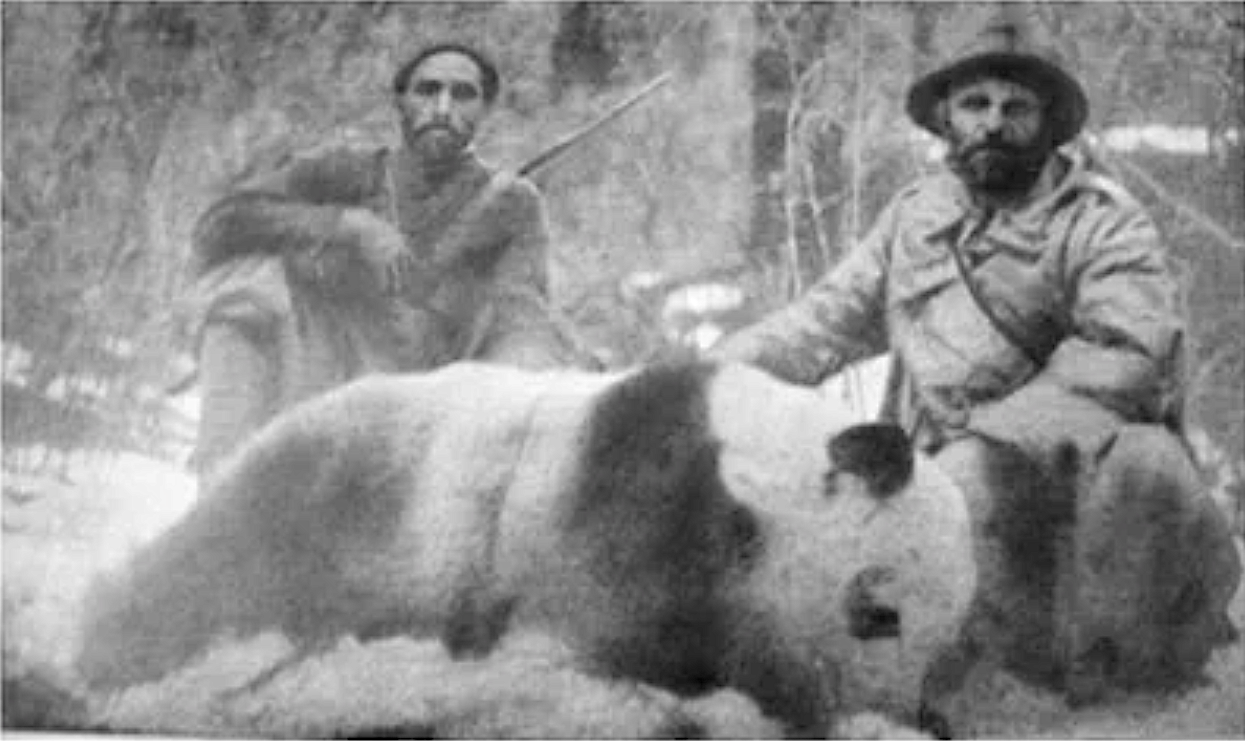
Teddy Roosevelt, hunter Mohkta Lone, and trophy. From the Roosevelts’ travelogue “Trailing the Giant Panda”
At least four other Westerners picked off pandas through the early 1930s: Ernst Schäfer, German zoologist, future Nazi SS officer and member of Brooke Dolan’s Central Asia Expedition (Stötzner was in the party too, finally seeing a live panda in the wild; Schäfer’s skin went to the Academy of Natural Sciences, Philadelphia); Americans Dean Sage and William Sheldon, who together shot a single panda for the American Museum of Natural History; and Captain Henry Courtney Brocklehurst, former cavalry officer, WWI fighter pilot, explorer and Game Warden of the Sudan. Heavy snow bogged Brocklehurst down for weeks, but one morning:
I saw an unusually large panda gazing at me from an eminence 15 feet above me and not 20 yards away. Signalling frantically for the coolie who was carrying the rifle I scrambled as best I could after the animal. It was like night under the trees, and almost impossible to distinguish a vital spot for the only shot I was likely to get ... Suddenly however the animal stopped and turned, and I took careful aim and killed him instantaneously with one bullet in the neck.
In November 1937 Brocklehurst’s mounted specimen appeared at a hunting exhibition held in Germany hosted by Nazi Aviation Minister Hermann Goering.
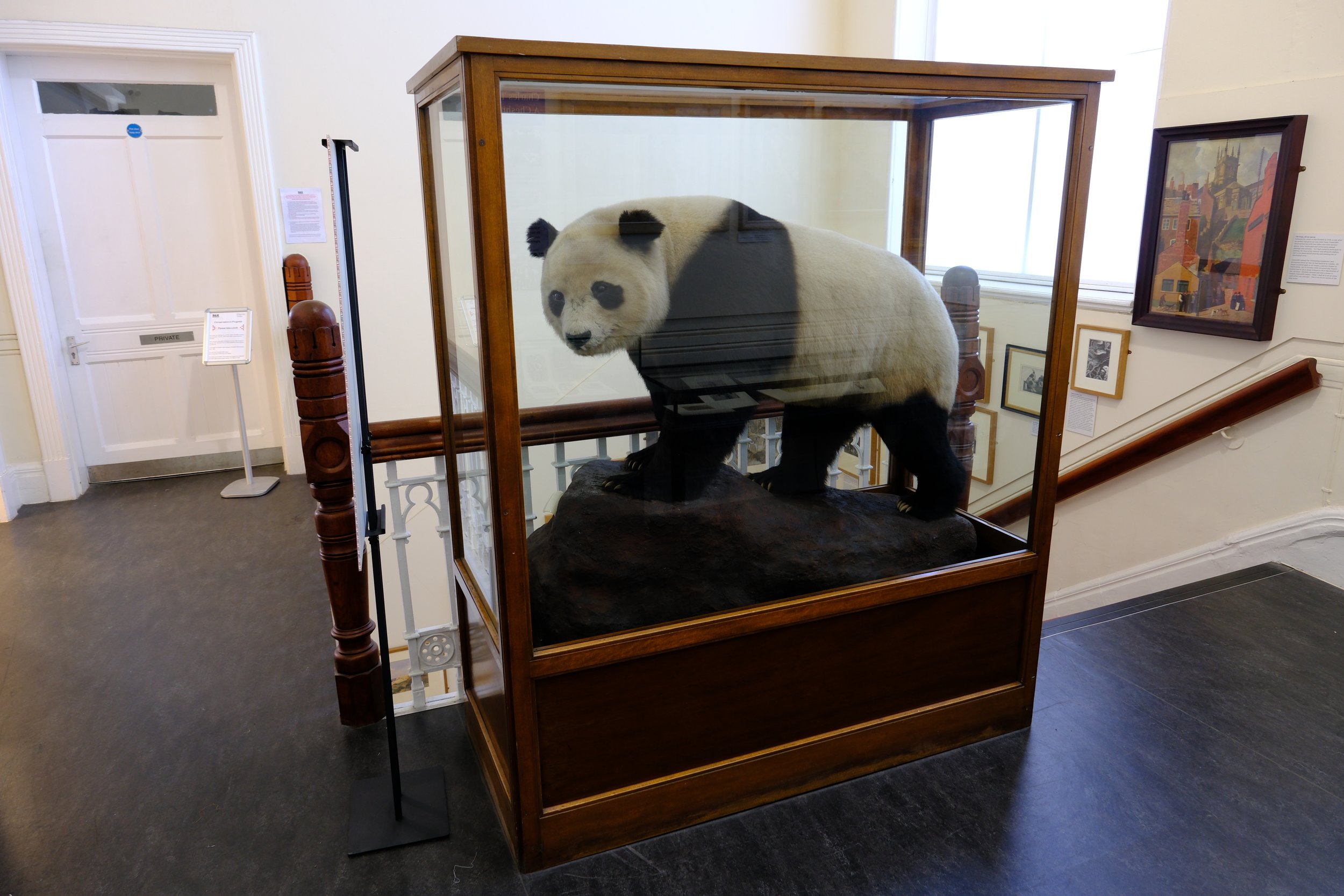
Brocklehurst’s panda upstairs at the Silk Museum, Macclesfield
While museum collections were rapidly filling up on skins, zoos wanted a live panda. The first people to try were Americans Bill Harkness and Lawrence Griswold, who had previously supplied the Bronx Zoo with Indonesian komodo dragons and in 1935 headed to China on a panda quest. Their local fixer was Floyd Tangier Smith, a former banker long resident in Shanghai and leader of the productive 1930–1932 Marshall Field Zoological Expedition to southwest China.
But when Harkness died of cancer in early 1936, his wife Ruth – a New York socialite who by her own admission “hardly knew one end of a gun from another” – took over the expedition. Dispensing with Smith and Griswold she gathered her own team under Westernised Chinese Quentin Young, headed to Sichuan and incredibly managed to capture a panda cub, which she claimed had been deserted by its mother (nursing pandas are now known to leave their cubs for lengthy periods while they go foraging).
Ruth Harkness was unusual in actually being on the spot when this panda – christened Su-Lin – was caught. Few foreign collectors were so directly involved; they generally set up base camp at some mountain village or farmstead, from where local hunters with packs of dogs were dispatched to do the actual tracking and trapping. As reported by Reuters news agency, Smith stated that capturing a panda was a simple as chasing them for a few hundred yards, when they became exhausted and could be easily tied up. He also used steel traps.
Harkness bottle-fed Su-Lin, registered him as a dog, bribed officials for an export license, and sold him to Chicago’s Brookfield Zoo for US$14,000 – around ten times the average annual US wage (she had expected far more, however). An estimated 35,000 people came to see Su-Lin on first day alone, and 320,000 before he died in 1938 from “choking on a twig” – today he’s on display at the Field Museum of Natural History, Chicago.
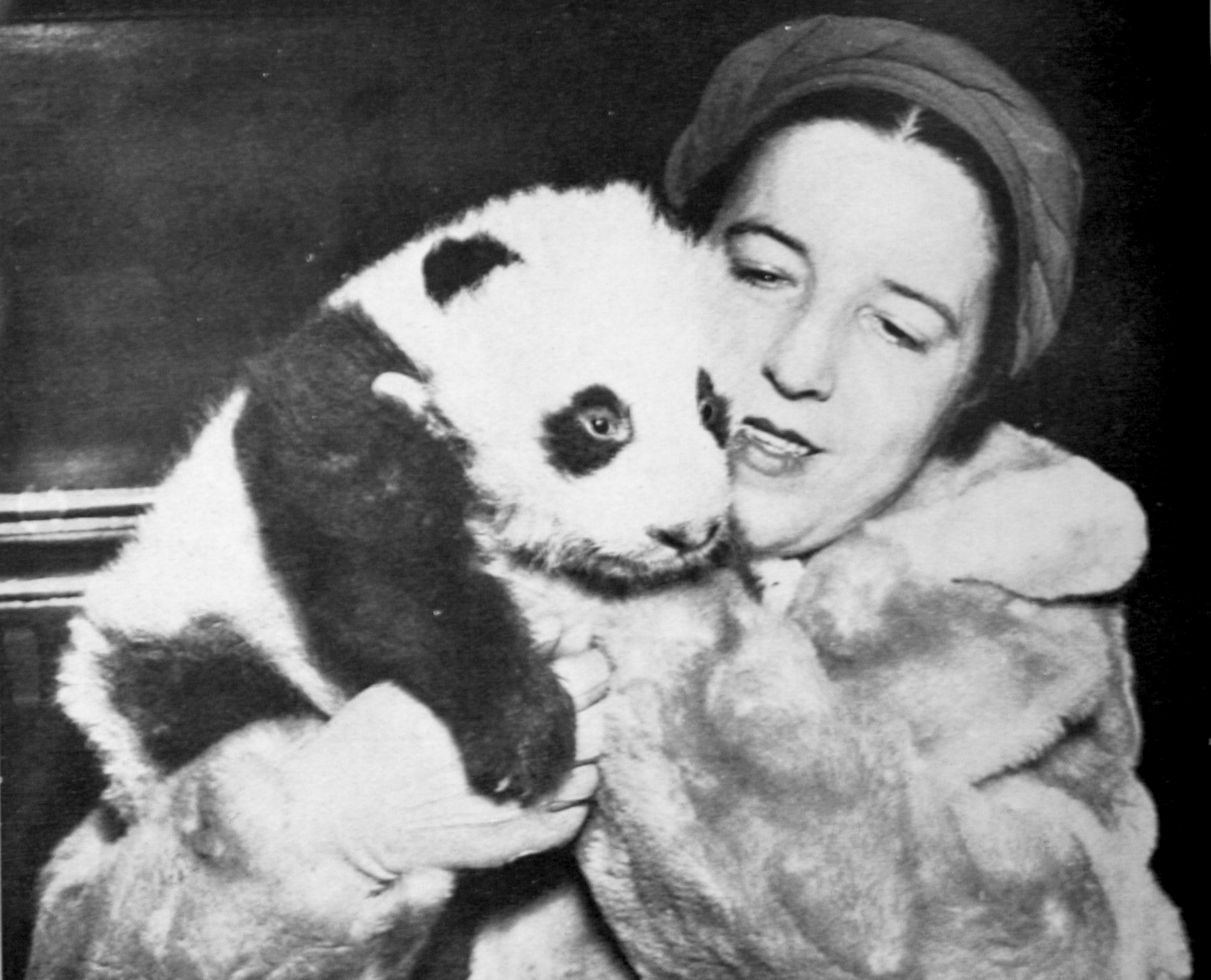
Ruth Harkness and Su-Lin, from the pages of The China Journal. Harkness believed the cub was a female, and it was only after the panda’s death that an autopsy proved otherwise. The sex of several of the 14 wild pandas caught before 1949 was similarly misidentified
The success of complete novice Harkness infuriated Smith, who now dispatched hundreds of “medicine collectors, charcoal burners and bamboo cutters” into the mountains with orders to trap at least twenty pandas. When Ruth Harkness returned to Sichuan in 1937 and netted a second cub without his help, Mei-Mei, Smith accused her of buying the beast from his own hunters. (Mei-Mei was also sold to Brookfield Zoo, drawing 42,000 visitors on the first day; he died in 1942.)
Other surprising competitors emerged too – US and Canadian missionary staff from the multi-denominational West China Union University (WCUU) at the Sichuanese capital Chengdu. In 1938 professor Frank Dickinson bought Pandora off hunters for the Bronx Zoo (she appeared the following year at the New York World Fair, and died in 1941). The WCUU campus was to become something of a holding pen for captured pandas, as they waited to be shipped down to the coast and overseas.
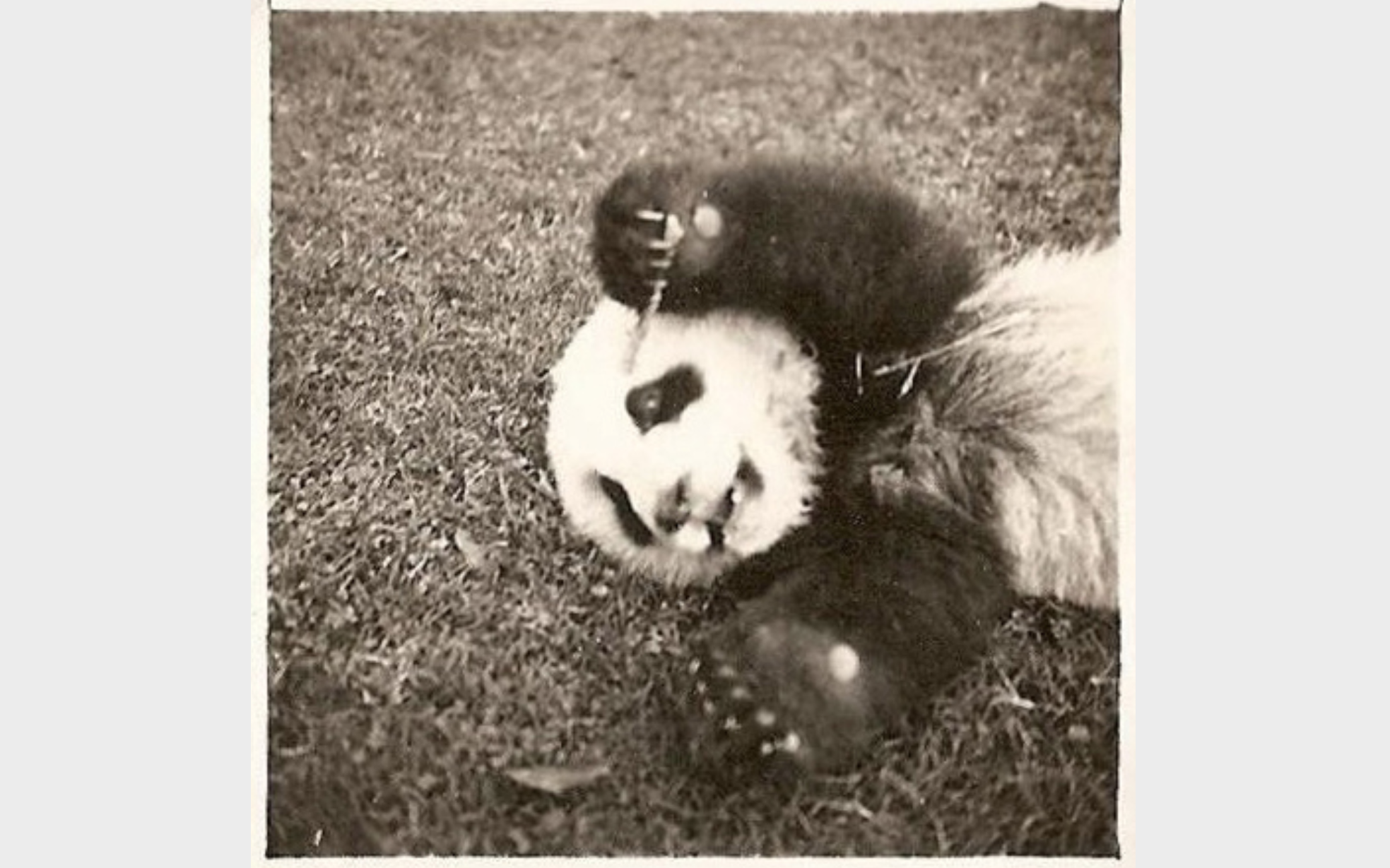
Pandora at the WCUU in Chengdu, April–May 1938*
Despite the competition, by 1938 Smith had obtained at least eight pandas. Two of them died shortly after capture, another in transit to Hong Kong, but three – Tang, Sung and Ming – lived long enough to reach London Zoo where Ming became a wartime celebrity, visited by future queen Elizabeth. Sung and Tang died in 1939 and 1940 respectively, while Ming survived until 1944. Smith’s fifth panda Happy went to St Louis (d. 1946), while Grandma succumbed on arrival in London and ended up on display at Leeds Museum. The skulls of Sung, Ming and (possibly) Grandma are preserved at the Royal College of Surgeons’ Hunterian Museum.
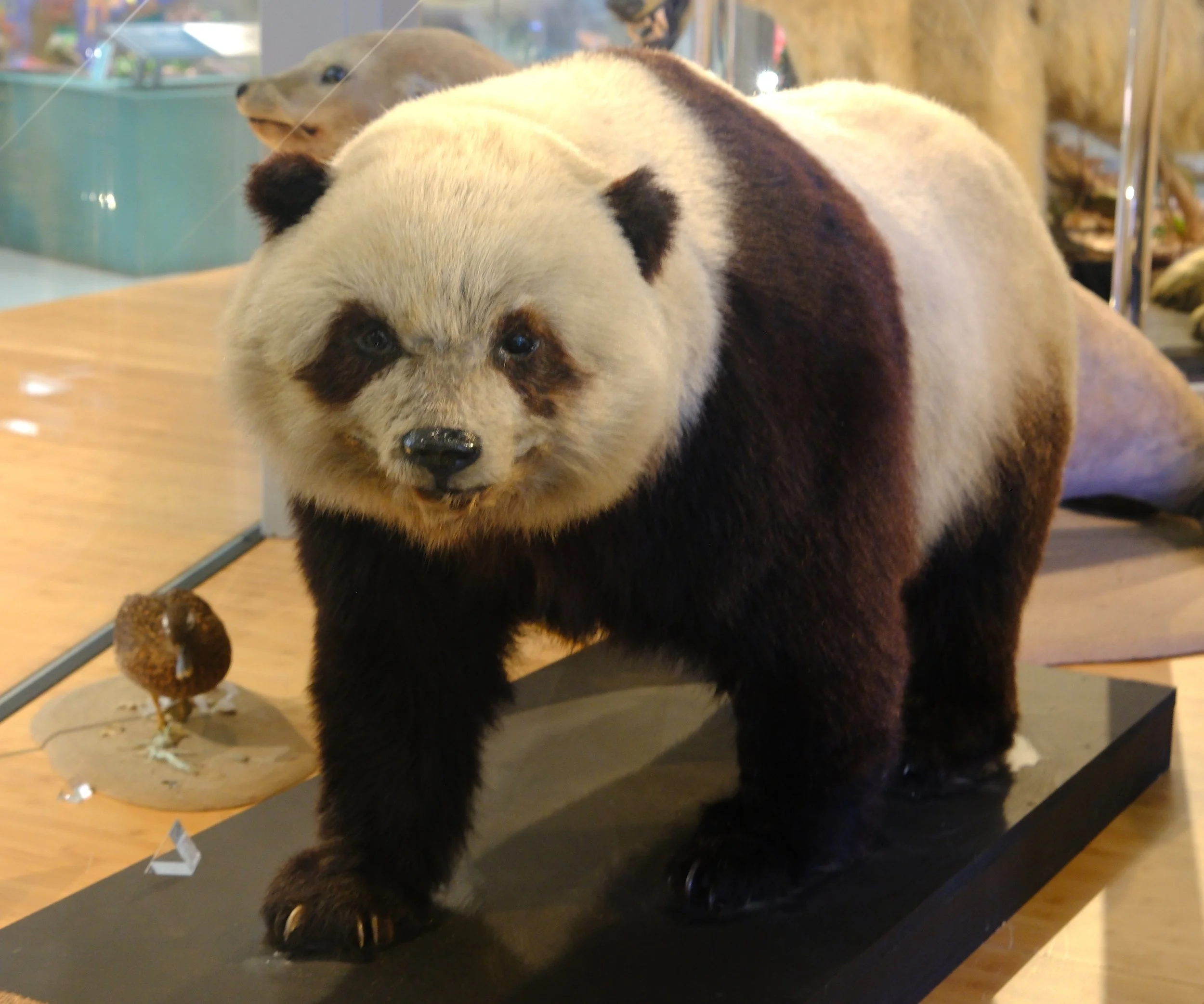
Grandma in Leeds Museum. Probably. In 2022 another panda surfaced in the US from Floyd Tangier Smith’s estate, also assumed to be Grandma and mounted by the same London taxidermist
Harkness later returned to Sichuan to collect another two pandas which she hoped would become a breeding pair. But the male had to be shot and – disgusted by the unethical commercialisation of pandas she had helped create – she took the female back into the mountains and turned her loose. Broke and alcoholic, Harkness died of a heart attack in a Pittsburgh hotel in 1947.
In fact by 1938 the increased supply of pandas had seen their value drop considerably. With no middlemen involved, Bronx Zoo paid a bargain US$300 for Pandora “including transportation”, and while Ming cost London Zoo a healthier £800 – approximately US$4000 – this was only about a third of what Harkness received for Su-Lin.
Captures by local hunters continued through 1939, albeit at a slower rate, the animals sent to US zoos by intermediaries. There was Pao-Pei, bought by St Louis via the Chengdu representative of an American aircraft manufacturer, WH Schultz, (died 1952); Pan to Bronx (via Dickinson again; died 1940); and Mei-Lan to Brookfield (via war journalist Archibald Steele; died 1953).
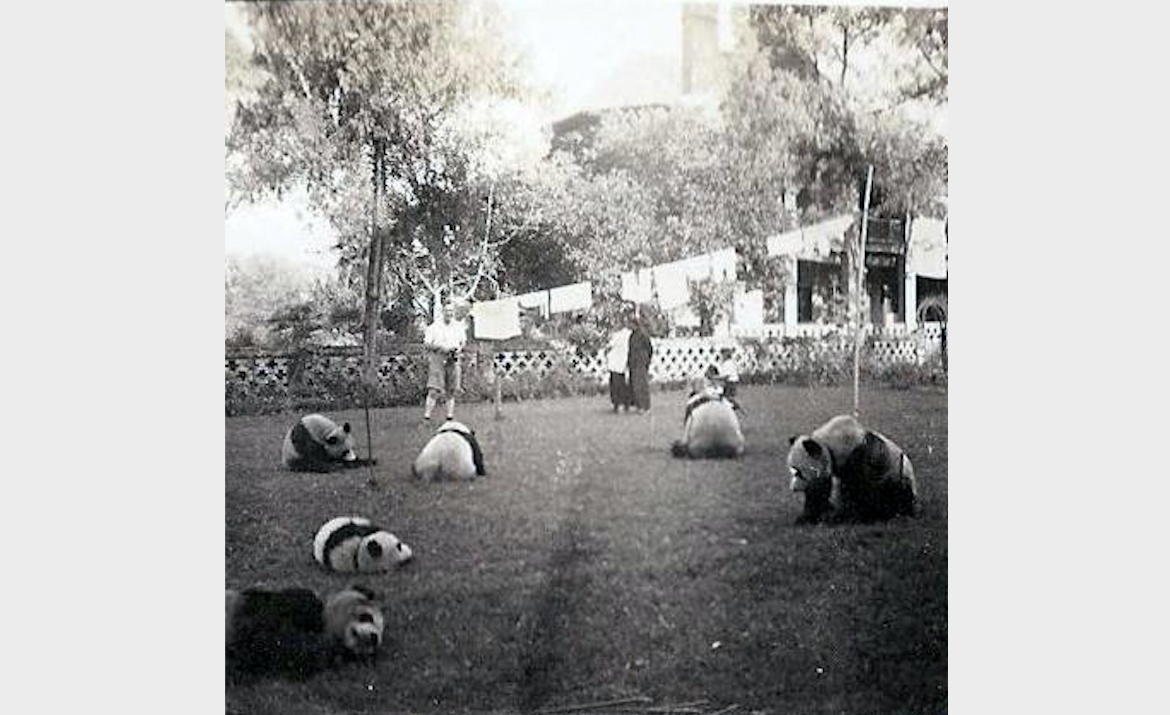
Floyd Tangier Smith’s six pandas chained out on the WCUU lawn*
But by now concerns that the unregulated trapping and export of pandas was beginning to impact on their numbers led to calls – even from former hunters the Roosevelts, Dean Sage and Brocklehurst – to clamp down on the trade.
From his hospital bed in London, a dying Floyd Tangier Smith scoffed at these concerns, absurdly claiming that there were “something like four hundred thousand pandas” in Sichuan’s mountains and that, given the trouble of hunting them through such difficult country, pandas had all the protection they needed.
Smith’s opinions were ridiculed by China-born Arthur de Carle Sowerby, naturalist, hunter and founder of the China Journal of Science and Arts. In a letter to the North China Herald Sowerby questioned why, if pandas were so thickly distributed that “one would not be able to walk a mile” without tripping over a few, it had taken Smith himself years to catch his first specimen? Sowerby doubted that there were even four hundred pandas in this part of Sichuan, concluding:
All those foreign explorers and hunters who have personally gone after giant pandas, and not just left it to native hunters to bring them in, [believe] that these animals are far from common... With the native hunters being tempted by the good prices offered for live specimens [the giant panda] is bound to become extinct in the near future if it is not immediately protected.
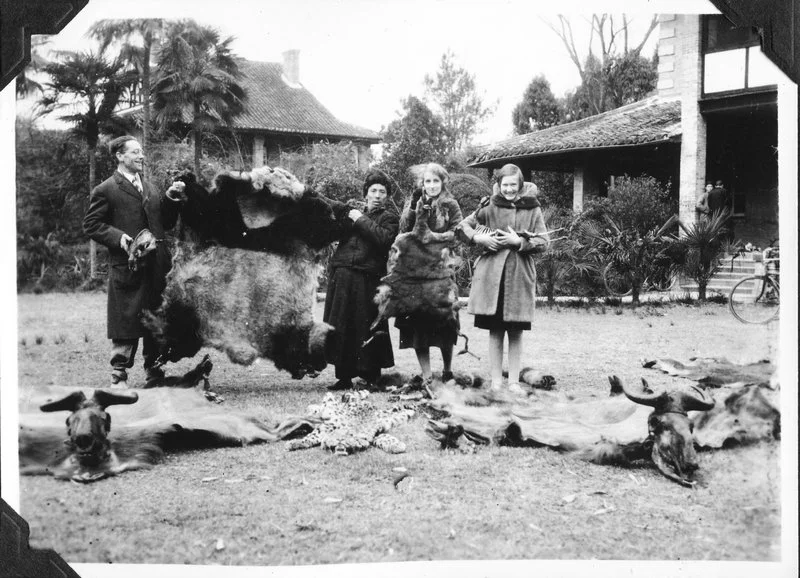
Rare animal skins for sale in Chengdu including takin, leopard and panda, 1930s. After her third trip, Harkness reported that whole valleys had been stripped of wildlife as hunters scoured the mountains for game to sell to Westerners*
Sowerby’s views echoed those of the Chinese authorities. In April 1939 foreign diplomatic missions were notified that trapping giant pandas had been prohibited, after the independent Academia Sinica warned the government that the animals were facing extermination – although the New York Times pointed out that the notice did not absolutely ban their export.
Indeed, after Pandora and Pan had both died in the US, in 1941 the Chinese government authorised Dr. David Crockett Graham of the WCUU to procure two more cubs as replacements. Hunters trained by Graham were already responsible for some of the previous live captures; now they supplied Pan-dee (d.1945) and Pan-dah (d.1951) which were duly gifted to the US in thanks for wartime assistance against the Japanese invasion of China.
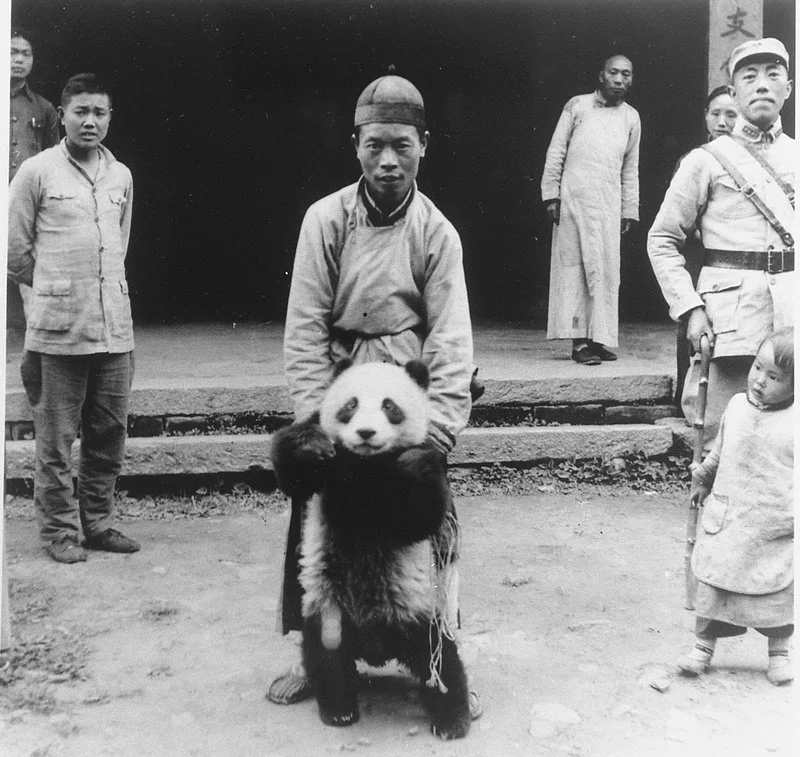
Pan-dee or Pan-dah with local officials, 1941*
In 1946 the fourteenth and final panda to reach the West before the communist takeover of mainland China was a cub named Lien-Ho (aka Unity; d.1950), presented to London Zoo by the Chinese government. After this, a total ban was placed on their commercial export – although one more panda did slip through the net, with the arrival of Chi-Chi at London Zoo in 1958. Captured three years previously Chi-Chi had been given to Russia, sent back to China, obtained privately by an Austrian dealer on behalf of East Germany, and finally purchased by Su-Lin’s former institution, Brookfield Zoo. But the US had a trade embargo on all things Chinese, so London bought her for £12,000. Until her death in 1972 Chi-Chi was the only panda in the West, and in 1961 became the model for the World Wildlife Fund’s famous logo.

Early incarnation of the WWF logo, based on Chi-Chi
Following president Nixon’s visit in 1972, China presented two pandas to the US to mark the easing of tensions between the two countries. Since then pandas have become diplomatic goodwill tokens and money-spinners for the Chinese state, loaned to foreign nations for a hefty fee – the original animals and any cubs born overseas remain China’s property.
Panda reserves were first established the 1960s and currently protect 67% of the wild population and 1.4 million hectares of their habitat – indirectly benefitting many other species. China has signed up to the Convention on the International Trade in Endangered Species (CITES) making trade in panda skins illegal worldwide; China’s own penal code sets penalties of between 10 years imprisonment and death for anyone caught hunting or smuggling giant pandas.
One factor affecting panda numbers is fragmentation of their habitat through farming, forestry, roadbuilding and the like. This is because bamboo periodically flowers and dies off simultaneously over huge areas, forcing pandas to migrate to new regions or starve. Mass flowerings in the 1970s and 1980s, when pandas were unable to move between what were then small and scattered reserves, saw the population crash to perhaps just 1200 animals. The subsequent expansion of reserves with wildlife corridors between them hopes to prevent this in future.
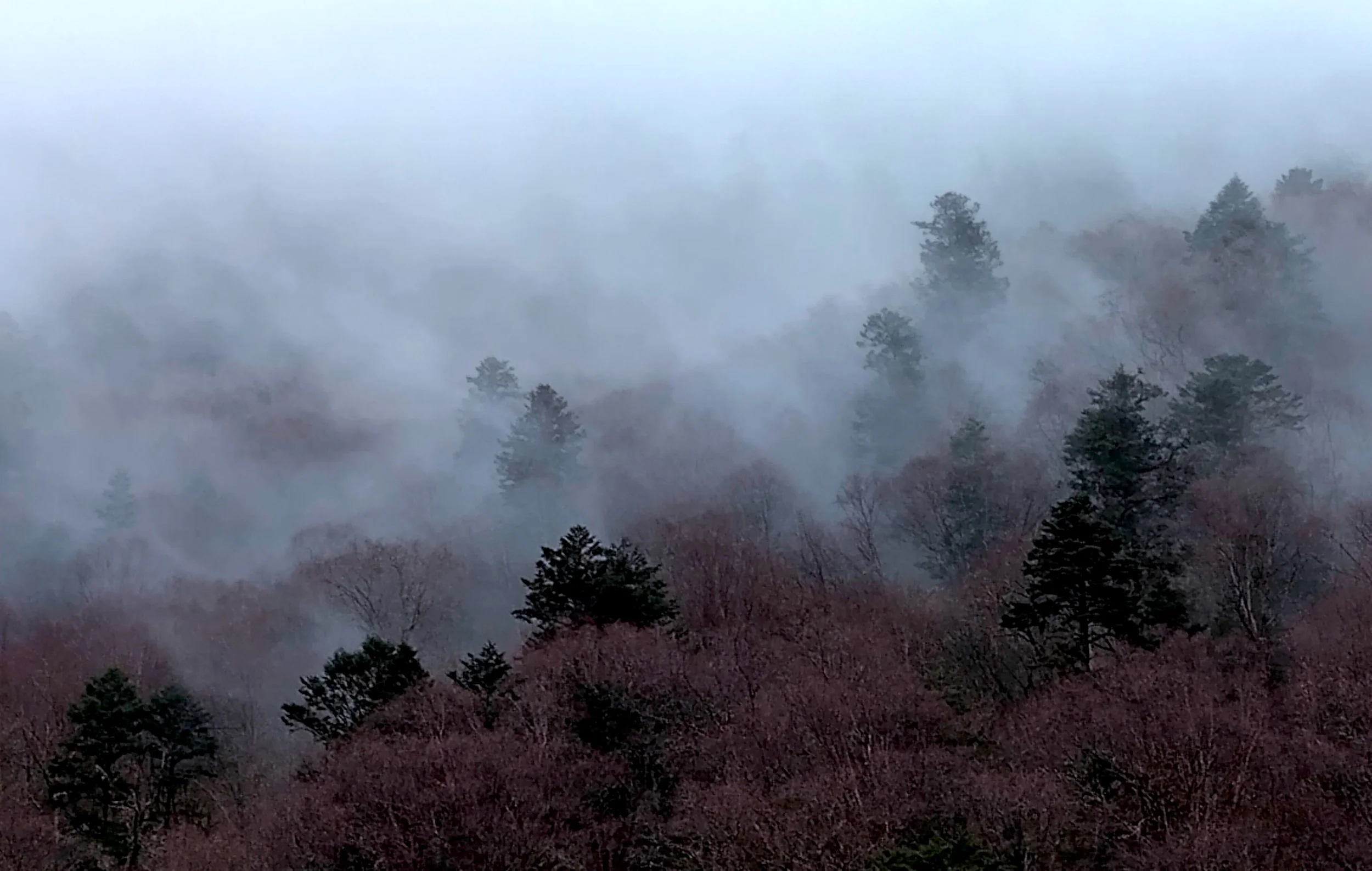
On the edge of panda country: conifer and copper birch forest up in the mountains of western Sichuan
Initially few captive pandas bred successfully and survival rates were low, but artificial insemination programmes in China have raised their numbers to 800 or so – something of an oversupply, as plans for releasing captive-bred animals into the wild are uncertain. The IUCN Red List currently estimates wild panda numbers at around 2000 individuals: no longer endangered but still vulnerable to human interference and climate change, which is predicted to decrease their range by about a third over the next century.
Special thanks to Clare Brown, Laurence Etter, Peter Hibbard, Malcom Peaker, Sarah Pearson, Royle Safaris, Cory Wilmott
References
Brown, Clare
– How a Giant Panda – possibly called Grandma – ended up at Leeds City Museum (NatSCA Blog, 25 May 2023; https://natsca.blog/2023/05/25/how-a-giant-panda-possibly-called-grandma-ended-up-at-leeds-city-museum)
– The journey of the giant panda ‘Grandma’ (Ailuropoda melanoleuca) from China to Britain in 1938–1939 (Archives of Natural History vol.52 No.1; Edinburgh University press 2025)
China Middle Kingdom (chinamiddlekingdom.siue.edu. Many articles and photos documenting the Western China Union University’s involvement in collecting pandas during the 1930s)
Claude, Cäsar Bambusbären (Ailuropoda melanoleuca DAVID, 1869) aus der STÖTZNERschen Expedition 1913/15 in Schweizer Museen (Vierteljahrsschrift der Naturforschenden Gesellschaft in Zürich 1971)
Croke, Vicki Constantine The Lady and the Panda (Random House 2006)
David, Armand Voyage en Chine (Nouvelles Archives du Museum d’Histoire Naturelle de Paris 1869)
Graham, David Two Pandas – China’s Gift to America (Animal Kingdom magazine vol. XLV No.1; Jan 1942)
Harkness, Ruth The Lady and the Panda: An Adventure (Carrick & Evans 1938)
Henderson, Nevile Failure of a Mission (Life magazine, 25 March 1940)
Hong Kong Telegraph (https://sls.hkpl.gov.hk/digital-collection/en/index.html)
IUCN Red List (www.iucnredlist.org)
Jin Changzhu et al The first skull of the earliest giant panda (PNAS Vol. 104 No. 26, June 2007; https://www.pnas.org/doi/10.1073/pnas.0704198104)
Kiefer, Michael Quentin Young, Ruth Harkness, and the pandas in China (San Diego Reader 1990)
Leek Post & Times (article on Brocklehurst, 16 Jan 2019)
Li Shizhen Materia Medica (李時珍: 本草綱目; https://zh.wikisource.org/zh-hant/欽定古今圖書集成/博物彙編/禽蟲典/06卷)
Liu Kexin Uncovering the Archaeological Secrets of Ba Ling: Interred Giant Pandas May Have Come From the Northern Slopes of the Qinling Mountains (刘可欣 - 揭秘霸陵考古: 陪葬大熊猫或来自秦岭北坡; Huaxi Metropolis Daily 华西都市报 3 August 2023)
Montgomery et al Characteristics that make trophy hunting of giant pandas inconceivable (Conservation Biology Vol 34, #4, 2020)
New York Times archive (www.nytimes.com)
*Photos
– Floyd Tangier Smith’s six pandas: Harrison Mullet, https://chinamiddlekingdom.siue.edu/omeka-s/s/westchinamissions/item/2155
– Pan-dee or Pan-dah: David Crockett Graham, https://chinamiddlekingdom.siue.edu/omeka-s/s/westchinamissions/item/509
– Pandora with twig: Harrison Mullet, https://chinamiddlekingdom.siue.edu/omeka-s/s/westchinamissions/item/2153
– Rare animal skins for sale in Chengdu: Jill Willmott, https://chinamiddlekingdom.siue.edu/omeka-s/s/westchinamissions/item/2276
Reuters article Flying Zoo to Hong Kong (Philippines Sunday Tribune 26 June 1938)
Roosevelt, Theodore and Kermit Trailing the Giant Panda (Charles Scribner’s Sons 1929)
Schaller et al The Giant Pandas of Wolong (University of Chicago Press 1985)
Sheldon, William The Wilderness Home of the Giant Panda (University of Massachusetts Press 1975)
Trove Newspaper Archive (http://trove.nla.gov.au)
Sowerby, Arthur de Carle
– The China Journal (Vol. V October, 1926 No.4; Vol. XVII December 1932 No. 6; Vol. XIX November 1933 No. 5; Vol. XXI July 1934 No. 1; Vol. XXII January 1935 No. 1; Vol. XXV December, 1936 No. 6; Vol. XXVIII May, 1938 No. 5)
– The Giant Panda: A Really Rare Animal (North China Herald 8 March 1939)
Stötzner, Walther Ins unerforschte Tibet (R.J. Koehler 1924)
Time archive (www.time.com)
Wei Peh T’i Through Historical Records and Ancient Writings in Search of the Giant Panda (Journal of the Hong Kong Branch of the Royal Asiatic Society, vol 28, 1988)
Wilson, Ernest A Naturalist in Western China (Cadogan Books 1986)
Younghusband and Pereira Peking to Lhasa (Houghton Mifflin 1926)