Wu Song’s Tomb 宋義士武松之墓
Near the Xiling Bridge (西泠桥), on the northwest shore of Hangzhou’s famously scenic West Lake, a stone gateway and tomb mound commemorate “Pilgrim” Wu Song, one of the heroes of The Water Margin.
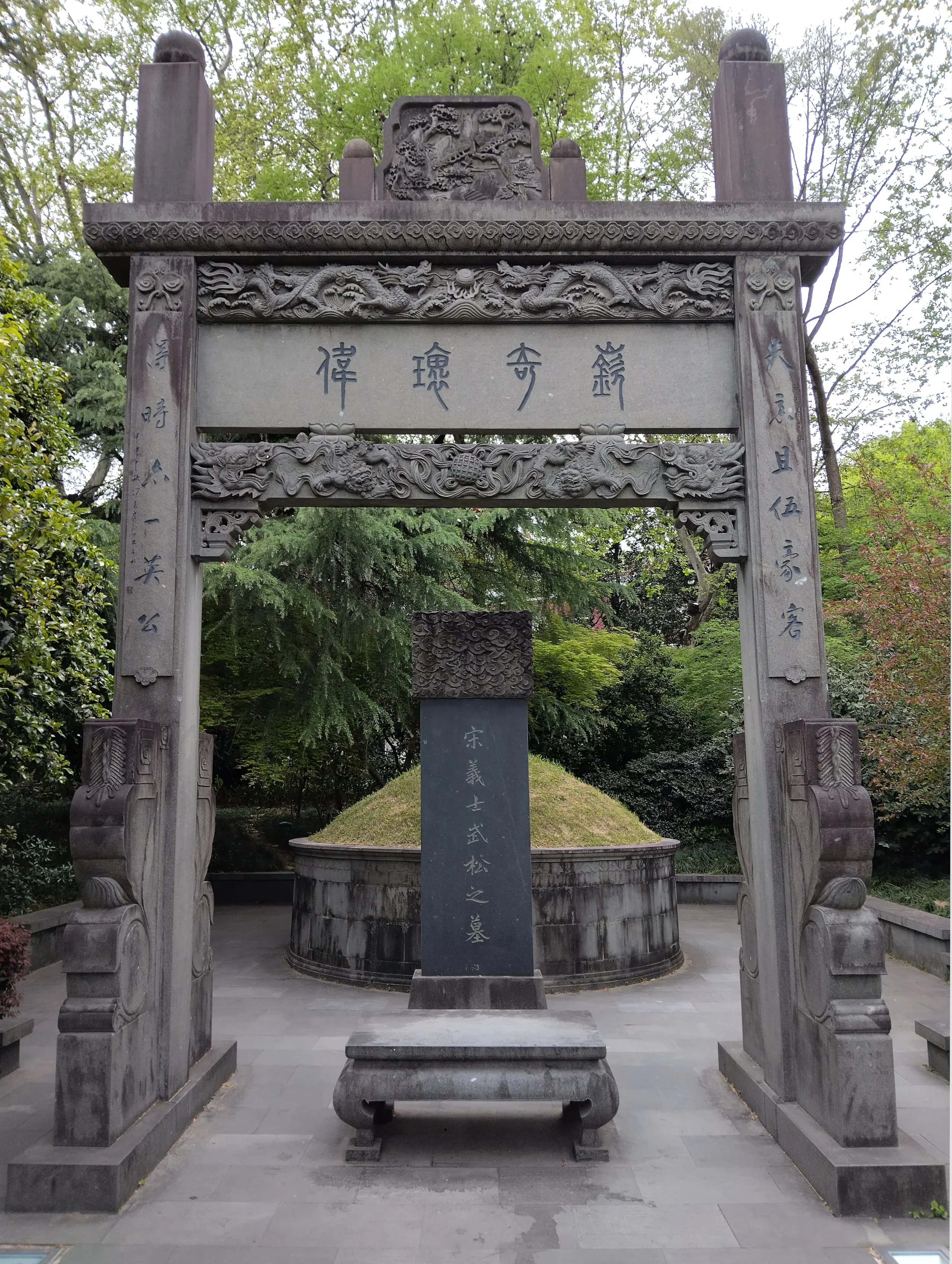
Wu Song’s tomb. The inscription on the gateway posts, written in 2004 by polymath Feng Jicai (also a woodblock print historian), translates something like "Disillusioned, he rose to be a hero; In his prime, a paragon of virtue"
China’s earliest vernacular classic, The Water Margin is China’s equivalent of Robin Hood, a “noble outlaws” saga believed to be based very loosely on actual events. Set in the closing decades of the Song dynasty (960–1279), itfollows the adventures of 108 heroic bandits – including Wu Song – who descend from their hideout in Shandong’s remote Liang Shan ranges to right wrongs inflicted on the population by the corrupt Song court.
Tall, robust, hard-drinking and forthright, Wu Song first appears in Chapter 23 of The Water Margin, where he beats a man-eating tiger to death with his bare hands. He then vengefully murders his sister-in-law and her lover after they fatally poison his brother, slaughters a swathe of evil officials trying to frame him and goes on the run. Disguising himself as a pilgrim warrior monk, Wu fights through to join the outlaws at their Liang Shan fortress. He eventually loses an arm in battle and retires, now genuinely converted to Buddhism, to live his final years in seclusion at Hangzhou’s Liuhe Pagoda (六和塔).
The novel’s date is uncertain, but as early as the Yuan dynasty (1271–1368) – within a couple of centuries of the actual events on which The Water Margin is based – Wu Song’s escapades already featured in local opera. The contemporary Miscellaneous Records from Gui Xin Street compiled by Zhou Mi (周密: 癸辛杂识) mentions Wu too, though his character sketch under the "Thirty-Six Eulogies of Song Jiang" (宋江三十六赞) is not exactly complimentary: You, a lay Buddhist bound by the five precepts, were increasingly inclined to kill because of wine, women, wealth, and rage.
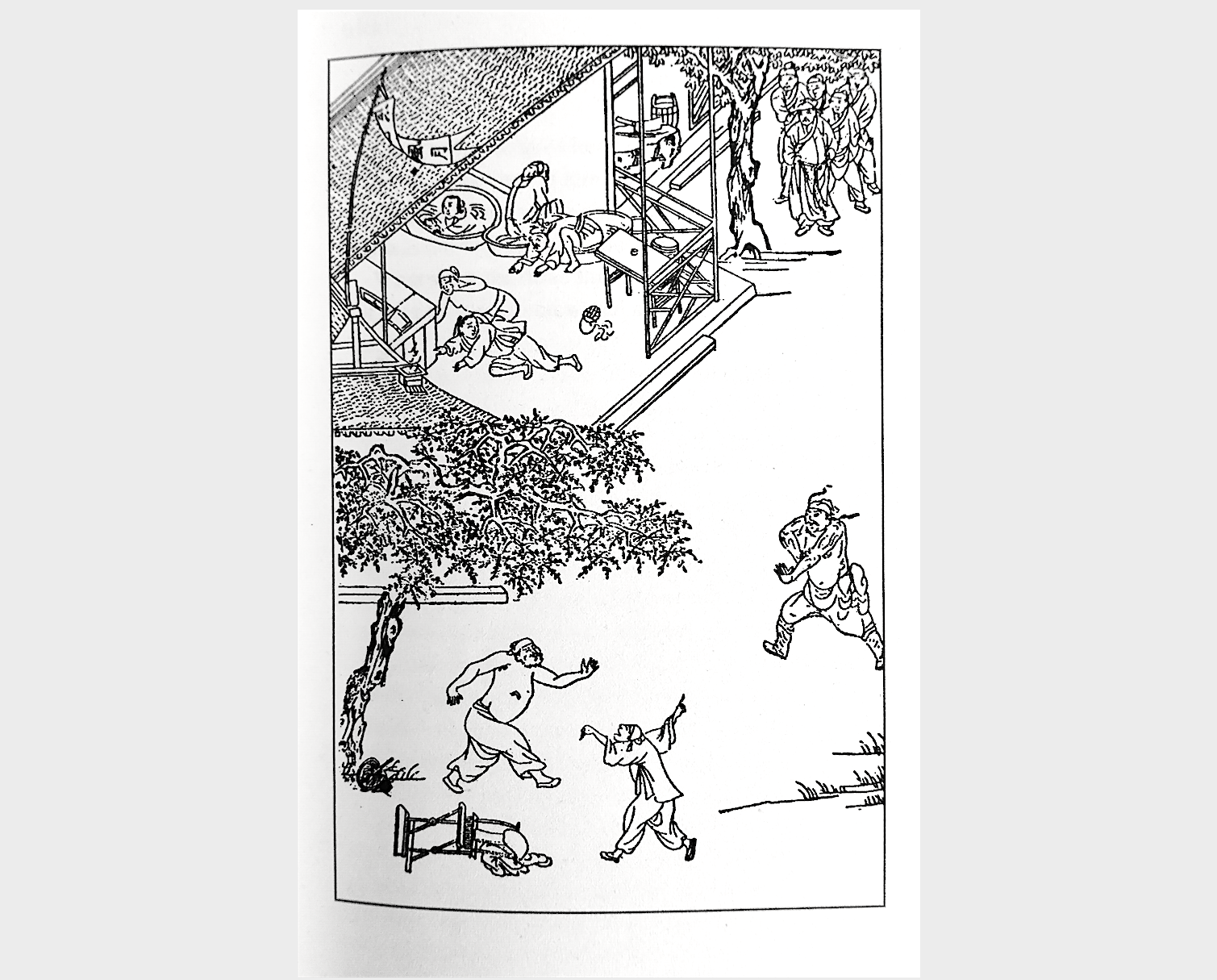
“Drunk, Wu Song Beats Jiang the Gate Guard Giant”
The real Wu Song may have been very different. According to local gazetteers, he first caught public attention as a street entertainer performing martial arts outside Hangzhou’s Yongjin Gate (涌金门). Employed in the military by prefect Gao Quan (高权), Wu Song fell along with his mentor when Gao was dismissed from office. The new prefect, tyrannical “Tiger” Cai Yun (蔡鋆), oppressed Hangzhou so fiercely that Wu Song assassinated him for the public good. Wu died under torture in prison, but Hangzhou’s grateful citizens retrieved his body and buried it near Xiling Bridge.
Other historical snippets contradict most of this. Lu Ciyun’s late seventeenth century Miscellaneous Records of the Lakeside (陆次雲: 湖壖杂记) states that in the early years of the Qing dynasty Wu Song’s inscribed tombstone was unearthed at a place called “Longpu, below Tieling Pass”, a location obscure today.
Alternatively, Jiang Danshu’s Miscellaneous Jottings on Art Education (姜丹書: 艺术教育杂著), holds that in 1893 his friend Wu Jianfei (吳劍飛) saw Wu Song’s mausoleum unearthed near the Yongjin Gate by workmen repairing Hangzhou’s city wall; the lid was inscribed “Wu Song’s Coffin” in ancient-style characters.
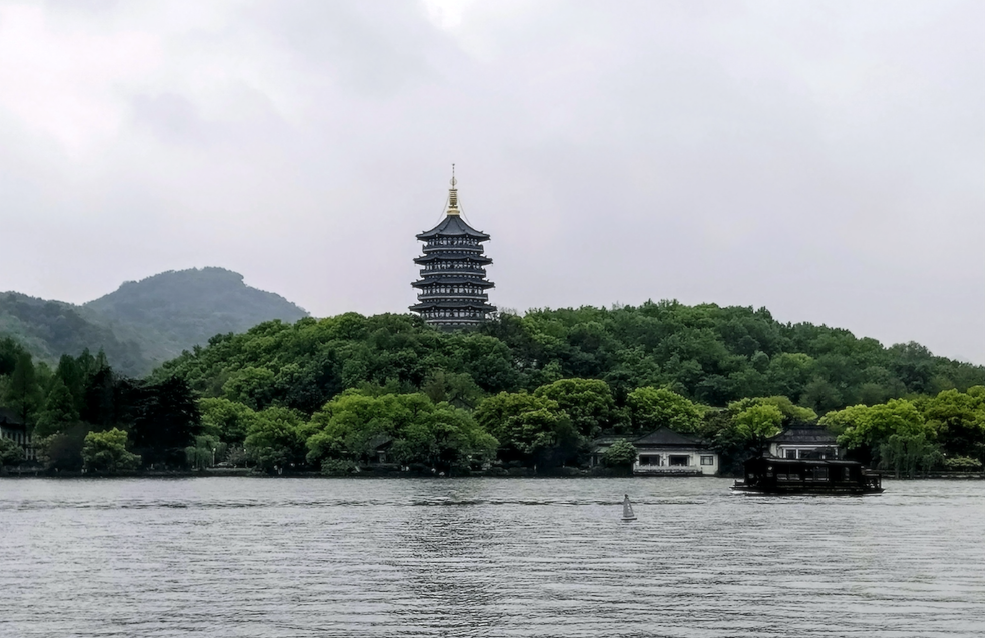
Liuhe Pagoda at West Lake, said to be where Wu Song spent his final years
The current site near Xiling Bridge first appeared in the early twentieth century as a simple tomb mound, which locals assumed contained the remains found at Yongjin Gate. The tomb was enlarged and embellished with stonework in 1924 by Du Yuesheng, Huang Jinrong and Zhang Xiaolin (杜月笙, 黄金荣, 张啸林), bosses of Shanghai’s notorious Green Gang, who presumably admired Wu’s martial heroism.
Between 1956 and 1964 the area was redeveloped and Wu Song’s tomb demolished; workers did indeed find bones inside the mound which were relocated to Jilong Mountain (雞籠山), southwest of the lake. The modern tomb dates to 2004 and is a reconstruction of the 1924 one based on old photos.
I can’t find out whether Wu Song’s apparent remains were brought back from Jilong Mountain to be interred here, or whether today’s site is just an empty memorial.