Five Tigers From Vietnam
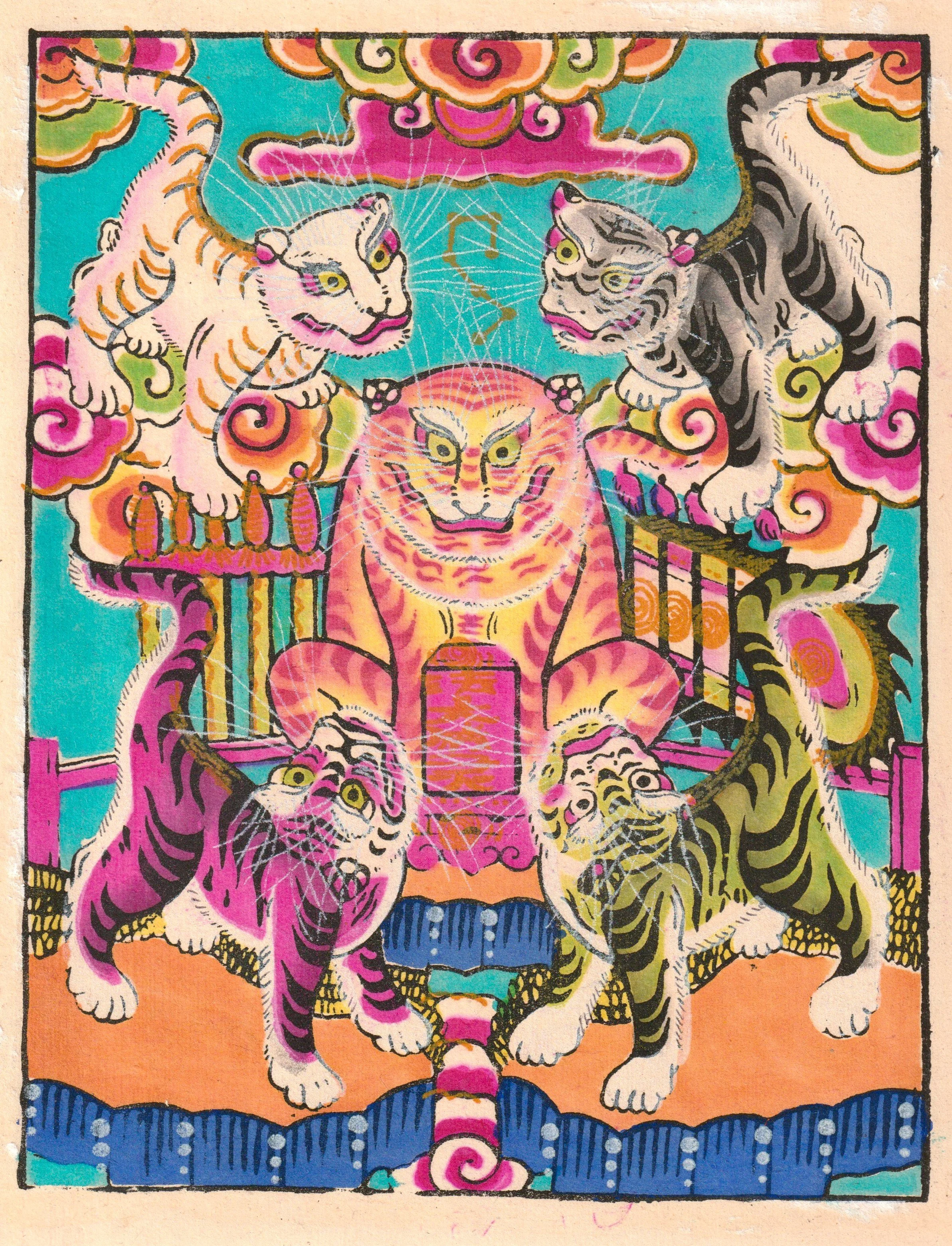
Five Tigers: Black, Red, White, Green and Yellow, 1980s
Here’s a Ngu Ho (“Five Tigers”) woodblock print from northern Vietnam, outside my usual collection zone. But in fact northern Vietnam shares a border with China and was under Chinese rule for nearly a thousand years, and local culture inevitably retains some foreign characteristics.
So, as in China, Vietnamese folk religion believes that the tiger – despite being dangerously troublesome to humans – is also a protective force against demons, especially those causing illness. Tiger images were pasted up on doorways to symbolically protect homes and temples, scaring away any evil influences which might try to enter.
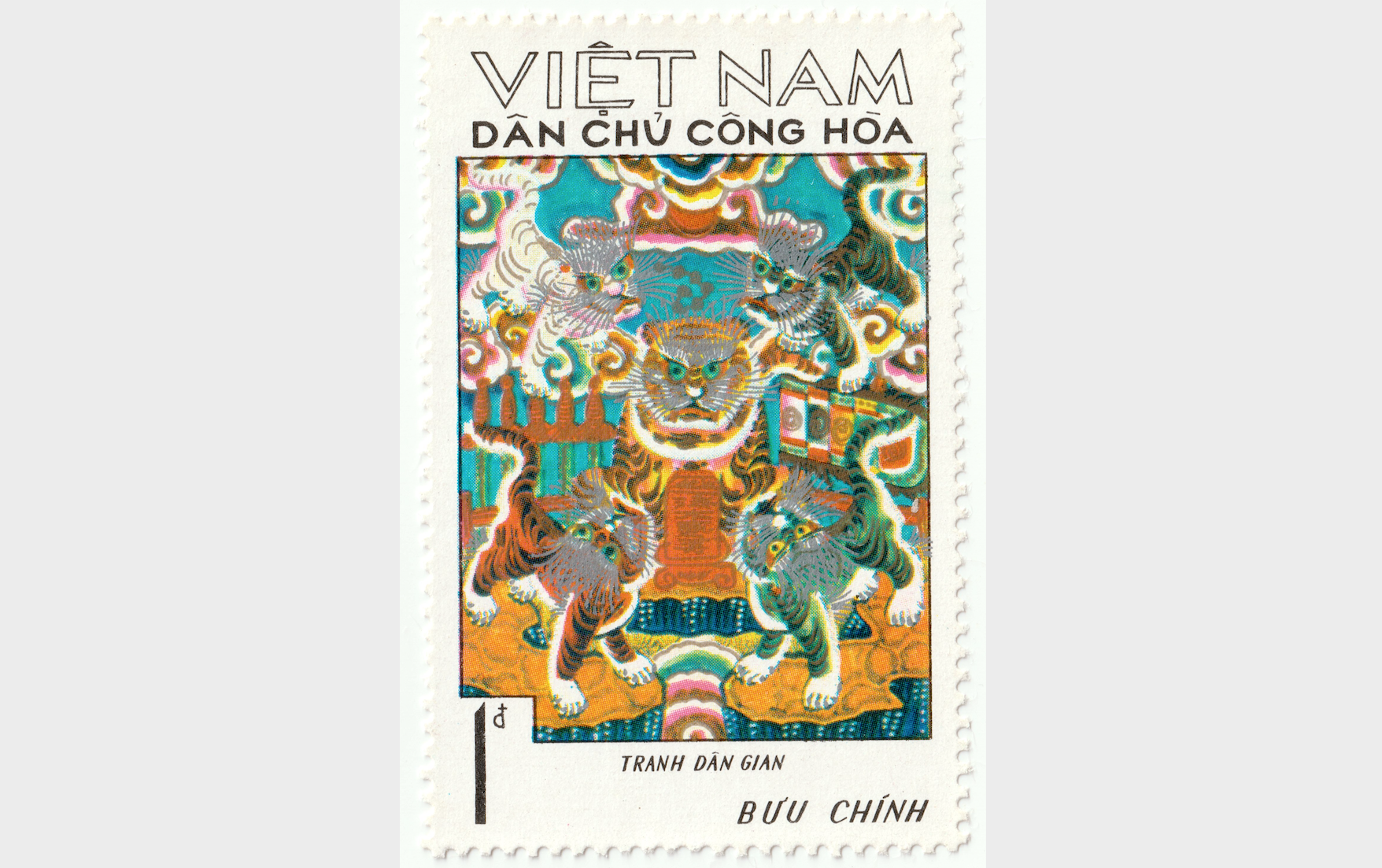
1d stamp from Northern Vietnam, 1971 – a separate state until it unified with the south in 1975.
These Five Tigers prints were a speciality of workshops along Hang Trong street in Hanoi. Only the black outline was printed, with the colours – vibrant pinks, blues and yellows – painted on by hand; the tigers’ splendidly abundant whiskers were finished in glittery metallic silver. Production peaked in the late nineteenth century and, though a set of stamps featuring tiger prints was issued in 1971, all of Hang Trong’s workshops had closed by the late 1990s.
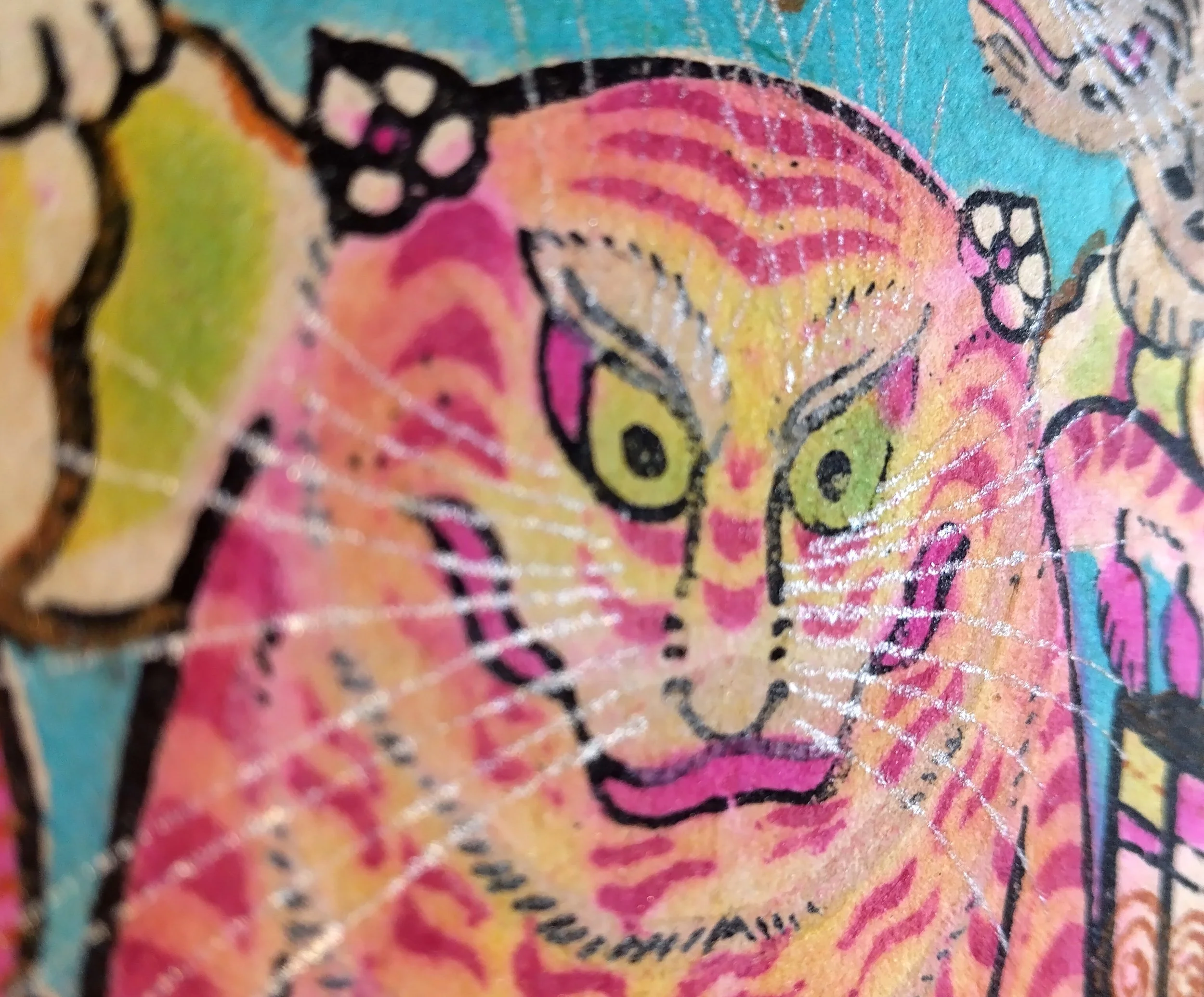
Splendid silver whiskers
Following Chinese cosmography, each tiger represents a direction and an element, with all but the yellow tiger also representing a season: black for the north (winter; water), red for the south (summer; fire), white for the west (autumn; metal), green for the east (spring; wind) and yellow in the centre (earth). But the use of five differently-coloured tigers is unique to Vietnam: in China a different animal would stand in for each direction (a turtle and snake to the north, the Red Bird to the south, a green dragon to the east, a white tiger to the west and a yellow lion or qilin at the centre).
Either way, the idea is that when all directions are balanced, peace, health and harmony will ensue; for example, in times of unseasonal rainfall and flooding, officials might order the north gates of a city to be closed in an attempt to block excess “northern” attributes and restore the weather to normal.
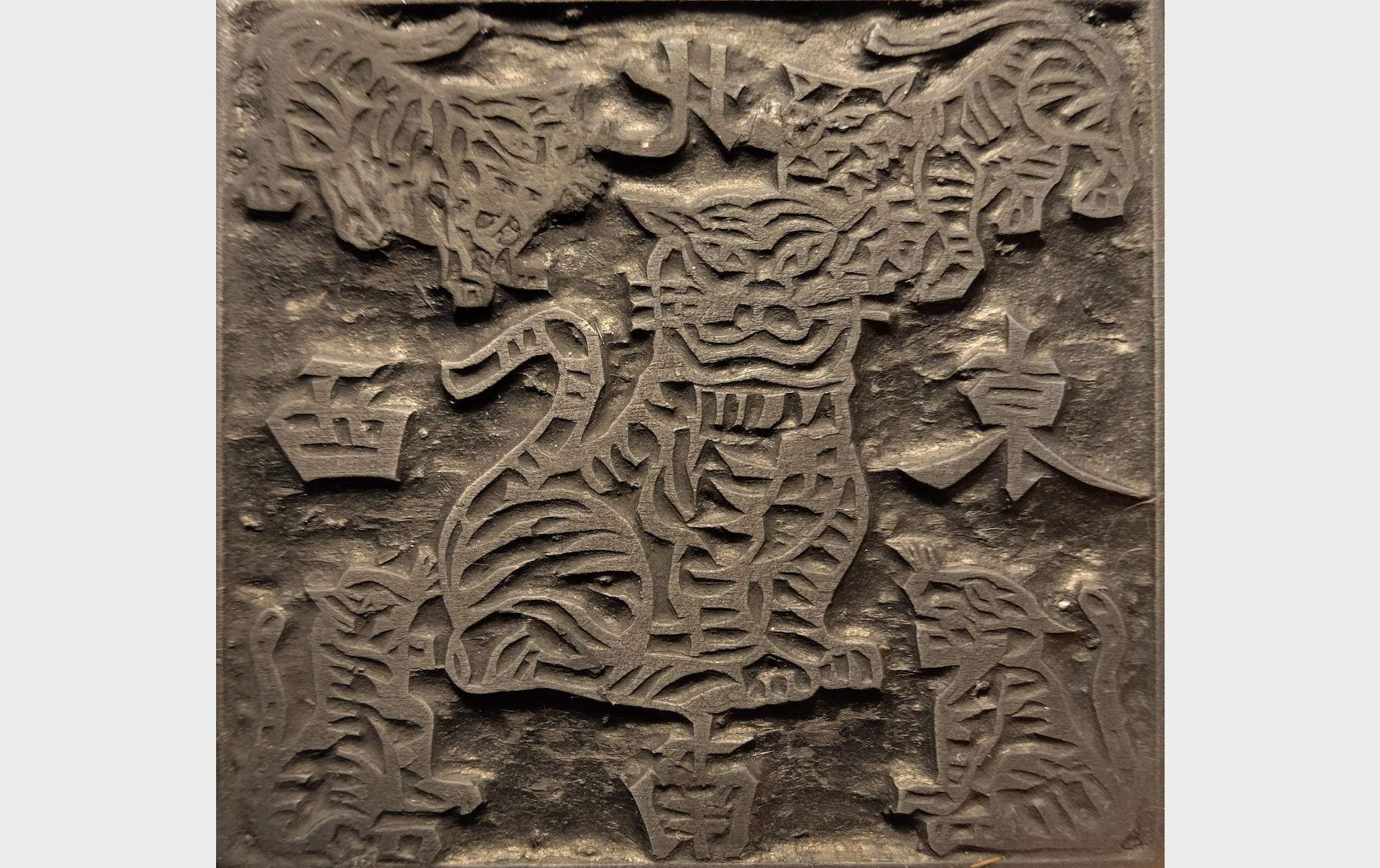
Woodblock for printing small version of the Five Tigers, with compass points marked (北,南,東,西)
The Big Dipper above the yellow tiger’s head governs the 108 constellations, representing 36 Heavenly Generals and 72 Earthly Fiends, whose power can be harnessed to drive away evil influences and cure illnesses. This is echoed by the tablet protected by the yellow tiger, inscribed in red Chinese characters reading 法大威灵, “Powerful Guardian of (Heaven’s) Law”.
All in all then, a defensive good-luck talisman for the home.
Thanks to Jim Kemp
Reading
Müllerová, Petra: The Tiger: A Religious Motif of Tonkin Wooden Prints and Chinese Ink Drawings (Annals of the Náprstek Museum, Prague 1999)
Phan Cam Truong et al: The Ancient Graphic Arts of Vietnam (Fine Arts Publishing House; 2022)