The Miao Martial Arts of Wu Daheng 吴大衡苗族武術
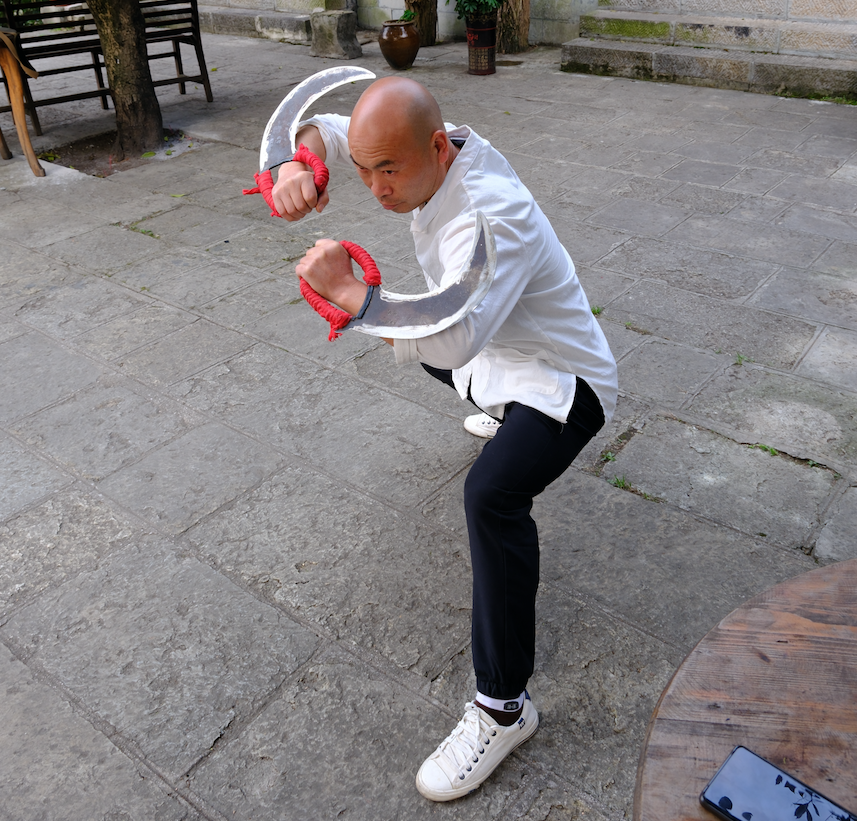
Wu Daheng with his Buffalo King Knives
“My style of fighting is the Huangping style. It came from the ancestors.”
So I’m out on the shockingly green astroturf of Kaili Sports Stadium in Guizhou province, chatting with martial arts master Mr Wu Daheng. It’s the dress rehearsal for a huge parade of ethnic Miao (Hmong) culture being held that afternoon: there are hundreds of Miao women dancers in their beautiful, intricately embroidered dresses, a long-haired shaman with a wild dragon jacket and twisted root staff, a lone marksman from Basha village carrying a musket over his shoulder, even two men dressed as the famous white Xiasi hunting dogs.
Wu Daheng comes from Yangpai village outside Wanshui (灣水 洋排) on the Chong’an river, some 20km north of Kaili. He’s in his early fifties with a shaven head and a quiet, contained presence, and tells me he practices martial arts for six hours every day. One of his teachers was seventy-year-old Wu Zhongyong (吴钟镛), a famous fighter. He looks across the astroturf to where his display team, dressed in white uniforms, run through barehand and staff routines, while a few older students whirl short benches around. Mr Wu is critical. “They should train harder”.
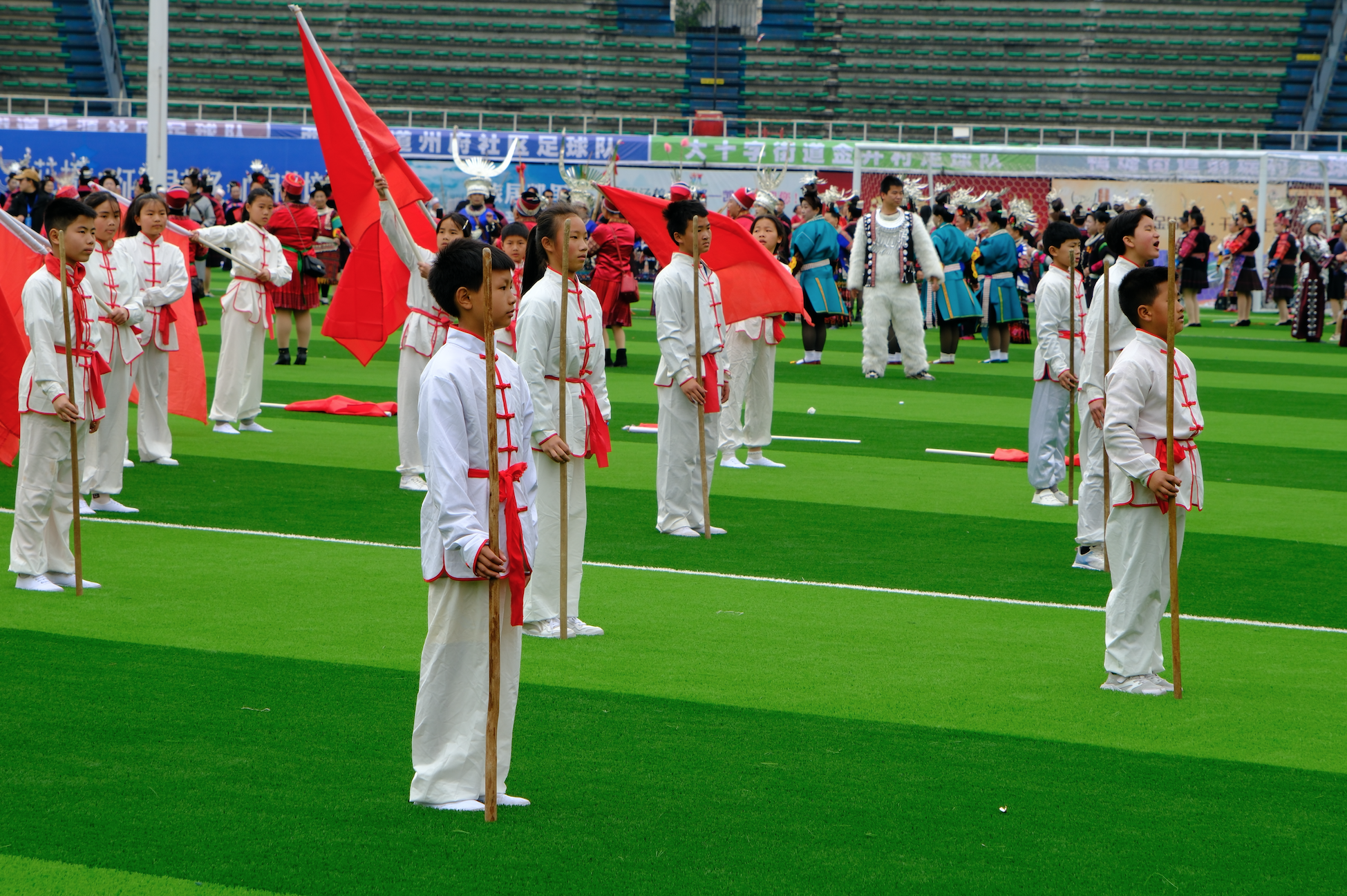
Wanshui Primary School martial arts display team at Kaili Stadium. The short boy leading them on the right was pretty good. Miao women dancers in embroidery and silver tiaras in the background, alongside Xiasi hunting dog
To be fair, many of the performers are very young, students from Wanshui Primary School. A few years ago the headmaster Wu Pingchang (吴平昌) persuaded Wu Daheng to teach all 508 students kung fu routines as part of the school’s daily warm-up exercises before class. Since then fifty children have joined the display team, while a few of the more serious pay for private lessons outside school hours. Three older tudi – formal disciples – hold their own classes at villages around Wanshui.
For headmaster Wu this is all part of a programme promoting local Miao culture in the face of outside competition – like the Korean taekwondo studios popping up all around Kaili. “We Miao have our own martial arts... thanks to Wu Daheng’s efforts, we are now officially registered as traditional kung fu cultural school.”
****************
Wanshui’s Miao have a long martial history. The Chong’an river is part of a system that flows 500km northeast to empty into Dongting Lake, on the central Yangzi. This has opened the district to contact and trade with the rest of China, but in times of war has also allowed lawless bandits and militias to invade and rampage through the countryside. So like many other isolated communities, Wanshui’s residents developed martial arts to defend themselves.
And war has flared many times. The Miao believe they originated a thousand kilometres away in the Yellow River valley but – in a very distant past – were defeated by the Chinese and driven southwest, eventually settling here in Guizhou’s remote highlands. They have been at odds with the Chinese ever since, especially since the first determined efforts to draw Guizhou under Imperial rule during the Ming dynasty (1368–1644). The closing years of the Ming saw the region become a battleground, honing the extraordinary skill of local fighters.
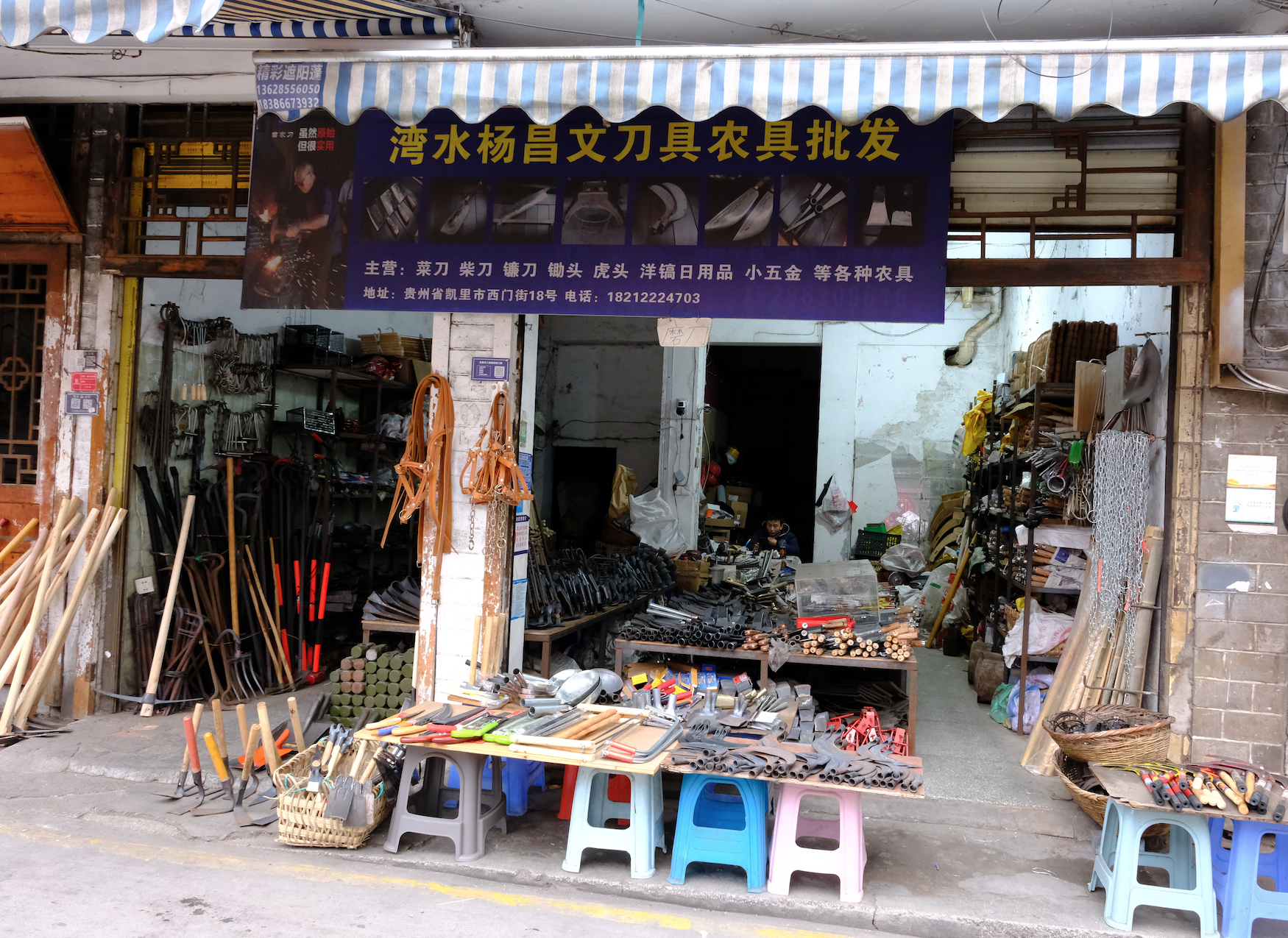
Wanshui blacksmith shop – mostly farm tools nowadays
Over the next few centuries Guizhou remained in near-constant rebellion against the Chinese administration, culminating in the Miao Uprising of 1854–1872. After their final defeat, many Miao warriors hid out at Wanshui and began secretly teaching locals kung fu, handing their skills down to the present day. As recently as the 1980s many boys practiced it; a wealthy family might even pay to have their daughters trained too.
When not fighting the Chinese, rival villages would fight each other; as a local saying goes, "Friends come with good wine, enemies come with guns." Inter-village conflicts – they still happen – usually begin with minor arguments at festivals, perceived slights to women, “aggressive” tunes played on lusheng pipes, offensive love songs.
Traditional weapons included swords, spears and even matchlock guns – long-barrelled niaoqiang, good for sniping – though just about any farm tool could be easily adapted for fighting. Wanshui remains famous for its blacksmiths, even if their modern focus is on kitchen cleavers, sickles and hoes. The smithying “season”, when the forges are first lit, begins with the agricultural year after the Qingming festival in early April.
***************
Next morning I walk through Kaili’s Sunday market to hilly Dage Park, past the newly-painted Earth God shrine at the entrance and up through woodland to a stone terrace, pagoda and modest wooden halls at the top where Wu Daheng lives. Boards either side of the main door read 物质文化遗产苗族武术传习所in Chinese and Dad Bend Sangs Lul Lil Dud Zaid Hmub Sax Lob Bil Laib Ghab Dangx in the Hmong language – “Intangible Cultural Heritage Miao Martial Arts Training Centre”. Freshly-collected medicinal herbs are laid out to dry in the sun. Like many martial artists, Wu Daheng is also skilled in traditional medicine and makes his main living treating patients at a small clinic here.
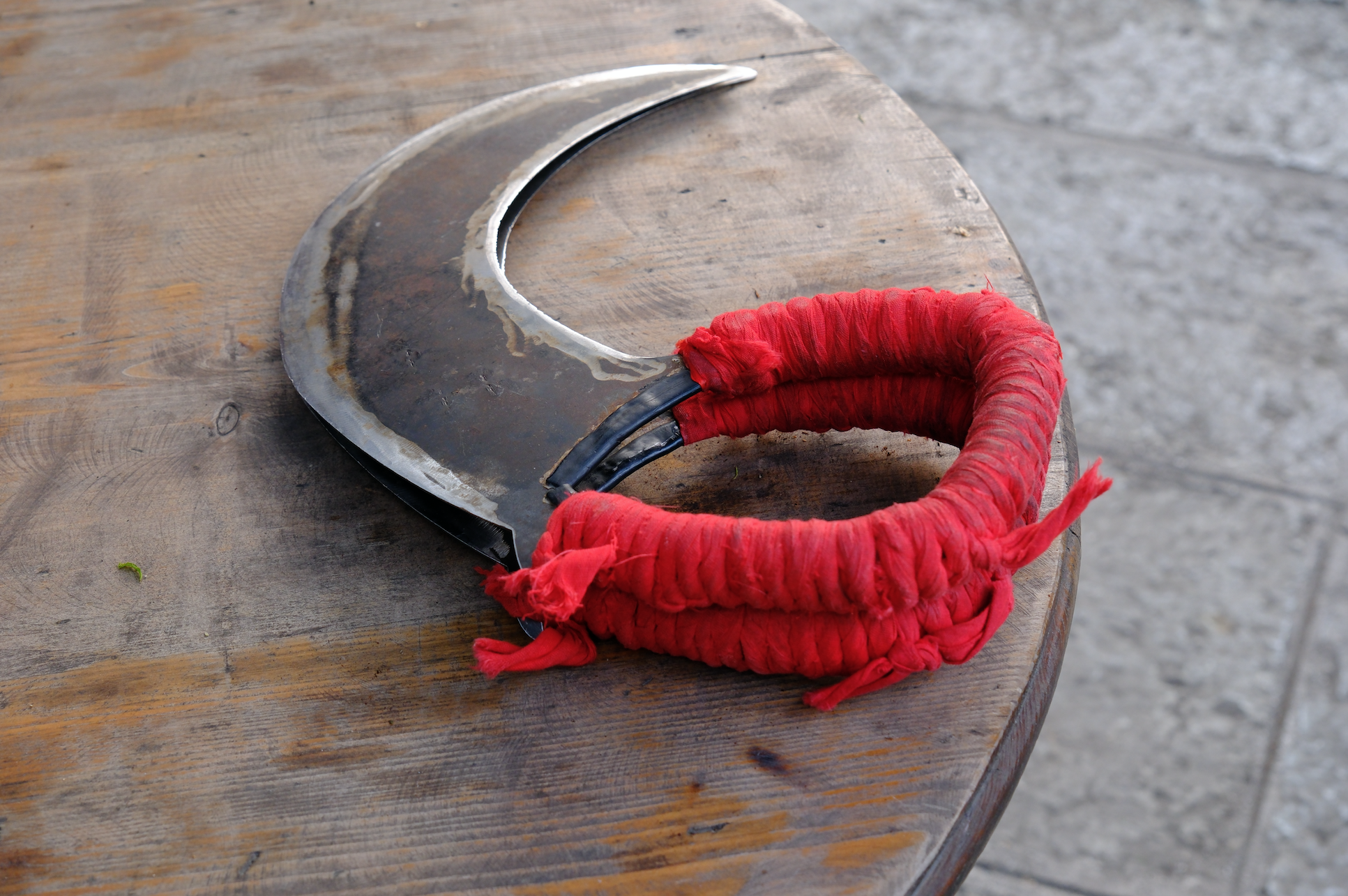
Niuwang dao – Buffalo King Knives
Out on the terrace Mr Wu shows me a unique weapon he designed himself, a pair of curved pointed blades with ring pommels called niuwang dao (牛王刀), “buffalo king knives”. Their form and use are inspired by buffalo horns and bull fighting, a feature of many Miao festivals. Wu Daheng drew on how battling bulls use their horns to overturn an opponent or to attack their legs. When fighting with niuwang dao, the near knife intercepts attacks while the other sweeps forward in a crescent at the throat or eyes.
Mr Wu also demonstrates empty-hand combat, how one posture’s crossed hands can separate to block a frontal attack, then again target the opponent’s throat or chest. He also shows a curved stepping pattern to hook behind the attacker’s foot and trip them. On the whole Mr Wu’s system seems designed to neutralise pole weapons or long sword attacks and then move in for close-range fighting: it avoids big kicks and overly large movements, and also employs zig-zag “saw-tooth” steps common to many battlefield fighting systems.
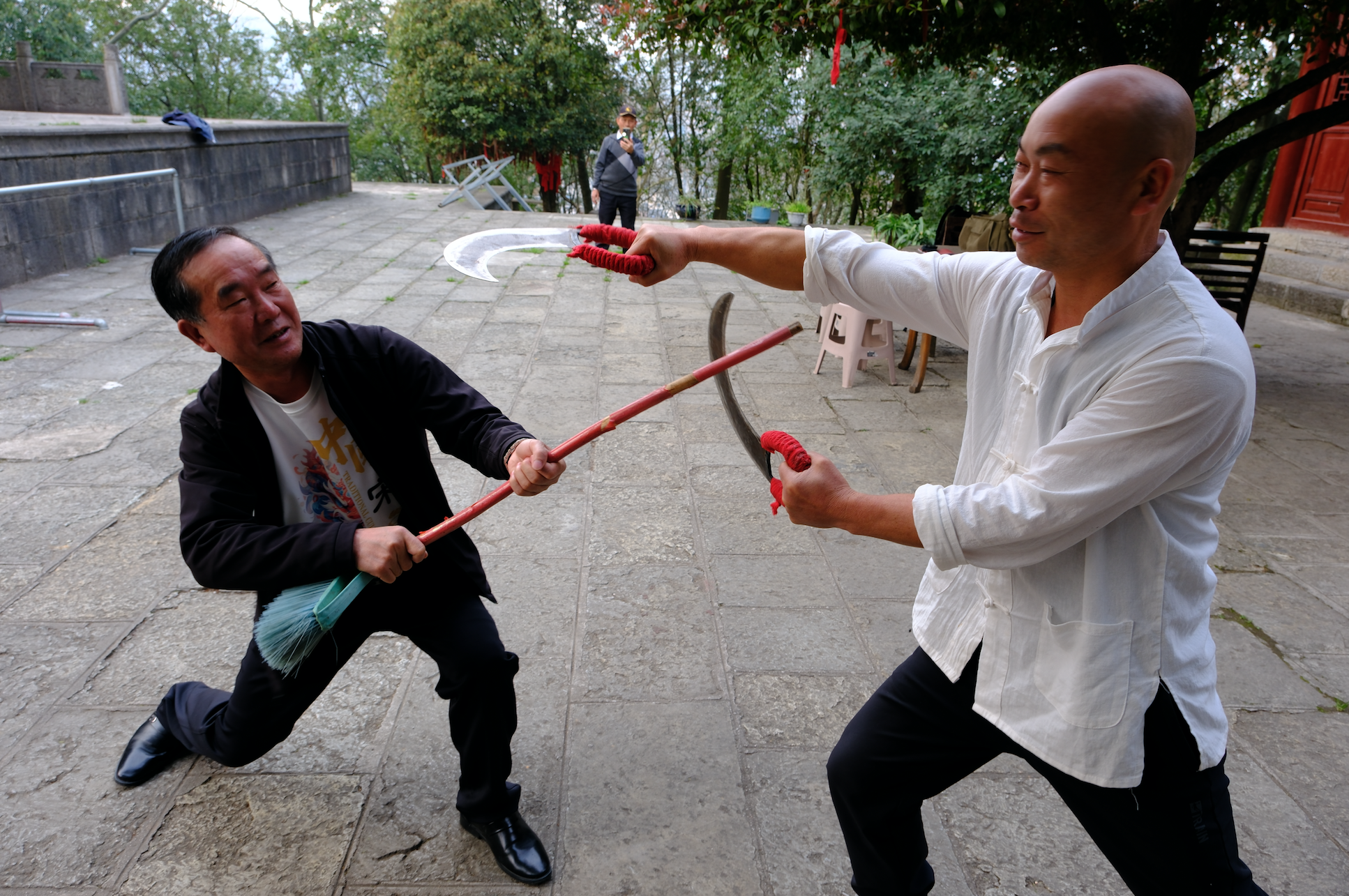
Even an old broom can be a weapon…
Inside the halls are racks full of weapons and sideboards weighed down with medals and competition trophies. There is also something I’ve never seen before: a wooden carving of the war god Chiyou (蚩尤), patron of Miao martial arts. Chiyou is also an ancestral deity and Miao homes often sport a small unadorned shrine to him, but using statues – a Chinese custom – is a modern innovation.
Surprisingly Chiyou doesn’t feature in Miao song cycles – the way their history has traditionally been passed down – though groups over in western Guizhou hold a festival in his honour called tiaohuapo (跳花坡), “dancing on the flowery slopes”. Chinese mythologies describe Chiyou as horned like a bull and having “eight arms and eight toes. He revelled in chaos, destroying friend and foe alike”.
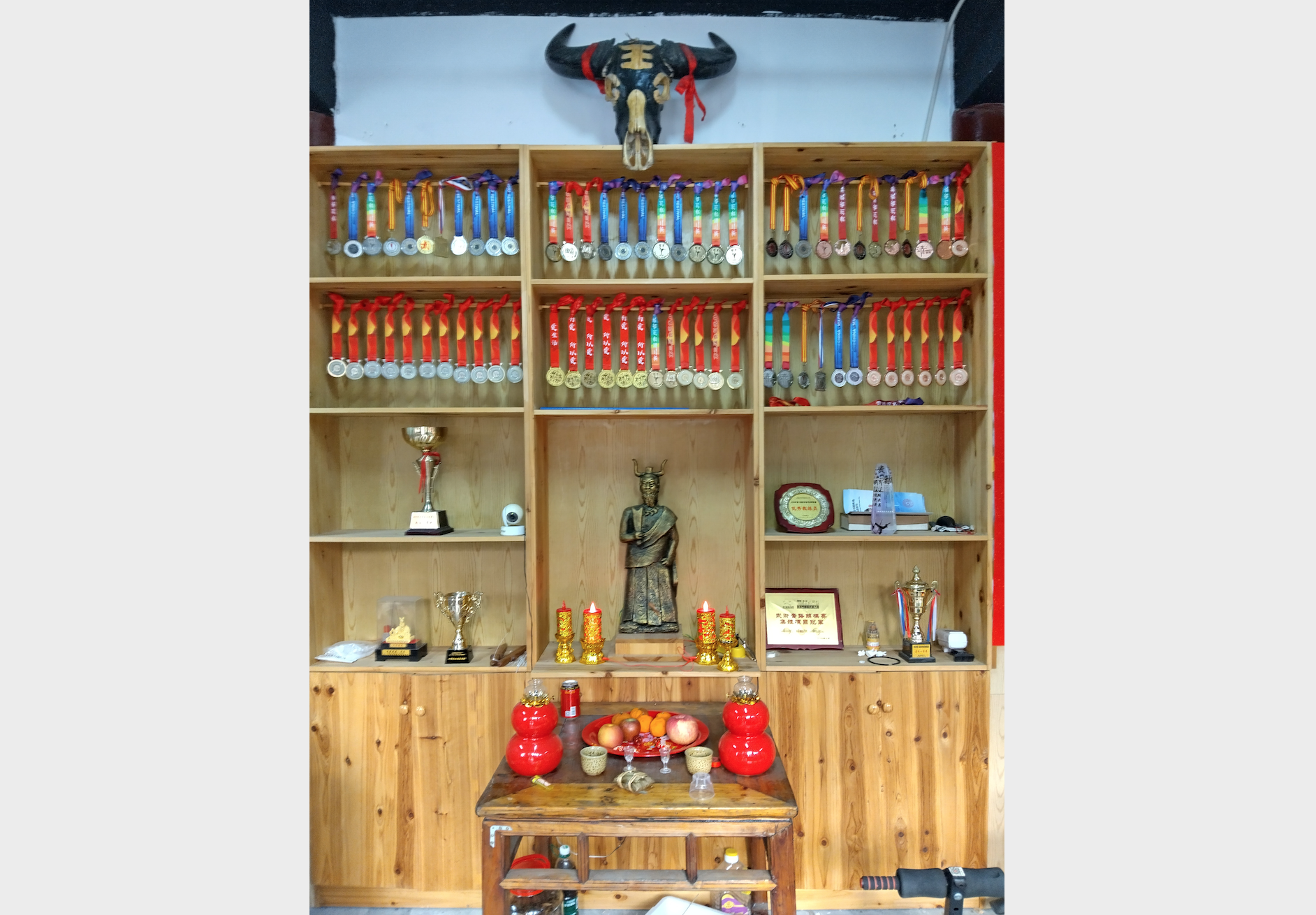
Chiyou shrine with statue. Above is a bull’s skull with the character 王 , “king”; extra spikes along the horns represent Chiyou and the Miao clans which followed him
Having invented weapons Chiyou went to war with the Chinese Yellow Emperor, Huangdi, who unleashed the winged creature Yinglong against him. Chiyou defeated Yinglong with a huge rainstorm, but Huangdi called up the drought demon Ba and escaped from the battlefield using a compass to navigate through banks of thick fog. Yinglong rallied and killed Chiyou, whose corpse was dismembered and scattered around China.
It seems promising that Wanshui school has provided a supply of students for Wu Daheng to pass on his martial arts to a new generation. But Mr Wu is not so optimistic. True, the head teacher invited him to volunteer for a few months – but when the programme was a success, expected him to continue as a volunteer, unpaid.
He also felt that the stadium performance, covered by local TV, could have been better. The schoolchildren were keen but not very skilled, so Mr Wu called in several older, more serious students to demonstrate bench fighting. He sighs. “But they all spend too much time playing games on their phones, not enough time training”.
Watch Wu Daheng demonstrating his niuwang dao here.
Many thanks to Wu Daheng, Li Maoqing and Wu Pingchang
References
A Chinese Bestiary (山海經; translated by Richard Strassberg, University of California Press 2002)
Leishan Miao Guzang Festival (雷山苗族鼓藏节; edited by Li Yuwen; China Culture Publishing House 2010)
Luo MiLushi (罗泌: 路史; https://zh.wikisource.org/wiki/路史)
Mesny, William Mesny’s Chinese Miscellany (Shanghai 1895–1906)
Sima Qian Records of the Grand Historian